
Key Takeaways
- Enterprise AI is moving toward measurable value. As adoption expands, organisations are placing greater emphasis on ROI, production deployment and outcomes tied to revenue, cost and operational performance. Pasted text
- Workflow integration will be critical to scaling AI. The strongest opportunities emerge when AI connects with enterprise data, applications and established processes rather than remaining within isolated pilots. Pasted text
- The path to 2030 will depend on execution. Data readiness, governance, connected workflows and disciplined investment will influence how effectively organisations convert AI adoption into sustained business value.
Enterprise AI adoption has expanded rapidly, but measurable business value has not progressed at the same pace.
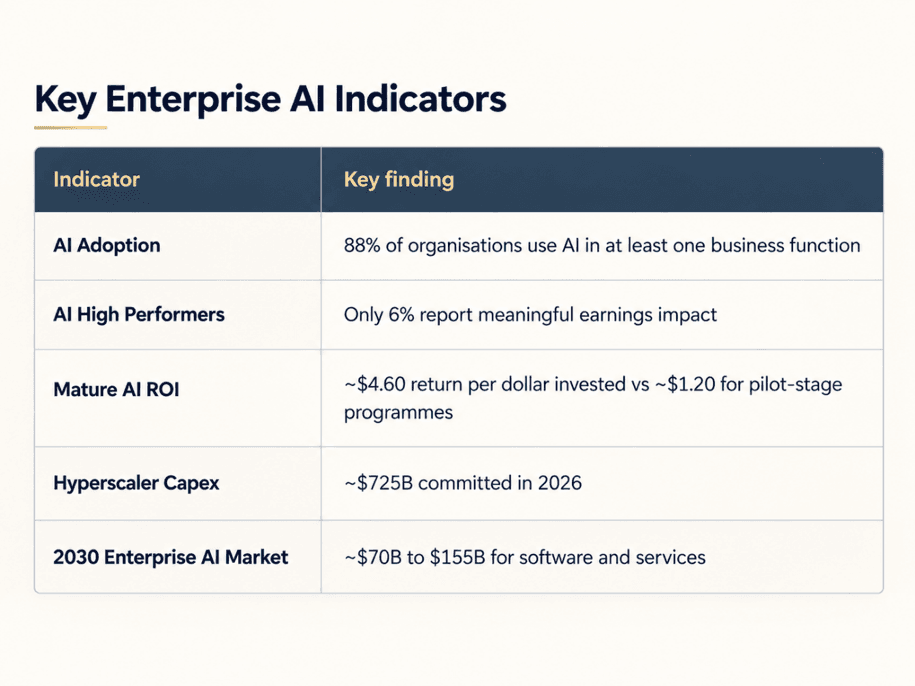
In 2026, enterprise AI adoption is already widespread. McKinsey’s latest research shows that 88% of organisations use AI in at least one business function. Yet measurable financial returns remain concentrated among a much smaller group, with only 6% qualifying as AI high performers generating significant value and at least 5% EBIT impact from AI.
The gap between AI adoption and measurable business value is emerging as a key consideration for enterprise AI through 2030. Progress will depend on how effectively organisations move AI into production, strengthen data readiness, integrate AI into core workflows, mature governance and direct investment toward use cases with measurable business outcomes.
Enterprise AI becomes consequential when intelligence reaches the point of work.

Veera Nagi Reddy Mekala
Director of Technology Innovation, 12th Wonder
Where the Enterprise AI Opportunity Actually Sits
Enterprise AI forecasts vary because they measure different parts of the technology stack. Gartner forecasts worldwide AI spending to exceed $2.5 trillion in 2026, a broad estimate that includes infrastructure, software, services and other AI-related categories. More focused enterprise AI forecasts measure narrower segments of this market, such as the platforms and software used directly within business operations.
Published forecasts illustrate how significantly market estimates can change with scope. Verdantix forecasts the enterprise AI platform market to reach $50.3 billion by 2030, based specifically on corporate end-user software spending. Broader estimates are considerably higher, with Grand View Research projecting the enterprise AI market to reach $155.2 billion by 2030. The difference between these estimates reflects variations in what each forecast includes, reinforcing the importance of defining the market before interpreting its growth.
For this analysis, enterprise AI primarily covers software, platforms, applications, agents and implementation services used within business operations. Clear market boundaries are essential because headline spending figures can create a misleading view of the enterprise opportunity.
The ROI gap is becoming the central enterprise challenge
AI adoption has expanded faster than many organisations’ ability to demonstrate its financial contribution. Measuring value becomes more practical as AI moves from isolated pilots into production workflows where outcomes such as cost savings, productivity improvements, revenue impact and operational efficiency can be tracked consistently. This makes ROI measurement an important part of deciding which AI initiatives should be scaled and where further investment is justified.
Many organisations continue to deploy AI through isolated pilots. Individual tasks may improve while the surrounding workflow remains unchanged. Ownership can become unclear when projects move beyond innovation teams, while measurement often focuses on usage or time savings without connecting improvements to revenue, cost, risk or operational performance.
The strongest use cases tend to have clearly defined inputs, measurable outputs and established data infrastructure. Greater value can emerge when AI improves an entire workflow rather than a single task. In customer service, for example, AI can support request classification, information retrieval, response generation and case routing within the same process, allowing organisations to measure its effect across resolution time, service capacity and operating costs. These workflow-level deployments typically require deeper integration with enterprise data, applications and operating processes.
The enterprise operating foundation will determine AI scale
Enterprise AI performance depends on the quality, accessibility and governance of business data. Customer information may sit in CRM systems, operational data in ERP platforms, documents in collaboration tools and permissions within identity platforms. AI applications must operate across these environments while maintaining appropriate access controls. Data engineering, integration and identity management are therefore central to AI readiness. Enterprises need reliable access to business context, consistent permissions, connected systems and traceability around the information influencing AI-assisted decisions.
Agentic AI introduces additional operational complexity because AI systems can take a more active role in business processes. Instead of simply providing information or recommendations, these systems can complete multiple steps within a workflow, such as retrieving information, updating applications or initiating predefined actions. As this level of autonomy increases, organisations need clearer controls over what AI systems can access, which actions they can perform and how those actions are monitored and reviewed.
The economics of agentic AI will also determine which deployments survive. Gartner expects more than 40% of agentic AI projects to be cancelled by the end of 2027. Production agents will need reliable enterprise data, clearly defined permissions, measurable outcomes and visibility into the actions they perform.
AI value is becoming visible in specific workflows
Current evidence of enterprise AI value is strongest in workflows with measurable operational outcomes. Fraud detection and anti-money-laundering applications have demonstrated significant savings in financial services. Predictive maintenance is reducing downtime and maintenance costs in manufacturing. Clinical documentation tools are reducing administrative workload in healthcare. Code generation is improving developer productivity, while customer service applications are reducing routine support volumes.
AI adoption varies considerably across industries and business functions. McKinsey’s research shows that scaled AI-agent deployment is currently most advanced in the technology sector, particularly in software engineering and IT, while other industries show stronger adoption in specific functions. This variation suggests that industry-level maturity is better understood through where AI has moved into scaled workflows rather than adoption alone. Across sectors, the opportunity for measurable value becomes clearer when AI is applied to well-defined workflows with accessible data and outcomes that can be tracked.
Enterprise AI strategy will depend on deployment and vendor choices
As AI moves deeper into business operations, enterprises have several ways to deploy it. AI capabilities can be adopted within existing business applications, developed through broader AI platforms or built into custom applications and agents. The right approach depends on the workflow, existing technology environment, data requirements and the level of control the organisation needs.
Vendor selection through 2030 will increasingly depend on integration depth, interoperability, data access, security and switching costs. Model performance will remain important, but architecture and operational fit will carry more weight as deployments become more deeply connected to enterprise systems.
Governance is becoming part of AI operations
Governance is becoming increasingly important as AI systems take on greater autonomy within enterprise workflows. McKinsey’s 2026 AI Trust Maturity Survey found that only about 30% of organisations had reached higher maturity levels in governance and agentic AI controls. The research also found an association between greater investment in responsible AI, higher governance maturity and realised AI value, although this relationship does not establish that governance investment alone drives stronger business performance.
Regulation is reinforcing this shift. The EU AI Act, US regulatory activity, NIST AI RMF and ISO/IEC 42001 are creating more structured expectations around risk management, oversight and accountability. Governance now extends across model usage, data access, human oversight, auditability, risk classification and accountability, particularly as agentic systems gain permission to interact with enterprise applications.
The economics of AI infrastructure will shape the market
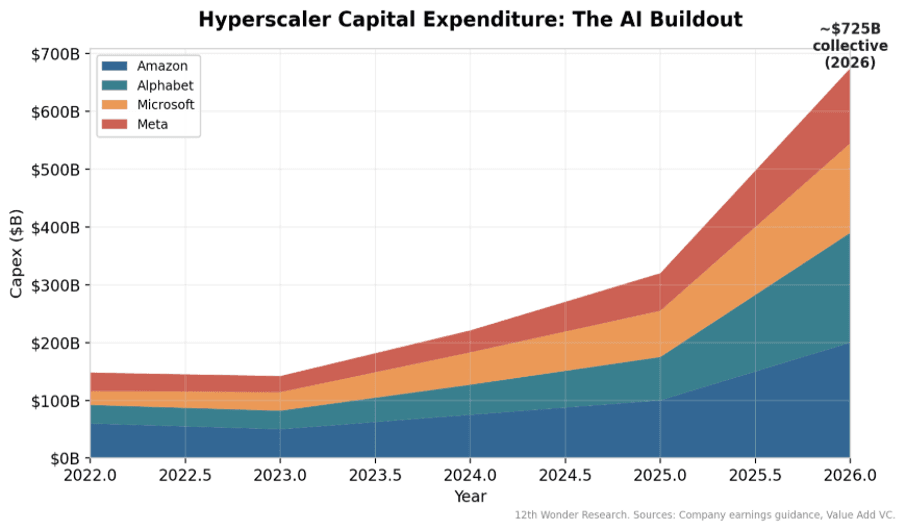
The five largest hyperscalers are expected to commit approximately $725 billion in capital expenditure in 2026, compared with roughly $410 billion in 2025.At that level of infrastructure investment, enterprise demand must increasingly translate into recurring production workloads and software revenue.
AI continues to attract significant capital. According to the Stanford AI Index 2026, global corporate AI investment reached $581.7 billion in 2025 across private investment, mergers and acquisitions, minority stakes and public offerings. This level of investment increases the focus on how effectively organisations translate AI initiatives into recurring production use and measurable business outcomes.
What the path to 2030 could look like
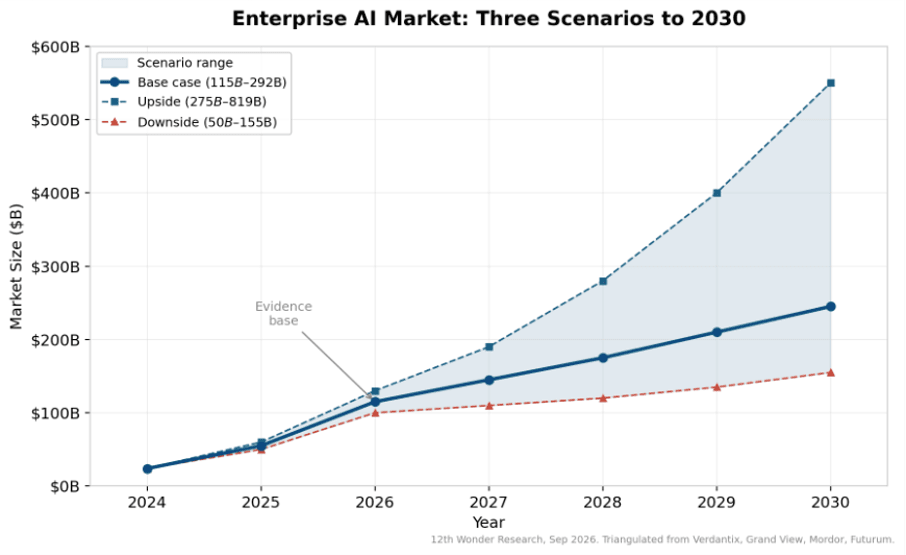
The research outlines three possible outcomes for enterprise AI through 2030: broad value realisation, correction followed by recovery and sustained correction. These scenarios reflect different paths the market could take as organisations evaluate AI investments, discontinue initiatives that fail to demonstrate value and expand use cases that prove effective in production. Rather than identifying one outcome as the most likely, the scenarios provide a framework for considering how enterprise AI adoption could evolve under different levels of business value realisation.
The transition is likely to unfold in stages. In 2026, experimentation, infrastructure expansion and agentic AI investment will continue. Through 2027 and 2028, organisations are likely to reassess pilot portfolios, strengthen financial accountability and concentrate investment on initiatives with measurable outcomes. By 2030, spending is expected to shift further toward production AI, connected workflows, enterprise data, governance and applications that demonstrate sustained operational value.
Enterprise leaders should monitor earnings contribution from AI, the share of projects reaching production, agentic project cancellation rates, governance maturity and hyperscaler capital expenditure. Programmes that improve revenue, cost efficiency, risk management or operational performance will justify continued investment. Initiatives that remain isolated from core workflows or lack measurable outcomes will face greater scrutiny.
By 2030, enterprise AI maturity will be defined by how effectively AI is integrated into business operations. Organisations with strong data foundations, connected workflows, clear governance and disciplined investment will be best positioned to convert current adoption into sustained business value.
Enterprise AI by 2030: From Adoption to Measurable Business Value
Release Date: 30 Sept, 2026
Key Takeaways
- Enterprise AI is moving toward measurable value. As adoption expands, organisations are placing greater emphasis on ROI, production deployment and outcomes tied to revenue, cost and operational performance. Pasted text
- Workflow integration will be critical to scaling AI. The strongest opportunities emerge when AI connects with enterprise data, applications and established processes rather than remaining within isolated pilots. Pasted text
- The path to 2030 will depend on execution. Data readiness, governance, connected workflows and disciplined investment will influence how effectively organisations convert AI adoption into sustained business value.
Enterprise AI adoption has expanded rapidly, but measurable business value has not progressed at the same pace.
In 2026, enterprise AI adoption is already widespread. McKinsey’s latest research shows that 88% of organisations use AI in at least one business function. Yet measurable financial returns remain concentrated among a much smaller group, with only 6% qualifying as AI high performers generating significant value and at least 5% EBIT impact from AI.
The gap between AI adoption and measurable business value is emerging as a key consideration for enterprise AI through 2030. Progress will depend on how effectively organisations move AI into production, strengthen data readiness, integrate AI into core workflows, mature governance and direct investment toward use cases with measurable business outcomes.
Enterprise AI becomes consequential when intelligence reaches the point of work.
Veera Nagi Reddy Mekala
Director of Technology Innovation, 12th Wonder
Where the Enterprise AI Opportunity Actually Sits
Enterprise AI forecasts vary because they measure different parts of the technology stack. Gartner forecasts worldwide AI spending to exceed $2.5 trillion in 2026, a broad estimate that includes infrastructure, software, services and other AI-related categories. More focused enterprise AI forecasts measure narrower segments of this market, such as the platforms and software used directly within business operations.
Published forecasts illustrate how significantly market estimates can change with scope. Verdantix forecasts the enterprise AI platform market to reach $50.3 billion by 2030, based specifically on corporate end-user software spending. Broader estimates are considerably higher, with Grand View Research projecting the enterprise AI market to reach $155.2 billion by 2030. The difference between these estimates reflects variations in what each forecast includes, reinforcing the importance of defining the market before interpreting its growth.
For this analysis, enterprise AI primarily covers software, platforms, applications, agents and implementation services used within business operations. Clear market boundaries are essential because headline spending figures can create a misleading view of the enterprise opportunity.
The ROI gap is becoming the central enterprise challenge
AI adoption has expanded faster than many organisations’ ability to demonstrate its financial contribution. Measuring value becomes more practical as AI moves from isolated pilots into production workflows where outcomes such as cost savings, productivity improvements, revenue impact and operational efficiency can be tracked consistently. This makes ROI measurement an important part of deciding which AI initiatives should be scaled and where further investment is justified.
Many organisations continue to deploy AI through isolated pilots. Individual tasks may improve while the surrounding workflow remains unchanged. Ownership can become unclear when projects move beyond innovation teams, while measurement often focuses on usage or time savings without connecting improvements to revenue, cost, risk or operational performance.
The strongest use cases tend to have clearly defined inputs, measurable outputs and established data infrastructure. Greater value can emerge when AI improves an entire workflow rather than a single task. In customer service, for example, AI can support request classification, information retrieval, response generation and case routing within the same process, allowing organisations to measure its effect across resolution time, service capacity and operating costs. These workflow-level deployments typically require deeper integration with enterprise data, applications and operating processes.
The enterprise operating foundation will determine AI scale
Enterprise AI performance depends on the quality, accessibility and governance of business data. Customer information may sit in CRM systems, operational data in ERP platforms, documents in collaboration tools and permissions within identity platforms. AI applications must operate across these environments while maintaining appropriate access controls. Data engineering, integration and identity management are therefore central to AI readiness. Enterprises need reliable access to business context, consistent permissions, connected systems and traceability around the information influencing AI-assisted decisions.
Agentic AI introduces additional operational complexity because AI systems can take a more active role in business processes. Instead of simply providing information or recommendations, these systems can complete multiple steps within a workflow, such as retrieving information, updating applications or initiating predefined actions. As this level of autonomy increases, organisations need clearer controls over what AI systems can access, which actions they can perform and how those actions are monitored and reviewed.
The economics of agentic AI will also determine which deployments survive. Gartner expects more than 40% of agentic AI projects to be cancelled by the end of 2027. Production agents will need reliable enterprise data, clearly defined permissions, measurable outcomes and visibility into the actions they perform.
AI value is becoming visible in specific workflows
Current evidence of enterprise AI value is strongest in workflows with measurable operational outcomes. Fraud detection and anti-money-laundering applications have demonstrated significant savings in financial services. Predictive maintenance is reducing downtime and maintenance costs in manufacturing. Clinical documentation tools are reducing administrative workload in healthcare. Code generation is improving developer productivity, while customer service applications are reducing routine support volumes.
AI adoption varies considerably across industries and business functions. McKinsey’s research shows that scaled AI-agent deployment is currently most advanced in the technology sector, particularly in software engineering and IT, while other industries show stronger adoption in specific functions. This variation suggests that industry-level maturity is better understood through where AI has moved into scaled workflows rather than adoption alone. Across sectors, the opportunity for measurable value becomes clearer when AI is applied to well-defined workflows with accessible data and outcomes that can be tracked.
Enterprise AI strategy will depend on deployment and vendor choices
As AI moves deeper into business operations, enterprises have several ways to deploy it. AI capabilities can be adopted within existing business applications, developed through broader AI platforms or built into custom applications and agents. The right approach depends on the workflow, existing technology environment, data requirements and the level of control the organisation needs.
Vendor selection through 2030 will increasingly depend on integration depth, interoperability, data access, security and switching costs. Model performance will remain important, but architecture and operational fit will carry more weight as deployments become more deeply connected to enterprise systems.
Governance is becoming part of AI operations
Governance is becoming increasingly important as AI systems take on greater autonomy within enterprise workflows. McKinsey’s 2026 AI Trust Maturity Survey found that only about 30% of organisations had reached higher maturity levels in governance and agentic AI controls. The research also found an association between greater investment in responsible AI, higher governance maturity and realised AI value, although this relationship does not establish that governance investment alone drives stronger business performance.
Regulation is reinforcing this shift. The EU AI Act, US regulatory activity, NIST AI RMF and ISO/IEC 42001 are creating more structured expectations around risk management, oversight and accountability. Governance now extends across model usage, data access, human oversight, auditability, risk classification and accountability, particularly as agentic systems gain permission to interact with enterprise applications.
The economics of AI infrastructure will shape the market
The five largest hyperscalers are expected to commit approximately $725 billion in capital expenditure in 2026, compared with roughly $410 billion in 2025.At that level of infrastructure investment, enterprise demand must increasingly translate into recurring production workloads and software revenue.
AI continues to attract significant capital. According to the Stanford AI Index 2026, global corporate AI investment reached $581.7 billion in 2025 across private investment, mergers and acquisitions, minority stakes and public offerings. This level of investment increases the focus on how effectively organisations translate AI initiatives into recurring production use and measurable business outcomes.
What the path to 2030 could look like
The research outlines three possible outcomes for enterprise AI through 2030: broad value realisation, correction followed by recovery and sustained correction. These scenarios reflect different paths the market could take as organisations evaluate AI investments, discontinue initiatives that fail to demonstrate value and expand use cases that prove effective in production. Rather than identifying one outcome as the most likely, the scenarios provide a framework for considering how enterprise AI adoption could evolve under different levels of business value realisation.
The transition is likely to unfold in stages. In 2026, experimentation, infrastructure expansion and agentic AI investment will continue. Through 2027 and 2028, organisations are likely to reassess pilot portfolios, strengthen financial accountability and concentrate investment on initiatives with measurable outcomes. By 2030, spending is expected to shift further toward production AI, connected workflows, enterprise data, governance and applications that demonstrate sustained operational value.
Enterprise leaders should monitor earnings contribution from AI, the share of projects reaching production, agentic project cancellation rates, governance maturity and hyperscaler capital expenditure. Programmes that improve revenue, cost efficiency, risk management or operational performance will justify continued investment. Initiatives that remain isolated from core workflows or lack measurable outcomes will face greater scrutiny.
By 2030, enterprise AI maturity will be defined by how effectively AI is integrated into business operations. Organisations with strong data foundations, connected workflows, clear governance and disciplined investment will be best positioned to convert current adoption into sustained business value.
Recent Blogs
CodeIgniter in 2026: Where It Still Fits in Modern PHP Development
CodeIgniter has been part of the PHP development ecosystem for years. It became popular because it gave developers a simple
Read more →
How AI Is Transforming Android App Development in 2026
Android remains the dominant mobile operating system globally. According to StatCounter, Android represented
Read more →
7 Law Firm IT Priorities for 2026
A single IT failure can disrupt critical legal work. An unavailable matter file may delay a filing. A compromised account can expose
Read more →
How Modern Work Is Reshaping Managed IT
The modern workplace no longer behaves like a collection of separate IT systems. Employees move between offices, homes and customer locations
Read more →
Does Claude Leave a Hidden AI Signature?
A customer receives a detailed financial summary generated by an AI assistant. A marketing team publishes hundreds
Read more →
The EU AI Act Compliance Calendar for Enterprise AI Teams
On August 2, 2026, the EU AI Act reached one of the most important dates in its implementation calendar.
Read more →
Why Enterprise AI Needs More Than a Powerful Model
A powerful AI model can write a polished answer in seconds. Ask it about your pricing rules, internal systems or approval process,
Read more →
Utility OT Security Is Changing as Cloud Connectivity Grows
A substation does not need to be directly exposed to the internet to become part of a cyber risk chain.
Read more →
AI-Ready Data: What Agents Need from Your Data Layer
An employee asks an AI agent to identify delayed customer orders, determine the reasons and notify the relevant account managers.
Read more →
Claude Opus 5 vs Fable 5: Pricing, Performance and Enterprise Comparison
Fable 5 is built for workloads where sustained reasoning, longer task duration and deeper autonomy can materially affect the outcome.
Read more →
Beyond Time Saved: How to Measure AI ROI
An AI assistant reviews a 60-page supplier contract in five minutes instead of an hour. The dashboard records 55 minutes saved
Read more →
The Agentic AI Production Readiness Checklist: 21 Checks Before Deployment
A procurement AI agent receives an incomplete supplier record. Instead of stopping, it fills in the missing delivery terms, retries the same tool
Read more →
Will Data Centres Become the Biggest Bottleneck in AI?
AI demand is driving one of the largest expansions of computing infrastructure in recent history. According to a Reuters report published in July 2026, Hut 8 signed a $9.8 billion lease
Read more →
Start with pgvector: When Enterprise RAG Needs a Dedicated Vector Database
A RAG system can have a powerful LLM and still fail because the retrieval layer brings the wrong context.
Read more →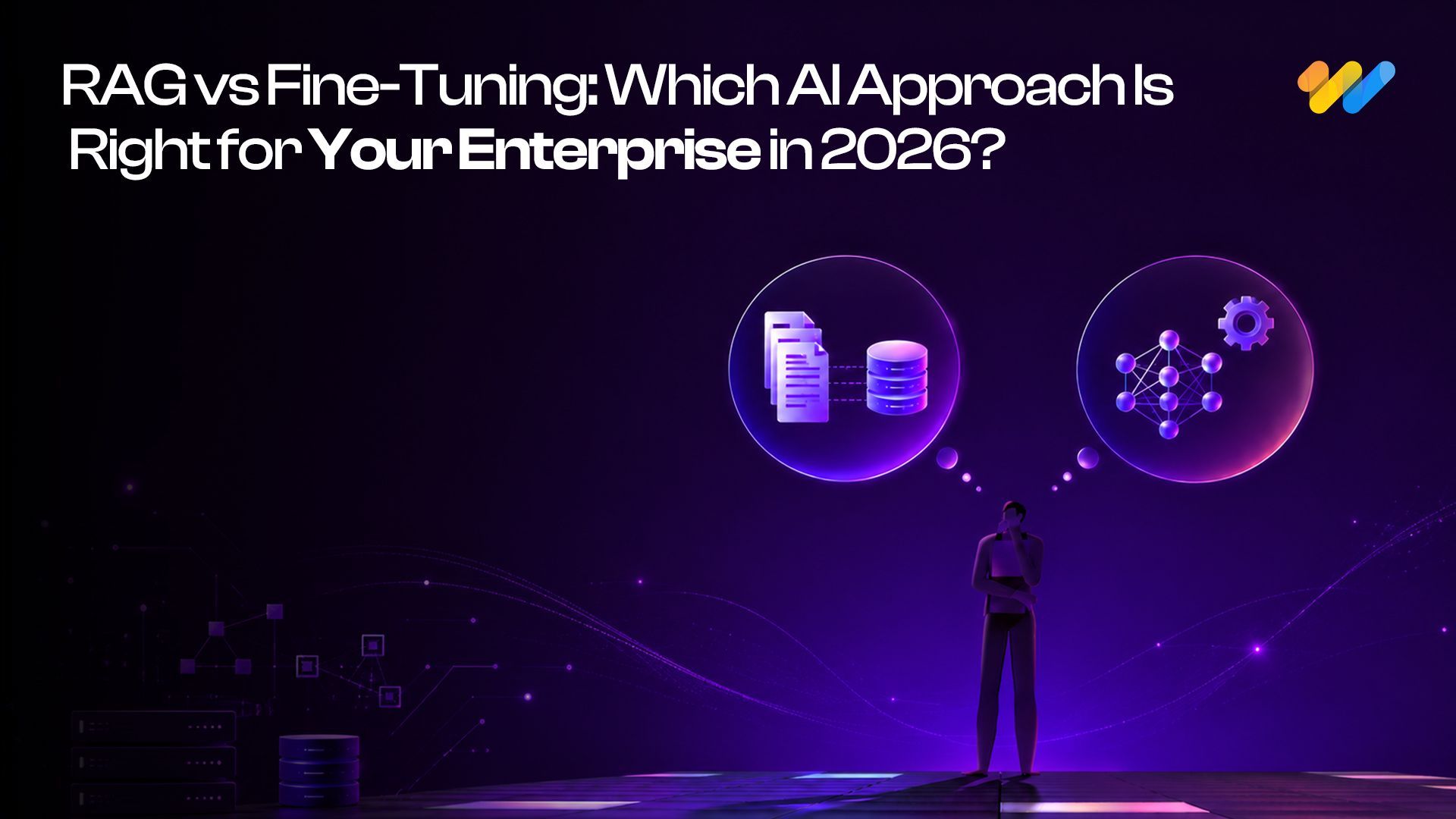
RAG vs Fine-Tuning: Which Approach Fits Your Enterprise Use Case?
In 2025, enterprise AI moved beyond experimentation and into real business workflows. McKinsey reported that 71% of organizations
Read more →
Beyond Model Accuracy: LLM Evaluation and Observability for Business AI
Organizations are moving beyond asking "Can we build it?" and increasingly asking "Can we trust it in production?
Read more →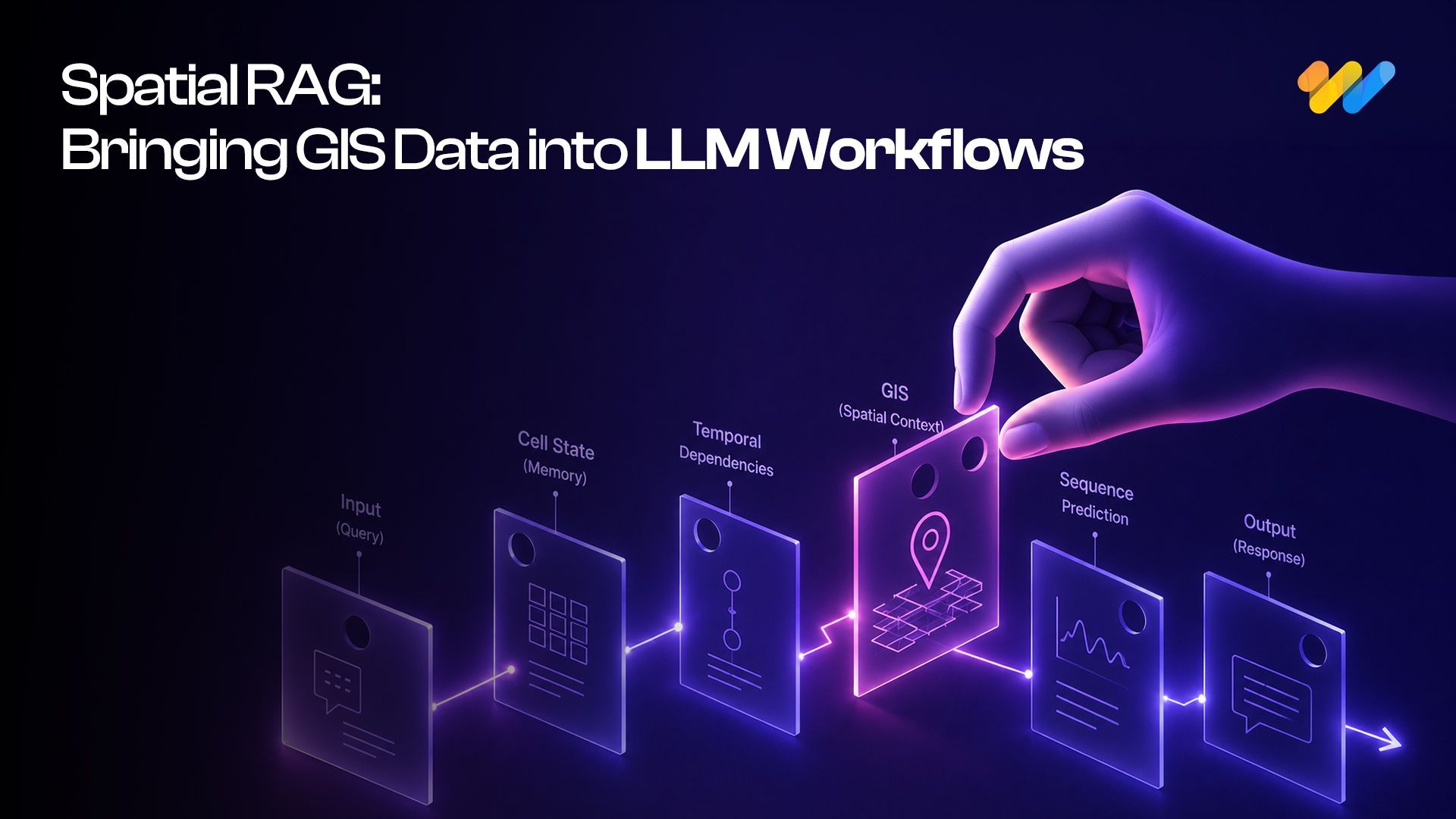
Spatial RAG: The Missing Layer Between GIS Data and LLMs
Ask an LLM which substations are inside a flood zone, and it may answer confidently without performing a spatial query.
Read more →
Agentic Testing: The Complete 2026 Guide to Autonomous Software Testing
Traditional test automation helped teams scale quality, but modern applications are evolving faster than many automation frameworks
Read more →
What Is MCP? Understanding the Model Context Protocol for Enterprise AI
AI agents are rapidly becoming part of the enterprise technology stack. Organizations are deploying engineering copilots, customer
Read more →
Agentic GeoAI: AI Agents Transforming Enterprise GIS Workflows (2026)
A flood warning is issued. By the time analysts collect satellite imagery, run spatial models, validate results and distribute reports,
Read more →
Frontier AI Models Guide: OpenAI vs Claude vs Gemini (2026)
Every major AI provider is promising to be your enterprise AI platform. Many organizations initially evaluat
Read more →
Build vs Buy: AI Agent Platforms Compared (2026)
Enterprise AI has evolved beyond simple chatbots into operational ecosystems capable of workflow automation, system integration, and real-time decision-making
Read more →
Claude Fable 5: The Mythos-Class AI Model You Can Use in 2026
Anthropic's Claude Fable 5 is the first publicly available Mythos-class AI model, representing a significant step beyond traditional AI assistants.
Read more →
Multi-Agent Systems for Business: A Practical Enterprise Guide (2026)
Enterprise AI is quietly moving away from the idea of one system doing everything. The future of enterprise AI is increasingly being shaped by coordinated intelligence
Read more →
AI Agent ROI: How to Measure It Before You Build
What was once considered cutting-edge technology reserved for large tech firms has now become part of everyday business operations
Read more →
AI Agent Security: Defending Against Prompt Injection in Enterprise AI Systems
The rate of adoption of autonomous AI agents by businesses is growing quickly. Autonomous AI agents have become commonplace, where they are being used to automate workflows, engage with customers,
Read more →
RAG Explained: The Complete Guide to Retrieval-Augmented Generation for Enterprise AI (2026)
Somewhere in your organization right now, an AI assistant just answered a question with complete confidence and complete inaccuracy. It cited a policy from two years ago, a product that was discontinued last quarter,
Read more →
EU AI Act Compliance Checklist: Everything Enterprises Need to Know Before 2027
AI governance has moved from a boardroom discussion to a legal obligation. The EU AI Act is the most comprehensive artificial intelligence policy framework enacted anywhere in the world and enforcement is already underway.
Read more →
Small Language Models vs LLMs: A Practical Guide to Choosing the Right AI Model for Your Business
The conversation around enterprise AI in 2026 has shifted. While large language models like GPT-4 and Claude still dominate headlines, a quieter revolution is happening at the edge.
Read more →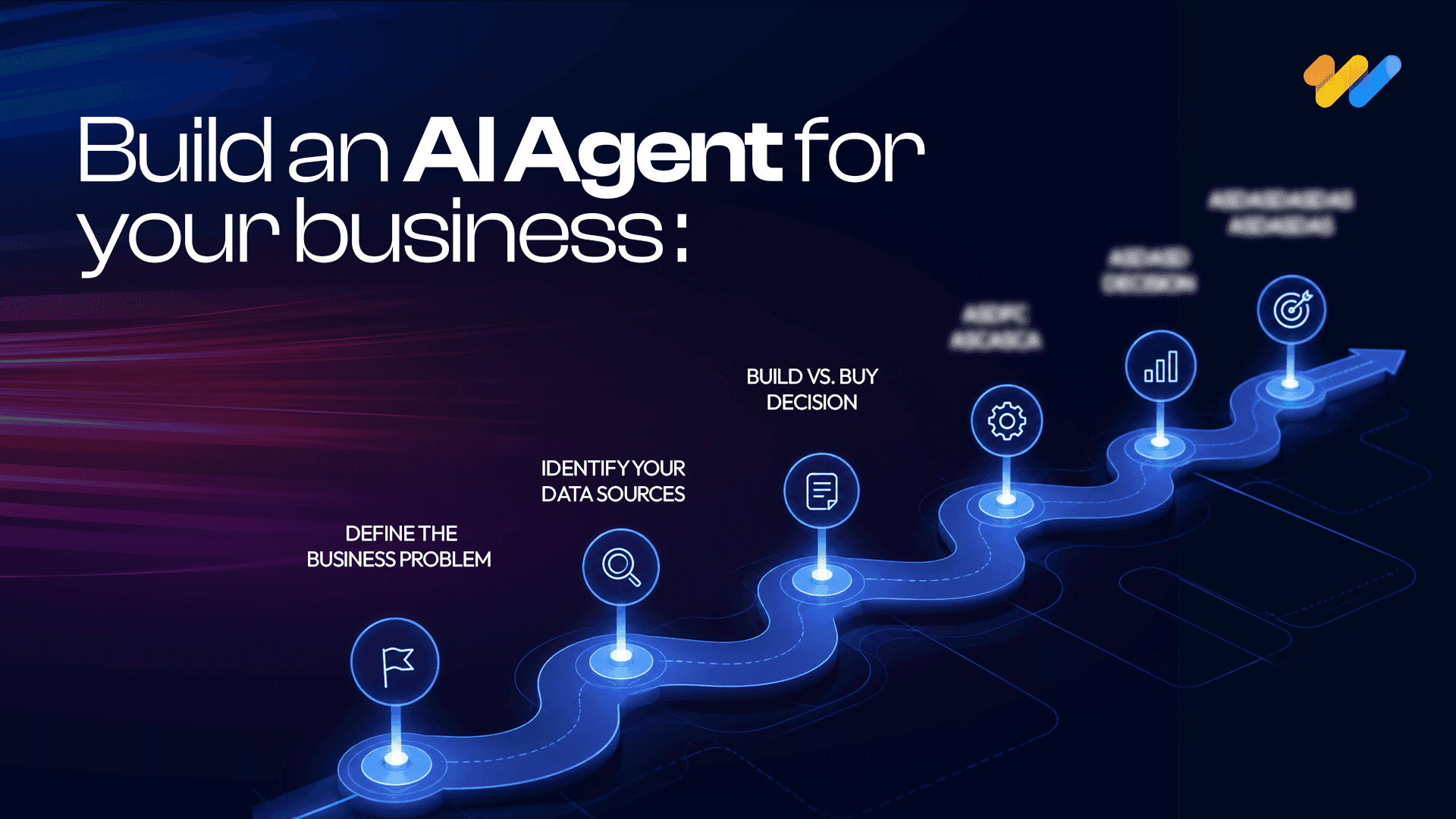
How to Build an AI Agent for Your Business: A Practical Guide (2026)
AI agents are no longer a future-facing experiment. Businesses across industries are using them to handle real workflows right now, and the
Read more →
AI and the Energy Crisis: How Data Centers Are Reshaping the Global Power Grid in 2026
AI data center energy consumption has become one of the defining infrastructure challenges of this decade. The numbers are no longer abstract.
Read more →
AI in the Supply Chain: Where Value Is Actually Created
AI adoption across supply chains is accelerating. Investment is growing, pilots are expanding, and technical capability is improving quickly.
Read more →
Vibe Coding in 2026: The Complete Guide to AI-Powered Development
Vibe coding is a natural-language-first approach to software development where you describe what you want in plain English and AI generates functional code for you.
Read more →
AI Trends in 2026: 7 Predictions That Will Reshape Every Industry
The most important AI predictions for 2026, agents, generative AI, industry transformation, governance and what's next. A practical guide for business and technology leaders.
Read more →
Real-Time Visibility in Logistics: Why Your Architecture Is Costing You More Than You Think
Here is a number worth pausing on: 45% of logistics organizations have real-time visibility into fewer than half their shipments.
Read more →
Why Field Operations Break When You Can’t See Them on a Map
Field operations rarely fail because teams are not working hard enough. They fail when leaders lose visibility into what is happening, where it is happening, and why.
Read more →
What Your GIS Data Actually Needs for GeoAI
We examined why many GeoAI projects fail before they even get started in the previous blog. Let's now discuss what makes GeoAI function in the real world.
Read more →
Why GeoAI Projects Fail Before They Even Start
GeoAI is currently omnipresent. In order to anticipate failures, automate decision-making, and make sense of intricate networks, utilities,
Read more →
GIS Drone Mapping: How Drones Are Powering the Next Era of Real-Time Geospatial Intelligence
GIS drone mapping is rapidly transforming how organizations collect, analyze, and act on geospatial data.
Read more →
Digital Twins & 3D GIS Modeling: Global Benefits, Challenges & Solutions
Digital twins and 3D GIS modeling are redefining how organizations plan, operate, and maintain physical asset
Read more →
GeoAI Explained: How Geospatial AI is Solving Real-World Challenges in the U.S.
GeoAI: short for Geospatial Artificial Intelligence is the convergence of geospatial data (location, maps, remote sensing, GPS, GIS systems)
Read more →
The ROI of Implementing a GIS Solution: A Business Case Study Approach
Relying on fragmented data and outdated mapping tools is no longer sustainable for organizations navigating complex,
Read more →
Building a Future-Ready Telecom Data Migration Framework: Tools, Automation, and Real-World Lessons
Telecom data migration is not just about moving data it's about ensuring scalability, security,
Read more →
The Telecom Data Migration Imperative: Challenges, Best Practices & Future-Ready Strategies
As telecom networks rapidly evolve from 4G to 5G and legacy OSS/BSS stacks shift
Read more →
Top 7 Emerging AI Trends to Watch in 2025
Pushing deeper into 2025, artificial intelligence continues to sprint from being a promising tool to
Read more →
Geospatial Revolution: Top 10 Industries Benefiting from GIS
Geographic Information Systems (GIS) have emerged as a powerful tool for businesses and organizations across various sectors.
Read more →
Empowering Smarter Cities: The Role of Geospatial Digital Twins in Urban Planning
Geographic Information Systems (GIS) have emerged as a powerful tool for businesses and organizations across various sectors.
Read more →
Enhancing Customer Experience with Location-Based Services Powered by GIS
Customer experience has emerged as a key differentiator for organizations across industries be it in utilities, retail or public services.
Read more →
Transforming Field Operations with Mobile GIS
Be it in utilities, transportation, or environmental management, field operations are complex and challenging.
Read more →
Emerging trends in GIS: Navigating the geospatial landscape
GIS or Geographical information systems has helped turn maps into advanced tools for problem-solving.
Read more →
How GIS is transforming predictive maintenance in the utility sector
The utility sector is the backbone of the modern economy providing vital services like electricity, water, and gas to people and businesses.
Read more →
Case study spotlight: Streamlining HFC network management with GIS for a US-based Telecom Service Provider
GIS (Geographical Information System) has been crucial to the growth of the telecom sector, providing invaluable geospatial data that benefits even
Read more →
GIS In Action: Real-World Examples of How It's Used
Geographic Information Systems (GIS) have become indispensable tools across a multitude of industries, revolutionizing the way we understand, analyze, and interact with spatial data.
Read more →
Case Study Spotlight: Revolutionizing Utility Asset Management
At 12th Wonder, we are transforming the way utility companies manage their assets. In one of our recent projects, we partnered with a leading utility
Read more →
The Cutting-Edge Benefits of GIS For Telecom Networks
Geographic Information Systems (GIS) are making a big impact in the telecommunications world. Think of GIS as a powerful tool that transforms heaps of data into clear, useful maps.
Read more →
What is Mobile GIS? Here’s what you should know.
The world of Geographic Information Systems (GIS) is changing quickly, and mobile GIS is leading the way. At 12thWonder, we’re using this exciting technology to transform how field data
Read more →
A mix of Introductory and Advanced Geospatial Solutions: 12W's Approach
Geospatial solutions are revolutionizing the way we understand and interact with the space around us. We are at the forefront of this transformative wave, a company that has seamlessly integrated technology
Read more →
The Importance of Data Interoperability in Today’s Geospatial Solutions
Have you ever wondered what makes the digital world tick seamlessly? It’s the magic of data interoperability, especially in the realm of geospatial solutions.
Read more →
Leading Top 10 Best Geospatial Companies
This guide highlights the top 15 GIS (Geographic Information Systems) companies leading the way with their cutting-edge solutions in mapping and spatial analysis.
Read more →
Getting Started in QA Test Automation: Essential Tips for Beginners
Starting on the journey of Quality Assurance (QA) test automation can be both exciting and challenging, especially for companies taking their first steps in this domain.
Read more →
How to Choose the Right QA Services Provider for Your Business: Including a Checklist
In today’s competitive market, software quality assurance (QA) is vital for ensuring robust, reliable, and high-performing software solutions.
Read more →
Solve Your Business Challenges with 12th Wonder's Tailored Digital Transformation Solutions!
Ready to elevate your business with cutting-edge digital solutions? At 12th Wonder we offer a suite of innovative software services. Our goal is to empower your workforce and lead your business towards
Read more →
Integrating QA Test Automation and Manual Testing: A Balanced Approach in Software Development
In software development, you can achieving the highest quality of product by using a strategic blend of both QA test automation and manual testing. While automation is offers speed and repeatability
Read more →
5 Ways QA Automation Can Transform Your Business
Staying ahead of the competition requires including innovative approaches to improve efficiency and quality. This is where QA automation comes into play.
Read more →
Dictionary of GIS Terms
Aerial Photography Mapping: The creation of maps based on the interpretation and analysis of aerial photographs, utilizing differences in vantage points and angles to construct detailed
Read more →
Leading Top 15 Best Software Testing & Quality Assurance Global Companies
This guide highlights the top 15 software testing companies that consistently deliver high value from small, mighty teams. It emphasizes the critical role of QA testing in ensuring software quality
Read more →
Maximizing Business Value: The Transformative Power of Automation in Quality Assurance Services
The integration of automation in Quality Assurance (QA) services has transformed industries by enhancing efficiency, accuracy, and cost-effectiveness.
Read more →
Navigating the Pitfalls of Application Development: How We Ensure a Smooth Journey
The process of application development can be both exciting and daunting. From the spark of an idea to the polished end product, there are numerous stages where errors might occur.
Read more →
Quality Assurance Redefined: Your Path to Success with 12thWonder
Are you ready for help with ensuring the highest quality for your products? Collaborating with 12thWonder for Quality Assurance (QA) services opens the door to a transformative experience that
Read more →
Streamline Your Testing Process with 12th Wonder's Test Automation Services
In this ever-evolving world of software development, where changes happen at the drop of a hat, ensuring quality, speed, and reliability is absolutely essential.
Read more →
7 Ways QA Services Can Reduce Costs in Software Development
In today’s fast-paced world of software development, your company faces a myriad of challenges. Balancing quality and cost-effectiveness is a perpetual struggle.
Read more →