
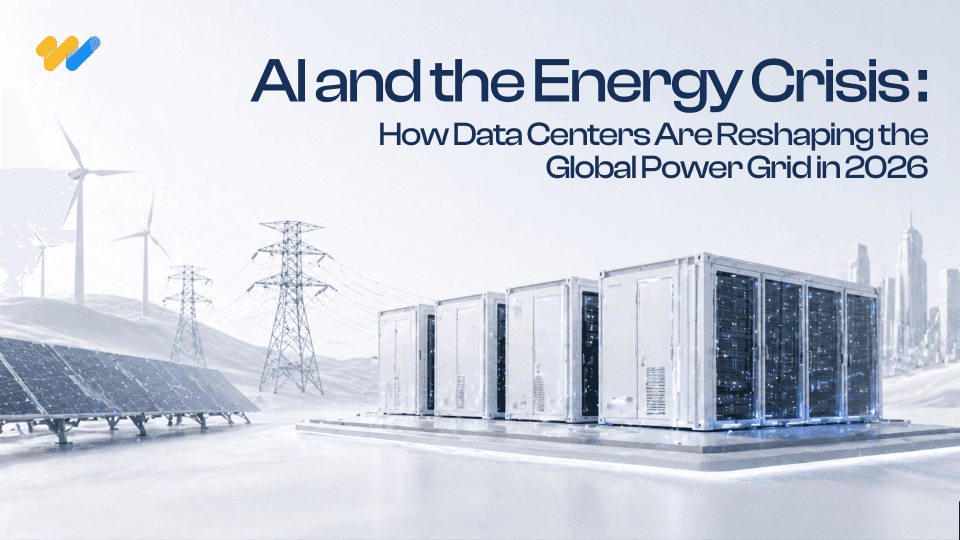

AI and the Energy Crisis: How Data Centers Are Reshaping the Global Power Grid in 2026
AI data center energy consumption has become one of the defining infrastructure challenges of this decade. The numbers are no longer abstract. Tech giants are projected to invest over $600 billion in hyperscale data centers in 2026 alone. A single high-density AI training rack now draws more than 60kW of power. And the demand was previously plateauing but now it is compounding. For executives, sustainability officers and policymakers, this is the story that sits at the top of every board agenda right now.
Read further to understand how this blog breaks down where the energy actually goes, which solutions are already working at scale and what enterprise leaders need to understand before their next cloud infrastructure decision.
The Scale of the Problem Is Structural, Not Temporary
It is easy to look at data center growth as a cyclical infrastructure investment. It is not. The energy demands that AI workloads create are fundamentally different from what came before and the gap is widening.
Traditional data centers were built around CPU-based compute. Servers ran at moderate density and cooling systems were designed accordingly. When AI training entered the picture, everything changed. Modern GPU clusters run at power densities that would have been considered extreme just five years ago. A rack of A100 or H100 GPUs does not just require more electricity. It generates heat at a rate that existing facilities were never engineered to handle.
Google and Meta, two companies that had made significant public commitments to carbon reduction, both acknowledged surges in CO2 emissions in recent years. This was a structural consequence of scaling AI infrastructure faster than renewable supply could keep up.
Between 2020 and 2026, global data center electricity consumption has more than doubled. By 2030, the green AI data center market alone is projected to reach $111 billion, which signals both the scale of the problem and the scale of the investment being mobilized to address it.
The AI carbon footprint conversation used to live in research papers. In 2026, it sits in earnings calls and ESG reports.
Where the Energy Actually Goes
Understanding the data center power crisis requires looking at the energy breakdown inside a modern facility.
Compute (primarily GPUs) accounts for the largest share of power draw during active training and inference workloads. But cooling is what surprises most people outside the industry. Roughly 40% of total data center energy consumption goes toward keeping equipment within safe operating temperatures. That figure, already significant in traditional facilities, climbs further when GPU-dense AI racks are involved because of how much more heat they produce per unit of space.
Networking infrastructure and storage round out the picture, though their relative share has grown as AI systems increasingly pull from distributed data sources and serve inference requests at global scale.
Geography adds another layer of complexity. Many of the regions most attractive for data center development, including parts of the American Southwest, Northern Africa and Southern Europe, face serious water stress. Traditional cooling systems rely heavily on water evaporation to manage heat. In those locations, that approach creates a direct conflict between AI expansion and local water resources. The Northern Virginia data center corridor, which hosts a significant portion of US cloud infrastructure, has already drawn scrutiny from local authorities over water usage.
The data center power crisis is a resource challenge, with growing regulatory implications in some regions.
Solutions That Are Already Working at Scale
The good news is that the industry has not been standing still. Several solutions have moved from pilot programs to real-world deployment and the results are turning out to be meaningful.
Liquid cooling and immersion cooling have gained serious traction. Instead of pushing chilled air through server racks, liquid cooling runs coolant directly across or around heat-generating components. Immersion cooling takes this further by submerging hardware in thermally conductive, non-conductive fluid. Both approaches dramatically reduce the energy required for thermal management. Microsoft, Google and a growing list of colocation providers have deployed liquid cooling in new facilities and retrofits are underway in older ones.
Renewable energy PPAs (Power Purchase Agreements) have become a standard tool for large cloud providers. Microsoft signed a 150MW agreement with Iberdrola to supply renewable energy to its European data centers. Amazon, Google and Meta have each committed to multi-gigawatt renewable portfolios. The challenge is that renewable generation is intermittent. Solar and wind do not produce at constant rates and AI training workloads do not pause for cloudy days.
Edge computing offers a structurally different answer to the centralization problem. Instead of routing every AI inference request to a hyperscale facility, edge infrastructure pushes compute closer to the point of use. This reduces the volume of data traveling long distances, lowers latency and distributes the energy load across a wider geographic footprint. For enterprise AI deployments, edge architectures can meaningfully reduce both cost and carbon intensity. This is an area where organizations like 12th Wonder are actively helping clients build more sustainable and resilient AI infrastructure.
AI-driven energy optimization is also being applied inside the facilities themselves. Google's DeepMind famously reduced cooling energy at its data centers by around 40% using reinforcement learning to manage airflow and temperature dynamically. That approach has since influenced how other operators think about facility management, and purpose-built energy optimization software is now a growing category.
Nuclear, Geothermal and the Baseload Problem
Renewables are essential, but they are not sufficient on their own for 24/7 AI workloads. This is the part of the conversation that generates debate and it should.
AI training runs continuously. Inference serving runs continuously. These are not workloads you can shift to match the availability of solar generation. They require reliable, uninterrupted power at scale. That requirement has pushed a serious number of technology companies toward nuclear energy as a long-term answer.
Small Modular Reactors (SMRs) have moved from theoretical to funded. Several projects are in development or construction phases across the US and Europe, with explicit backing from technology companies seeking reliable low-carbon baseload power. Microsoft signed an agreement to help restart the Three Mile Island nuclear facility specifically to power its AI data centers, a decision that generated significant debate but also significant attention.
Geothermal energy is the quieter contender in this conversation. Iceland has long used geothermal for data center cooling and power. Enhanced geothermal systems now being piloted in the US could expand access to this resource well beyond volcanic regions.
Hydrogen is earlier in its development arc. Several data center operators are trialing hydrogen fuel cells as backup power systems, replacing diesel generators with a lower-carbon alternative. Scaling hydrogen supply chains to support primary power remains a longer-term challenge.
The honest position is that no single alternative solves the baseload problem. A realistic energy strategy for a major AI infrastructure operator in 2026 involves a mix of renewables, storage, grid flexibility agreements and increasingly, nuclear or geothermal for the portions of demand that require constant availability.
What This Means for Enterprise Leaders
If you are an executive making cloud or AI infrastructure decisions in 2026, the AI sustainability question is not just an ethical one. It is a financial and regulatory one.
The EU Energy Efficiency Directive now requires larger data center operators to report energy performance data. ESG disclosure requirements in multiple jurisdictions are tightening around Scope 3 emissions, which includes the cloud infrastructure your organization uses. Investors are asking questions that procurement teams were not being asked three years ago.
Here are five questions worth asking your cloud provider before your next infrastructure commitment:
- What percentage of the energy powering my workloads comes from renewable or low-carbon sources and how is that measured?
- What is the Power Usage Effectiveness (PUE) rating of the facilities running my workloads?
- Does the provider offer carbon reporting at the workload or account level?
- What is the provider's position on water usage, and do they operate in water-stressed regions?
- Does the provider offer options to route workloads to lower-carbon regions or facilities?
These are not gotcha questions. Most major providers have public sustainability reports that address them. The value is in making energy and carbon performance an explicit part of your vendor evaluation criteria rather than an afterthought.
For organizations running significant AI workloads, the cost optimization angle is also real. Energy-efficient inference architecture, edge deployment for latency-sensitive applications and workload scheduling to favor off-peak or renewable-heavy periods can all reduce cloud spend alongside carbon footprint.
The intersection of AI and energy is where infrastructure strategy, sustainability policy and enterprise risk now meet. The organizations that treat AI data center energy consumption as someone else's problem are the ones that will find themselves caught off guard by regulatory changes, cost increases and reputational pressure.
The organizations building now with efficiency and sustainability as design constraints are the ones that will be better positioned heading into the second half of this decade. If you want to think through what that looks like for your cloud and AI infrastructure, the conversation starts with understanding where your energy goes.
AI Data Centers & the Energy Challenge
A closer look at how data centers consume power and manage rising cooling demands.