
Agentic Testing: The Complete 2026 Guide to Autonomous Software Testing

Author

Author

Veera Nagi Reddy Mekala

Director of Tech. Innovation

Agentic testing 2026 guide blog cover AI agents autonomously planning, executing and maintaining software testing workflows

Agentic Testing: The Complete 2026 Guide to Autonomous Software Testing

AI agents are rapidly becoming part of the enterprise technology stack. Organizations are deploying engineering copilots, customer service assistants, research agents and workflow automation systems across multiple business functions.

As adoption expands, a new challenge is emerging connecting AI systems to the applications, data sources and business processes they need to access. Every new agent introduces additional integration requirements, increasing complexity for engineering, security and IT teams.

Consider a manufacturing company deploying an engineering copilot, a procurement assistant and a maintenance agent. Each system requires access to ERP platforms, maintenance records, document repositories and operational data. As more agents are introduced, the number of integrations grows quickly, creating challenges around scalability, governance and operational efficiency.

Model Context Protocol (MCP) is emerging as a framework for addressing this challenge. By providing a standardized way for AI models and agents to connect with enterprise systems, MCP helps organizations simplify integration management and build a stronger foundation for scalable AI adoption.

Agentic Testing: Key Takeaways

  • Agentic testing uses autonomous agents to plan, execute, maintain and optimize software testing workflows.
  • Unlike traditional automation, agentic systems can adapt to application changes and make testing decisions dynamically.
  • AI agents reduce maintenance effort, improve test coverage and accelerate feedback cycles.
  • Multi-agent architectures allow specialized agents to collaborate across planning, execution, reporting and analysis.
  • Agentic testing extends beyond software QA into AI application validation and physical product testing environments.
  • Human oversight remains critical for governance, compliance and strategic quality decisions.

What Is Agentic Testing?

Agentic testing is an AI-driven approach to software quality assurance in which autonomous agents perform testing activities with minimal human intervention. These agents observe application behaviour, reason about risks, plan testing strategies, execute test scenarios and learn from previous outcomes.

The concept builds on advances in large language models, agent frameworks, computer vision and automated reasoning. Agentic testing treats quality assurance as an intelligent workflow that continuously adapts to application changes and business requirements.
blog-agentic-testing-inside1-preprod.png

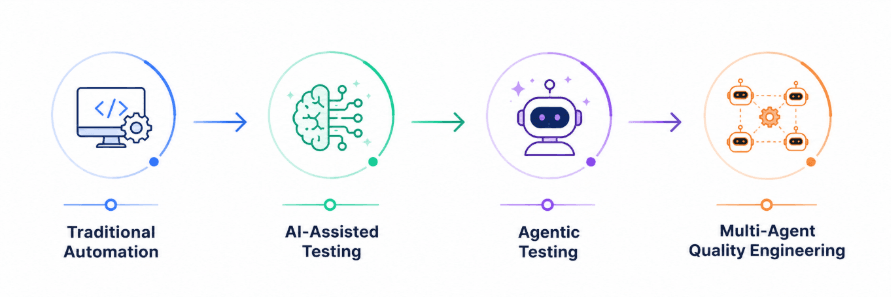
Agentic Testing vs Traditional Automation

Traditional test automation relies on predefined scripts, fixed workflows and manually maintained test suites. While effective for repetitive validation tasks, traditional automation often struggles with maintenance overhead, brittle selectors and limited adaptability.

Agentic testing introduces autonomy into the testing process. AI agents can generate new test scenarios, prioritize execution based on risk, adapt to interface changes and analyze failures without requiring extensive manual intervention. The result is a more resilient and scalable testing process that aligns with modern Agile and DevOps environments.

AI-Assisted Testing vs Agentic Testing: The Critical Difference

AI-assisted testing uses AI to support human testers. Examples include AI-generated test cases, code suggestions, defect prediction, or self-healing locators. Humans remain responsible for planning, executing and managing the overall testing process.

Agentic testing introduces autonomous decision-making into the testing lifecycle. AI agents actively participate in decision-making and execution. Instead of assisting a tester, the agent becomes an autonomous participant capable of determining what to test, how to test it and how to respond when failures occur. Human involvement shifts toward governance, validation and strategic oversight rather than routine execution.

Why Has Traditional Test Automation Plateaued?

Test automation transformed software quality by reducing manual effort and accelerating regression testing. However, as applications became more dynamic, distributed and release-driven, many automation programs reached a point where scaling further became increasingly difficult. Maintaining, expanding and trusting automated tests at scale remains a significant challenge.

Maintenance Debt

As test suites grow, so does the effort required to maintain them. Large organizations often manage thousands of automated tests across multiple products, environments and release cycles. Over time, maintaining existing scripts can consume a significant share of QA resources, slowing innovation and limiting the ability to expand test coverage.

The Cost of Flaky Tests

Few problems damage confidence in automation more than flaky tests. Tests that pass in one run and fail in another create uncertainty around release readiness. Teams spend valuable hours investigating false failures, rerunning pipelines and verifying results. As flaky tests accumulate, trust in the automation suite gradually declines.

Coverage and Scalability Challenges

Traditional automation excels at validating known workflows, but modern applications generate far more scenarios than predefined scripts can cover. Edge cases, unexpected user behaviour, complex integrations and rapidly evolving features often remain outside automated coverage, leaving quality gaps that are difficult to identify early.

What AI Agents Change in Testing

AI agents bring intelligence to every stage of the testing lifecycle. They help teams expand coverage, reduce maintenance effort, accelerate execution and resolve issues faster.

1. Test Generation

AI agents analyze requirements, code changes and historical defects to generate relevant test scenarios automatically. This enables broader coverage and faster test creation across rapidly evolving applications.

2. Test Execution

AI agents prioritize and execute the tests most likely to uncover risk. By focusing on high-impact areas, they shorten feedback cycles and improve testing efficiency.

3. Test Maintenance

Application updates constantly create work for QA teams. AI agents can detect changes in interfaces, APIs and workflows, then update tests automatically to keep automation reliable and current.

4. Failure Analysis and Triage

When failures occur, AI agents analyze logs, telemetry and execution history to identify probable causes. Automated insights and contextual defect reports help teams investigate and resolve issues more quickly.

How Agentic Testing Works

Agentic testing follows a continuous cycle of observation, decision-making, execution and improvement. Each layer contributes to helping autonomous agents understand applications, identify risks and optimize testing outcomes.

1. Perception Layer

AI agents begin by collecting signals from applications, APIs, logs, telemetry platforms and testing environments. This provides the context needed to understand application behaviour and identify areas that require validation.

2. Reasoning Layer

The agent analyzes available information, evaluates risk and determines testing priorities. Large language models and contextual data help the agent decide what deserves attention and why.

3. Planning Layer

Once priorities are established, the agent creates a testing strategy. This includes selecting relevant test scenarios, defining execution paths and determining the most effective validation approach.

4. Execution Layer

The agent executes tests across web, mobile, API and infrastructure environments. It records results, captures evidence and monitors application behaviour throughout the process.

5. Learning Layer

Every execution generates new insights. The agent learns from outcomes, identifies recurring patterns and continuously refines future testing decisions to improve efficiency and coverage.

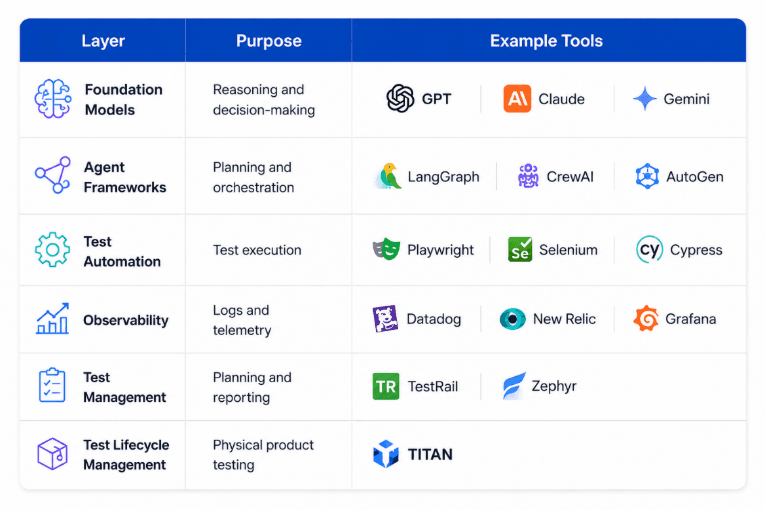
The Agentic Testing Stack
blog-agentic-testing-inside2-preprod.png

Together, these layers create an end-to-end quality ecosystem that combines intelligent decision-making, automated execution and continuous optimization.

Agentic Testing Tools in 2026

The agentic testing ecosystem continues to evolve as AI capabilities become more deeply integrated into quality engineering workflows. Most solutions fall into three categories.

1. AI-Native Testing Platforms

A new generation of testing platforms is being built around AI agents, natural language interactions and autonomous execution. These solutions focus on reducing script creation, maintenance effort and manual intervention throughout the testing lifecycle.

Examples: Momentic, KaneAI, Autify, Testim

2. Agent Frameworks

Agent frameworks provide the foundation for building autonomous testing workflows. They enable planning, memory management, tool integration and orchestration, allowing specialized agents to collaborate across complex testing scenarios.

Examples: LangGraph, CrewAI, AutoGen

3. Traditional Testing Tools with AI Capabilities

Established automation platforms are increasingly incorporating AI-driven features such as self-healing automation, intelligent test generation and defect prediction. These capabilities help teams enhance existing automation investments while introducing greater adaptability and efficiency.

Examples: Playwright, Selenium and Cypress ecosystems enhanced with AI extensions and integrations

Multi-Agent Testing Systems

As testing workflows become more complex, organizations are moving beyond single-agent architectures. Multi-agent systems use specialized AI agents that collaborate to improve scalability, coverage and decision-making across the testing lifecycle.

1. Planning Agent

The Planning Agent analyzes requirements, code changes and risk factors to determine what should be tested. It prioritizes test activities and coordinates workflows across the testing pipeline.

2. Execution Agent

The Execution Agent performs testing across web, mobile, API and infrastructure environments. It runs test scenarios, captures results and monitors application behaviour throughout execution.

3. Analysis Agent

The Analysis Agent investigates failures, correlates logs and telemetry, identifies probable root causes and generates actionable reports for QA and engineering teams.

Example: During a release cycle, the Planning Agent identifies impacted features, the Execution Agent validates them across multiple environments, and the Analysis Agent investigates failures and produces defect reports for developers.

Testing AI Applications and AI Agents

Agentic testing extends beyond traditional software validation. Organizations are increasingly testing AI-powered applications, copilots and autonomous agents that interact with users, tools and enterprise systems.

These systems introduce new quality considerations, including response accuracy, decision consistency, tool usage, safety controls and reliability across different scenarios. Teams must also account for risks such as hallucinations, prompt injection attacks and context limitations that can influence AI behaviour.

As AI adoption grows, testing strategies are evolving to evaluate application functionality, decision quality, output reliability and production trustworthiness.

Physical Product Testing: Where Test Lifecycle Management Fits

Agentic testing is often associated with software quality assurance, but many industries also manage complex physical testing programs. Automotive, aerospace and manufacturing organizations rely on structured testing processes to validate performance, reliability, safety and regulatory compliance throughout the product lifecycle.

1. Automotive and Aerospace Testing

Modern vehicles, aircraft systems and embedded technologies undergo extensive validation before deployment. Testing programs generate large volumes of requests, results, compliance records and certification data that must be managed efficiently across multiple teams and facilities.

2. Manufacturing and Industrial Testing

Industrial products require qualification, environmental, reliability and performance testing throughout development and production. As products become more connected and software-driven, coordinating testing activities, documentation and approvals becomes increasingly important.

As physical products become increasingly software-driven, organizations require greater visibility, traceability and coordination across testing workflows.

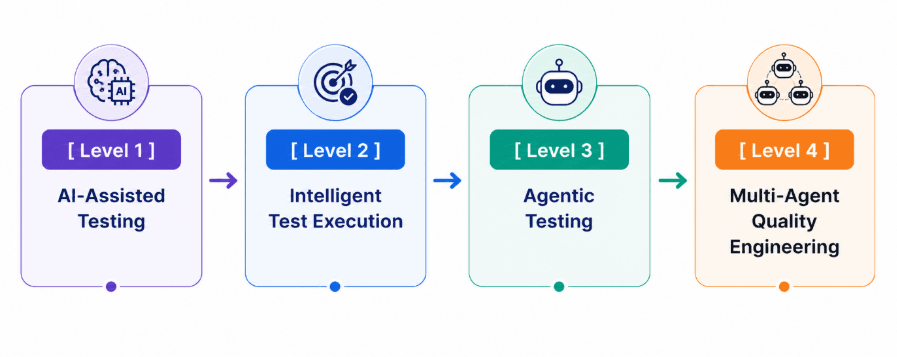
Agentic Testing Implementation Roadmap
blog-agentic-testing-insdie3-preprod.png

The Honest Limitations: When Agentic Testing Fails

Agentic testing can improve efficiency, coverage and automation maturity, but it is not immune to failure. Understanding its limitations is essential for successful adoption.

1. Hallucinated Decisions

AI agents can occasionally misinterpret requirements, generate incorrect assertions or make flawed testing decisions. Validation mechanisms are still required to ensure accuracy.

2. Context Constraints

Enterprise applications often span multiple systems, workflows and business rules. Agents may lack the complete context needed to evaluate complex scenarios consistently.

3. Security and Compliance Risks

Autonomous agents frequently interact with production-like environments, test data and enterprise systems. Strong governance controls are necessary to ensure security, auditability and regulatory compliance.

4. The Need for Human Oversight

Quality strategy, risk assessment, exploratory testing and final release decisions continue to require human judgment. Agentic testing enhances quality engineering workflows, but accountability remains with people.

Real-World Example: Agentic Testing in a SaaS CI/CD Pipeline

Consider a SaaS platform releasing updates multiple times per week. When a developer commits new code, an AI agent analyzes the change, identifies affected functionality and selects the most relevant test scenarios. The agent executes validation across web, API and integration layers, investigates failures, generates contextual defect reports and updates regression coverage based on the latest application behaviour.

This creates a continuous quality workflow that delivers faster feedback, reduces manual effort and helps teams maintain confidence as release velocity increases.

Final Thoughts

Agentic testing is reshaping how modern engineering teams approach quality. AI agents can generate tests, prioritize execution, maintain automation suites, investigate failures and accelerate defect analysis, helping organizations improve both speed and coverage across the software delivery lifecycle.

The opportunity lies in building intelligent quality systems that continuously adapt, learn and scale alongside increasingly complex applications, faster release cycles and growing business expectations. As software engineering enters the era of autonomous systems, organizations that embrace agentic testing will be better positioned to deliver quality at scale without increasing operational overhead.

At 12th Wonder, we help enterprises build modern quality engineering capabilities that combine AI-driven testing, engineering governance and scalable delivery practices.

FAQ

1. What is agentic testing in QA and software testing?

Agentic testing uses autonomous AI agents that can plan, execute, maintain and optimize testing activities with minimal human intervention.

2. How is agentic testing different from traditional automation testing?

Traditional automation follows predefined scripts, while agentic testing adapts dynamically to application changes and testing objectives.

3. How is agentic testing different from AI-assisted testing?

AI-assisted testing supports human testers, whereas agentic testing enables autonomous agents to make decisions and perform testing workflows independently.

4. What are the best agentic testing tools in 2026?

The market includes AI-native testing platforms, agent frameworks and traditional testing solutions that incorporate autonomous capabilities.

5. Is agentic testing replacing QA engineers and SDETs?

No. QA professionals are evolving into quality orchestrators who govern, validate and optimize autonomous testing systems.

6. What are the biggest limitations and challenges of agentic testing?

Common challenges include hallucinations, context limitations, governance concerns, compliance requirements and the need for continued human oversight.

Request Demo

Build Autonomous Testing Capabilities That Scale

Combine AI-driven testing, engineering governance and deliver software faster.

Recent Blogs

What is MCP blog cover — Model Context Protocol connecting AI agents to enterprise systems through standardised integration

What Is MCP? Understanding the Model Context Protocol for Enterprise AI

AI agents are rapidly becoming part of the enterprise technology stack. Organizations are deploying engineering copilots, customer

Read more...
AI agents for enterprise GIS visual Agentic GeoAI combining LLMs, spatial reasoning and multi-agent systems in 2026

Agentic GeoAI: AI Agents Transforming Enterprise GIS Workflows (2026)

A flood warning is issued. By the time analysts collect satellite imagery, run spatial models, validate results and distribute reports,

Read more...
Frontier AI Models guide cover image

Frontier AI Models Guide: OpenAI vs Claude vs Gemini (2026)

Every major AI provider is promising to be your enterprise AI platform. Many organizations initially evaluat

Read more...
Enterprise AI agent platform comparison illustration — build vs buy decision framework for 2026 with hybrid architecture.

Build vs Buy: AI Agent Platforms Compared (2026)

Enterprise AI has evolved beyond simple chatbots into operational ecosystems capable of workflow automation, system integration, and real-time decision-making

Read more...
Claude Fable 5 illustration, Anthropic's Mythos-class AI model for autonomous workflows and enterprise use

Claude Fable 5: The Mythos-Class AI Model You Can Use in 2026

Anthropic's Claude Fable 5 is the first publicly available Mythos-class AI model, representing a significant step beyond traditional AI assistants.

Read more...
Multi-agent systems blog thumbnail — 2026 enterprise guide to multi-agent AI

Multi-Agent Systems for Business: A Practical Enterprise Guide (2026)

Enterprise AI is quietly moving away from the idea of one system doing everything. The future of enterprise AI is increasingly being shaped by coordinated intelligence

Read more...
Blog cover

AI Agent Security: Defending Against Prompt Injection in Enterprise AI Systems

The rate of adoption of autonomous AI agents by businesses is growing quickly. Autonomous AI agents have become commonplace, where they are being used to automate workflows, engage with customers,

Read more...
AI agent ROI blog thumbnail — how to measure AI value before you build

AI Agent ROI: How to Measure It Before You Build

What was once considered cutting-edge technology reserved for large tech firms has now become part of everyday business operations

Read more...
Blog cover

RAG Explained: The Complete Guide to Retrieval-Augmented Generation for Enterprise AI (2026)

Somewhere in your organization right now, an AI assistant just answered a question with complete confidence and complete inaccuracy. It cited a policy from two years ago, a product that was discontinued last quarter,

Read more...
Blog cover

EU AI Act Compliance Checklist: Everything Enterprises Need to Know Before 2027

AI governance has moved from a boardroom discussion to a legal obligation. The EU AI Act is the most comprehensive artificial intelligence policy framework enacted anywhere in the world and enforcement is already underway.

Read more...
Blog cover

Small Language Models vs LLMs: A Practical Guide to Choosing the Right AI Model for Your Business

The conversation around enterprise AI in 2026 has shifted. While large language models like GPT-4 and Claude still dominate headlines, a quieter revolution is happening at the edge.

Read more...
Blog cover

How to Build an AI Agent for Your Business: A Practical Guide (2026)

AI agents are no longer a future-facing experiment. Businesses across industries are using them to handle real workflows right now, and the

Read more...
Blog cover

AI and the Energy Crisis: How Data Centers Are Reshaping the Global Power Grid in 2026

AI data center energy consumption has become one of the defining infrastructure challenges of this decade. The numbers are no longer abstract.

Read more...
Blog cover

AI in the Supply Chain: Where Value Is Actually Created

AI adoption across supply chains is accelerating. Investment is growing, pilots are expanding, and technical capability is improving quickly.

Read more...
Blog cover

Vibe Coding in 2026: The Complete Guide to AI-Powered Development

Vibe coding is a natural-language-first approach to software development where you describe what you want in plain English and AI generates functional code for you.

Read more...
Blog cover

AI Trends in 2026: 7 Predictions That Will Reshape Every Industry

The most important AI predictions for 2026, agents, generative AI, industry transformation, governance and what's next. A practical guide for business and technology leaders.

Read more...
Blog cover

Real-Time Visibility in Logistics: Why Your Architecture Is Costing You More Than You Think

Here is a number worth pausing on: 45% of logistics organizations have real-time visibility into fewer than half their shipments.

Read more...
Blog cover

Why Field Operations Break When You Can’t See Them on a Map

Field operations rarely fail because teams are not working hard enough. They fail when leaders lose visibility into what is happening, where it is happening, and why.

Read more...
Blog cover

What Your GIS Data Actually Needs for GeoAI

We examined why many GeoAI projects fail before they even get started in the previous blog. Let's now discuss what makes GeoAI function in the real world.

Read more...
Why GeoAI projects fail blog banner — common reasons GeoAI initiatives stall before launch

Why GeoAI Projects Fail Before They Even Start

GeoAI is currently omnipresent. In order to anticipate failures, automate decision-making, and make sense of intricate networks, utilities,

Read more...
GIS drone mapping blog banner — drones powering real-time geospatial intelligence

GIS Drone Mapping: How Drones Are Powering the Next Era of Real-Time Geospatial Intelligence

GIS drone mapping is rapidly transforming how organizations collect, analyze, and act on geospatial data.

Read more...
Blog cover

Digital Twins & 3D GIS Modeling: Global Benefits, Challenges & Solutions

Digital twins and 3D GIS modeling are redefining how organizations plan, operate, and maintain physical asset

Read more...
Blog cover

GeoAI Explained: How Geospatial AI is Solving Real-World Challenges in the U.S.

GeoAI: short for Geospatial Artificial Intelligence is the convergence of geospatial data (location, maps, remote sensing, GPS, GIS systems)

Read more...
Blog cover

The ROI of Implementing a GIS Solution: A Business Case Study Approach

Relying on fragmented data and outdated mapping tools is no longer sustainable for organizations navigating complex,

Read more...
Blog cover

Building a Future-Ready Telecom Data Migration Framework: Tools, Automation, and Real-World Lessons

Telecom data migration is not just about moving data it's about ensuring scalability, security,

Read more...
Blog cover

The Telecom Data Migration Imperative: Challenges, Best Practices & Future-Ready Strategies

As telecom networks rapidly evolve from 4G to 5G and legacy OSS/BSS stacks shift

Read more...
Blog cover

Top 7 Emerging AI Trends to Watch in 2025

Pushing deeper into 2025, artificial intelligence continues to sprint from being a promising tool to

Read more...
Blog cover

Geospatial Revolution: Top 10 Industries Benefiting from GIS

Geographic Information Systems (GIS) have emerged as a powerful tool for businesses and organizations across various sectors.

Read more...
Blog cover

Empowering Smarter Cities: The Role of Geospatial Digital Twins in Urban Planning

Geographic Information Systems (GIS) have emerged as a powerful tool for businesses and organizations across various sectors.

Read more...
Blog cover

Enhancing Customer Experience with Location-Based Services Powered by GIS

Customer experience has emerged as a key differentiator for organizations across industries be it in utilities, retail or public services.

Read more...
Blog cover

Transforming Field Operations with Mobile GIS

Be it in utilities, transportation, or environmental management, field operations are complex and challenging.

Read more...
Blog cover

Emerging trends in GIS: Navigating the geospatial landscape

GIS or Geographical information systems has helped turn maps into advanced tools for problem-solving.

Read more...
Blog cover

How GIS is transforming predictive maintenance in the utility sector

The utility sector is the backbone of the modern economy providing vital services like electricity, water, and gas to people and businesses.

Read more...
Blog cover

Case study spotlight: Streamlining HFC network management with GIS for a US-based Telecom Service Provider

GIS (Geographical Information System) has been crucial to the growth of the telecom sector, providing invaluable geospatial data that benefits even

Read more...
Blog cover

GIS In Action: Real-World Examples of How It's Used

Geographic Information Systems (GIS) have become indispensable tools across a multitude of industries, revolutionizing the way we understand, analyze, and interact with spatial data.

Read more...
Blog cover

Case Study Spotlight: Revolutionizing Utility Asset Management

At 12th Wonder, we are transforming the way utility companies manage their assets. In one of our recent projects, we partnered with a leading utility

Read more...
Blog cover

The Cutting-Edge Benefits of GIS For Telecom Networks

Geographic Information Systems (GIS) are making a big impact in the telecommunications world. Think of GIS as a powerful tool that transforms heaps of data into clear, useful maps.

Read more...
Blog cover

What is Mobile GIS? Here’s what you should know.

The world of Geographic Information Systems (GIS) is changing quickly, and mobile GIS is leading the way. At 12thWonder, we’re using this exciting technology to transform how field data

Read more...
Blog cover

A mix of Introductory and Advanced Geospatial Solutions: 12W's Approach

Geospatial solutions are revolutionizing the way we understand and interact with the space around us. We are at the forefront of this transformative wave, a company that has seamlessly integrated technology

Read more...
Blog cover

The Importance of Data Interoperability in Today’s Geospatial Solutions

Have you ever wondered what makes the digital world tick seamlessly? It’s the magic of data interoperability, especially in the realm of geospatial solutions.

Read more...
Blog cover

Leading Top 10 Best Geospatial Companies

This guide highlights the top 15 GIS (Geographic Information Systems) companies leading the way with their cutting-edge solutions in mapping and spatial analysis.

Read more...
Blog cover

Getting Started in QA Test Automation: Essential Tips for Beginners

Starting on the journey of Quality Assurance (QA) test automation can be both exciting and challenging, especially for companies taking their first steps in this domain.

Read more...
Blog cover

How to Choose the Right QA Services Provider for Your Business: Including a Checklist

In today’s competitive market, software quality assurance (QA) is vital for ensuring robust, reliable, and high-performing software solutions.

Read more...
Blog cover

Solve Your Business Challenges with 12th Wonder's Tailored Digital Transformation Solutions!

Ready to elevate your business with cutting-edge digital solutions? At 12th Wonder we offer a suite of innovative software services. Our goal is to empower your workforce and lead your business towards

Read more...
Blog cover

Integrating QA Test Automation and Manual Testing: A Balanced Approach in Software Development

In software development, you can achieving the highest quality of product by using a strategic blend of both QA test automation and manual testing. While automation is offers speed and repeatability

Read more...
Blog cover

5 Ways QA Automation Can Transform Your Business

Staying ahead of the competition requires including innovative approaches to improve efficiency and quality. This is where QA automation comes into play.

Read more...
Blog cover

Dictionary of GIS Terms

Aerial Photography Mapping: The creation of maps based on the interpretation and analysis of aerial photographs, utilizing differences in vantage points and angles to construct detailed

Read more...
Blog cover

Leading Top 15 Best Software Testing & Quality Assurance Global Companies

This guide highlights the top 15 software testing companies that consistently deliver high value from small, mighty teams. It emphasizes the critical role of QA testing in ensuring software quality

Read more...
Blog cover

Maximizing Business Value: The Transformative Power of Automation in Quality Assurance Services

The integration of automation in Quality Assurance (QA) services has transformed industries by enhancing efficiency, accuracy, and cost-effectiveness.

Read more...
Blog cover

Navigating the Pitfalls of Application Development: How We Ensure a Smooth Journey

The process of application development can be both exciting and daunting. From the spark of an idea to the polished end product, there are numerous stages where errors might occur.

Read more...
Blog cover

Quality Assurance Redefined: Your Path to Success with 12thWonder

Are you ready for help with ensuring the highest quality for your products? Collaborating with 12thWonder for Quality Assurance (QA) services opens the door to a transformative experience that

Read more...
Blog cover

Streamline Your Testing Process with 12th Wonder's Test Automation Services

In this ever-evolving world of software development, where changes happen at the drop of a hat, ensuring quality, speed, and reliability is absolutely essential.

Read more...
Blog cover

7 Ways QA Services Can Reduce Costs in Software Development

In today’s fast-paced world of software development, your company faces a myriad of challenges. Balancing quality and cost-effectiveness is a perpetual struggle.

Read more...