

The Agentic AI Production Readiness Checklist: 21 Checks Before Deployment

Author

Author

Veera Nagi Reddy Mekala

Director of Tech. Innovation

Agentic AI production readiness checklist covering reliability, security, observability, cost, governance and rollback controls

The Agentic AI Production Readiness Checklist: 21 Checks Before Deployment

A procurement AI agent receives an incomplete supplier record. Instead of stopping, it fills in the missing delivery terms, retries the same tool several times and creates a purchase order using incorrect information. The supplier ships the wrong quantity to the wrong facility, delaying production and forcing the procurement team to rebuild the order.

This scenario shows how incomplete data can become an operational disruption when an agent is allowed to assume missing information and continue acting. Production systems introduce unclear requests, delayed APIs, conflicting records and tool failures.

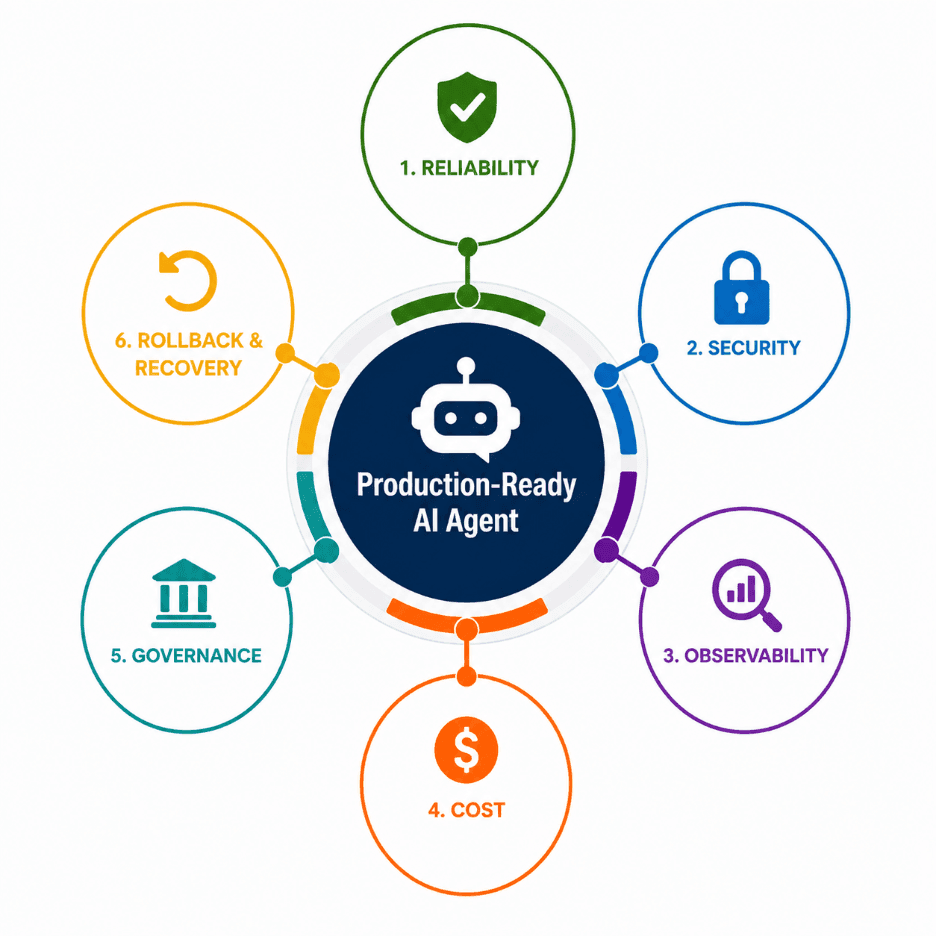
A well-designed agentic AI production checklist converts these risks into controls that engineering teams can test before deployment, including reliability, security, observability, cost, governance and recovery.

Why AI Agent Demos Fail in Production

AI agent demos usually operate with clean inputs, stable integrations and close supervision. Production systems do not. Inputs arrive incomplete, APIs time out, permissions change and downstream actions can alter business records, trigger transactions or affect customer-facing systems.

A user may omit a required field. An API may return an incomplete response. Two systems may provide conflicting information. Broad permissions can increase the impact of an agent error action while weak tracing makes the incident difficult to investigate.

Successful AI agent production deployment requires evidence that the system can recognize uncertainty, stop safely and escalate when human review is required.
blog-agentic-AI-production-inside1-preprod.png

1. Reliability Readiness

A reliable agent must know when to proceed, when to retry and when incomplete evidence should trigger escalation.

Check 1: Define Measurable Success Criteria

Set clear thresholds for success, failure and escalation before deployment. Test the agent against representative tasks, edge cases and known failure scenarios. If performance is described with vague claims such as “usually works,” the reliability standard is not measurable.

Check 2: Test Beyond the Happy Path

Evaluate how the agent responds to incomplete, conflicting, invalid and adversarial inputs. Remove required fields, provide unclear instructions and disable a critical tool during testing. If the agent invents information or continues without enough evidence, it is not ready for production.

Check 3: Set Execution Limits

Define limits for steps, retries, tool calls and execution time. Monitor repeated actions and unchanged workflow states so loops can be detected before the maximum limit is reached. Give the agent an unresolvable task and confirm that it stops safely. If it repeats the same tool call, revisits the same state or continues without progress, the execution controls are insufficient.

Check 4: Validate Tool Responses

Check the status, structure and completeness of every tool response before the agent uses it. Test empty delayed and malformed outputs to confirm that invalid data is rejected. If incomplete information moves into the next action, the workflow should not be released.

These controls should be introduced during development using the processes covered in the Build an AI Agent blog.

2. Security Readiness

A secure agent must treat user input, retrieved documents, emails, webpages, tool responses and messages from other agents as untrusted until validated. Security testing should confirm that external content cannot alter system behaviour, expand permissions or move sensitive data beyond approved boundaries.

Check 5: Test Prompt Injection

Insert malicious instructions into every untrusted source covered in the Prompt Injection and AI Agent Security blog. Test whether the content can change the agent’s objective, trigger unauthorized tool calls, exfiltrate data, bypass approval checkpoints or manipulate downstream agents. Deployment should be blocked if injected content can influence execution beyond the approved workflow.

Check 6: Apply Least-Privilege Access

Give the agent access only to the tools, records and actions required for its assigned task. Attempt unrelated reads, writes and administrative operations. If the agent can access unnecessary data or modify systems outside its scope, permissions are too broad.

Check 7: Restrict Tool and MCP Permissions

Define access rules for every MCP server, tool, resource and operation using the controls explained in the What Is MCP? blog. Review permissions by user, environment and action. Any MCP connection that grants broader access than the workflow requires should fail the readiness review.

Check 8: Protect Credentials and Sensitive Data

Keep API keys, secrets and protected information out of prompts, outputs, traces and debugging records. Inspect logs, error messages and tool responses during testing. If confidential data becomes model-visible or appears in monitoring systems, the security controls are incomplete.

3. Observability Readiness

Observability should provide enough evidence to explain, trace and reproduce every agent workflow.

Check 9: Trace Every Run with a Unique ID

Record model calls, tool actions, retries, latency, approvals and outcomes under one run identifier. Reconstruct a failed workflow across all connected systems. If related logs cannot be linked or the decision path is missing, observability is incomplete.

The same tracing standard should apply to every agent and tool in the workflow, particularly in the architectures covered in the Multi-Agent Systems guide.

Check 10: Monitor Operational Metrics

Track failure rate, timeout rate, retries, escalations, incomplete tasks and latency. Introduce a controlled failure and confirm that dashboards and alerts respond. Monitoring should detect defined critical failures before they propagate through the workflow or affect a significant number of users.

Check 11: Preserve Replayable Evidence

Retain the original input, configuration and tool responses needed to replay incidents safely. If the team cannot reproduce a failure under controlled conditions, root-cause analysis will remain unreliable.

4. Cost Readiness

Agent cost includes model inference, external API calls, search, compute, storage, monitoring, human review and failed retries. Teams should calculate the full cost of completing each workflow, including unsuccessful runs, rather than tracking model spend alone. This reveals which agents remain economically viable as usage, context size and tool activity increase.

Check 12: Set a Workflow Cost Budget

Define average and high-percentile cost limits for each use case. Test the agent across realistic workloads and measure model and tool usage. If teams can only see total monthly spending, cost control is not detailed enough.

Check 13: Limit Retries and Context Growth

Set limits for retries prompt size and context length. Simulate tool downtime and oversized inputs to confirm that the agent stops safely. If one failed task triggers repeated calls or unnecessary context growth, the workflow is not cost-ready.

Check 14: Verify Workflow Cost Sustainability

Define an acceptable cost range for successful runs, failed runs and high-volume usage. Include model inference, external APIs, search, compute, storage, monitoring, human review and retries in the calculation. Test the workflow under realistic load and failure conditions. If costs exceed the approved budget, vary unpredictably or cannot be traced to specific steps, the agent is not cost-ready for production.

5. Governance Readiness

AI agent governance should establish ownership, operating boundaries and accountability for production decisions.

Check 15: Assign a Production Owner

Name one accountable owner for the agent’s behaviour, risks and incidents. Confirm who can approve changes, stop a release and accept remaining risk. If no one owns the final deployment decision, the agent is not ready for production.

Check 16: Define Action Boundaries and Approval Requirements

Document permitted, prohibited and approval-gated actions. Compare the written policy with the agent’s actual tools, permissions and system access.

Test a protected action in staging and confirm that the workflow pauses for human or policy approval. Deployment should be blocked if written rules do not match actual permissions or the agent can perform high-impact actions independently.

Check 17: Track Configurations and Audit Records

Link each run to the model, prompt, tools, policies and approver involved. Review a past action and identify the exact configuration used. If the cause of a behavioural change cannot be traced, the audit record is insufficient.
blog-agentic-AI-production-inside2-preprod.png

6. Rollback and Recovery Readiness

Production-ready AI agents must be easy to stop and recover when they update records, trigger transactions or communicate with external systems.

Check 18: Implement a Complete Kill Switch

The kill switch should stop new requests, queued jobs, scheduled tasks and pending actions across the workflow. Test it in staging and confirm that no background process continues. If the interface stops while actions still run, the control is incomplete.

Check 19: Separate Decisions from Execution

The model should propose actions through structured output. A separate execution layer must validate permissions, policy rules and approvals before calling any tool.

Test this by submitting an action that violates one control. If the system still updates records, triggers transactions or contacts external systems, the architecture is not production-ready.

Check 20: Make Critical Actions Reversible

Any action that changes business data should have a rollback or compensating process. Test whether a transaction can be reversed or a previous record restored. If the original state cannot be recovered, the workflow is not production-ready.

Check 21: Maintain a Tested Fallback

The business process should continue when the agent is unavailable. Test a human workflow, deterministic system or previous agent version using the same task context. If an outage stops the full process, the fallback has not been validated.

Conclusion: Production Readiness Must Be Proven

A working AI agent demo proves that the idea is possible. Production readiness requires evidence that the agent can handle uncertain inputs, tool failures, security threats and operational disruptions without creating unacceptable business risk.

Before deployment, engineering teams should classify findings by severity, likelihood and business impact. Critical security, control or recovery gaps should block release, while lower-risk issues may proceed with documented remediation, monitoring and accountable ownership.

A structured agentic AI production checklist turns readiness into an evidence-based decision. 12th Wonder helps enterprises move AI agents from controlled prototypes to production workflows by designing the evaluation, security, observability, governance and recovery controls required for deployment.

FAQ

An agentic AI production checklist evaluates the reliability, security, observability, cost, governance and recovery controls required before deployment.

Ready to Move Your AI Agent into Production?

12th Wonder helps enterprises design, test and govern production-ready AI agents with controls that support safe and accountable deployment.

Talk to an Expert

Recent Blogs

AI ROI measurement framework showing three units: workflow improvement, business outcomes and organisational capacity

Beyond Time Saved: How to Measure AI ROI

An AI assistant reviews a 60-page supplier contract in five minutes instead of an hour. The dashboard records 55 minutes saved

Read more...
Will data centres become the biggest bottleneck in AI blog cover 12th Wonder guide to enterprise infrastructure scaling

Will Data Centres Become the Biggest Bottleneck in AI?

AI demand is driving one of the largest expansions of computing infrastructure in recent history. According to a Reuters report published in July 2026, Hut 8 signed a $9.8 billion lease

Read more...
Start with pgvector blog cover enterprise RAG vector database comparison of pgvector, Pinecone, Milvus and OpenSearch in 2026

Start with pgvector: When Enterprise RAG Needs a Dedicated Vector Database

A RAG system can have a powerful LLM and still fail because the retrieval layer brings the wrong context.

Read more...
Enterprise AI architecture showing Retrieval-Augmented Generation (RAG) versus fine-tuning for building scalable, accurate, and domain-specific LLM applications.

RAG vs Fine-Tuning: Which Approach Fits Your Enterprise Use Case?

In 2025, enterprise AI moved beyond experimentation and into real business workflows. McKinsey reported that 71% of organizations

Read more...
Illustration of enterprise AI observability showing LLM evaluation metrics, prompt monitoring, latency, hallucination detection, and model performance dashboards.

Beyond Model Accuracy: LLM Evaluation and Observability for Business AI

Organizations are moving beyond asking "Can we build it?" and increasingly asking "Can we trust it in production?

Read more...
Spatial RAG architecture connecting GIS data, spatial retrieval, and large language models (LLMs) for accurate GeoAI and enterprise spatial reasoning.

Spatial RAG: The Missing Layer Between GIS Data and LLMs

Ask an LLM which substations are inside a flood zone, and it may answer confidently without performing a spatial query.

Read more...
Agentic testing 2026 guide blog cover AI agents autonomously planning, executing and maintaining software testing workflows

Agentic Testing: The Complete 2026 Guide to Autonomous Software Testing

Traditional test automation helped teams scale quality, but modern applications are evolving faster than many automation frameworks

Read more...
What is MCP blog cover — Model Context Protocol connecting AI agents to enterprise systems through standardised integration

What Is MCP? Understanding the Model Context Protocol for Enterprise AI

AI agents are rapidly becoming part of the enterprise technology stack. Organizations are deploying engineering copilots, customer

Read more...
AI agents for enterprise GIS visual Agentic GeoAI combining LLMs, spatial reasoning and multi-agent systems in 2026

Agentic GeoAI: AI Agents Transforming Enterprise GIS Workflows (2026)

A flood warning is issued. By the time analysts collect satellite imagery, run spatial models, validate results and distribute reports,

Read more...
Frontier AI Models guide cover image

Frontier AI Models Guide: OpenAI vs Claude vs Gemini (2026)

Every major AI provider is promising to be your enterprise AI platform. Many organizations initially evaluat

Read more...
Enterprise AI agent platform comparison illustration — build vs buy decision framework for 2026 with hybrid architecture.

Build vs Buy: AI Agent Platforms Compared (2026)

Enterprise AI has evolved beyond simple chatbots into operational ecosystems capable of workflow automation, system integration, and real-time decision-making

Read more...
Claude Fable 5 illustration, Anthropic's Mythos-class AI model for autonomous workflows and enterprise use

Claude Fable 5: The Mythos-Class AI Model You Can Use in 2026

Anthropic's Claude Fable 5 is the first publicly available Mythos-class AI model, representing a significant step beyond traditional AI assistants.

Read more...
Multi-agent systems blog thumbnail — 2026 enterprise guide to multi-agent AI

Multi-Agent Systems for Business: A Practical Enterprise Guide (2026)

Enterprise AI is quietly moving away from the idea of one system doing everything. The future of enterprise AI is increasingly being shaped by coordinated intelligence

Read more...
AI agent ROI blog thumbnail — how to measure AI value before you build

AI Agent ROI: How to Measure It Before You Build

What was once considered cutting-edge technology reserved for large tech firms has now become part of everyday business operations

Read more...
Blog cover

AI Agent Security: Defending Against Prompt Injection in Enterprise AI Systems

The rate of adoption of autonomous AI agents by businesses is growing quickly. Autonomous AI agents have become commonplace, where they are being used to automate workflows, engage with customers,

Read more...
Blog cover

RAG Explained: The Complete Guide to Retrieval-Augmented Generation for Enterprise AI (2026)

Somewhere in your organization right now, an AI assistant just answered a question with complete confidence and complete inaccuracy. It cited a policy from two years ago, a product that was discontinued last quarter,

Read more...
Blog cover

EU AI Act Compliance Checklist: Everything Enterprises Need to Know Before 2027

AI governance has moved from a boardroom discussion to a legal obligation. The EU AI Act is the most comprehensive artificial intelligence policy framework enacted anywhere in the world and enforcement is already underway.

Read more...
Blog cover

Small Language Models vs LLMs: A Practical Guide to Choosing the Right AI Model for Your Business

The conversation around enterprise AI in 2026 has shifted. While large language models like GPT-4 and Claude still dominate headlines, a quieter revolution is happening at the edge.

Read more...
Blog cover

How to Build an AI Agent for Your Business: A Practical Guide (2026)

AI agents are no longer a future-facing experiment. Businesses across industries are using them to handle real workflows right now, and the
Read more...
Blog cover

AI and the Energy Crisis: How Data Centers Are Reshaping the Global Power Grid in 2026

AI data center energy consumption has become one of the defining infrastructure challenges of this decade. The numbers are no longer abstract.

Read more...
Blog cover

AI in the Supply Chain: Where Value Is Actually Created

AI adoption across supply chains is accelerating. Investment is growing, pilots are expanding, and technical capability is improving quickly.

Read more...
Blog cover

Vibe Coding in 2026: The Complete Guide to AI-Powered Development

Vibe coding is a natural-language-first approach to software development where you describe what you want in plain English and AI generates functional code for you.

Read more...
Blog cover

AI Trends in 2026: 7 Predictions That Will Reshape Every Industry

The most important AI predictions for 2026, agents, generative AI, industry transformation, governance and what's next. A practical guide for business and technology leaders.

Read more...
Blog cover

Real-Time Visibility in Logistics: Why Your Architecture Is Costing You More Than You Think

Here is a number worth pausing on: 45% of logistics organizations have real-time visibility into fewer than half their shipments.

Read more...
Blog cover

Why Field Operations Break When You Can’t See Them on a Map

Field operations rarely fail because teams are not working hard enough. They fail when leaders lose visibility into what is happening, where it is happening, and why.

Read more...
Blog cover

What Your GIS Data Actually Needs for GeoAI

We examined why many GeoAI projects fail before they even get started in the previous blog. Let's now discuss what makes GeoAI function in the real world.

Read more...
Why GeoAI projects fail blog banner — common reasons GeoAI initiatives stall before launch

Why GeoAI Projects Fail Before They Even Start

GeoAI is currently omnipresent. In order to anticipate failures, automate decision-making, and make sense of intricate networks, utilities,
Read more...
GIS drone mapping blog banner — drones powering real-time geospatial intelligence

GIS Drone Mapping: How Drones Are Powering the Next Era of Real-Time Geospatial Intelligence

GIS drone mapping is rapidly transforming how organizations collect, analyze, and act on geospatial data.

Read more...
Blog cover

Digital Twins & 3D GIS Modeling: Global Benefits, Challenges & Solutions

Digital twins and 3D GIS modeling are redefining how organizations plan, operate, and maintain physical asset

Read more...
Blog cover

GeoAI Explained: How Geospatial AI is Solving Real-World Challenges in the U.S.

GeoAI: short for Geospatial Artificial Intelligence is the convergence of geospatial data (location, maps, remote sensing, GPS, GIS systems)

Read more...
Blog cover

The ROI of Implementing a GIS Solution: A Business Case Study Approach

Relying on fragmented data and outdated mapping tools is no longer sustainable for organizations navigating complex,

Read more...
Blog cover

Building a Future-Ready Telecom Data Migration Framework: Tools, Automation, and Real-World Lessons

Telecom data migration is not just about moving data it's about ensuring scalability, security,

Read more...
Blog cover

The Telecom Data Migration Imperative: Challenges, Best Practices & Future-Ready Strategies

As telecom networks rapidly evolve from 4G to 5G and legacy OSS/BSS stacks shift

Read more...
Blog cover

Top 7 Emerging AI Trends to Watch in 2025

Pushing deeper into 2025, artificial intelligence continues to sprint from being a promising tool to

Read more...
Blog cover

Geospatial Revolution: Top 10 Industries Benefiting from GIS

Geographic Information Systems (GIS) have emerged as a powerful tool for businesses and organizations across various sectors.

Read more...
Blog cover

Empowering Smarter Cities: The Role of Geospatial Digital Twins in Urban Planning

Geographic Information Systems (GIS) have emerged as a powerful tool for businesses and organizations across various sectors.

Read more...
Blog cover

Enhancing Customer Experience with Location-Based Services Powered by GIS

Customer experience has emerged as a key differentiator for organizations across industries be it in utilities, retail or public services.

Read more...
Blog cover

Transforming Field Operations with Mobile GIS

Be it in utilities, transportation, or environmental management, field operations are complex and challenging.

Read more...
Blog cover

Emerging trends in GIS: Navigating the geospatial landscape

GIS or Geographical information systems has helped turn maps into advanced tools for problem-solving.

Read more...
Blog cover

How GIS is transforming predictive maintenance in the utility sector

The utility sector is the backbone of the modern economy providing vital services like electricity, water, and gas to people and businesses.

Read more...
Blog cover

Case study spotlight: Streamlining HFC network management with GIS for a US-based Telecom Service Provider

GIS (Geographical Information System) has been crucial to the growth of the telecom sector, providing invaluable geospatial data that benefits even

Read more...
Blog cover

GIS In Action: Real-World Examples of How It's Used

Geographic Information Systems (GIS) have become indispensable tools across a multitude of industries, revolutionizing the way we understand, analyze, and interact with spatial data.

Read more...
Blog cover

Case Study Spotlight: Revolutionizing Utility Asset Management

At 12th Wonder, we are transforming the way utility companies manage their assets. In one of our recent projects, we partnered with a leading utility

Read more...
Blog cover

The Cutting-Edge Benefits of GIS For Telecom Networks

Geographic Information Systems (GIS) are making a big impact in the telecommunications world. Think of GIS as a powerful tool that transforms heaps of data into clear, useful maps.

Read more...
Blog cover

What is Mobile GIS? Here’s what you should know.

The world of Geographic Information Systems (GIS) is changing quickly, and mobile GIS is leading the way. At 12thWonder, we’re using this exciting technology to transform how field data

Read more...
Blog cover

A mix of Introductory and Advanced Geospatial Solutions: 12W's Approach

Geospatial solutions are revolutionizing the way we understand and interact with the space around us. We are at the forefront of this transformative wave, a company that has seamlessly integrated technology

Read more...
Blog cover

The Importance of Data Interoperability in Today’s Geospatial Solutions

Have you ever wondered what makes the digital world tick seamlessly? It’s the magic of data interoperability, especially in the realm of geospatial solutions.

Read more...
Blog cover

Leading Top 10 Best Geospatial Companies

This guide highlights the top 15 GIS (Geographic Information Systems) companies leading the way with their cutting-edge solutions in mapping and spatial analysis.

Read more...
Blog cover

Getting Started in QA Test Automation: Essential Tips for Beginners

Starting on the journey of Quality Assurance (QA) test automation can be both exciting and challenging, especially for companies taking their first steps in this domain.

Read more...
Blog cover

How to Choose the Right QA Services Provider for Your Business: Including a Checklist

In today’s competitive market, software quality assurance (QA) is vital for ensuring robust, reliable, and high-performing software solutions.

Read more...
Blog cover

Solve Your Business Challenges with 12th Wonder's Tailored Digital Transformation Solutions!

Ready to elevate your business with cutting-edge digital solutions? At 12th Wonder we offer a suite of innovative software services. Our goal is to empower your workforce and lead your business towards

Read more...
Blog cover

Integrating QA Test Automation and Manual Testing: A Balanced Approach in Software Development

In software development, you can achieving the highest quality of product by using a strategic blend of both QA test automation and manual testing. While automation is offers speed and repeatability

Read more...
Blog cover

5 Ways QA Automation Can Transform Your Business

Staying ahead of the competition requires including innovative approaches to improve efficiency and quality. This is where QA automation comes into play.

Read more...
Blog cover

Dictionary of GIS Terms

Aerial Photography Mapping: The creation of maps based on the interpretation and analysis of aerial photographs, utilizing differences in vantage points and angles to construct detailed

Read more...
Blog cover

Leading Top 15 Best Software Testing & Quality Assurance Global Companies

This guide highlights the top 15 software testing companies that consistently deliver high value from small, mighty teams. It emphasizes the critical role of QA testing in ensuring software quality

Read more...
Blog cover

Maximizing Business Value: The Transformative Power of Automation in Quality Assurance Services

The integration of automation in Quality Assurance (QA) services has transformed industries by enhancing efficiency, accuracy, and cost-effectiveness.

Read more...
Blog cover

Navigating the Pitfalls of Application Development: How We Ensure a Smooth Journey

The process of application development can be both exciting and daunting. From the spark of an idea to the polished end product, there are numerous stages where errors might occur.

Read more...
Blog cover

Quality Assurance Redefined: Your Path to Success with 12thWonder

Are you ready for help with ensuring the highest quality for your products? Collaborating with 12thWonder for Quality Assurance (QA) services opens the door to a transformative experience that

Read more...
Blog cover

Streamline Your Testing Process with 12th Wonder's Test Automation Services

In this ever-evolving world of software development, where changes happen at the drop of a hat, ensuring quality, speed, and reliability is absolutely essential.

Read more...
Blog cover

7 Ways QA Services Can Reduce Costs in Software Development

In today’s fast-paced world of software development, your company faces a myriad of challenges. Balancing quality and cost-effectiveness is a perpetual struggle.

Read more...