

Build vs Buy: AI Agent Platforms Compared (2026)
Enterprise AI has evolved beyond simple chatbots into operational ecosystems capable of workflow automation, system integration, and real-time decision-making. By 2026, organizations are increasingly adopting hybrid AI models that combine commercial AI platforms with proprietary workflows, orchestration, and intelligence layers.
The real enterprise challenge is no longer whether to build or buy AI agents but determining which AI capabilities should be standardized and which should remain proprietary for long-term competitive advantage. While platforms such as Microsoft Copilot Studio, Google Vertex AI, OpenAI Agents, Salesforce Agentforce, Amazon Bedrock Agents and ServiceNow AI Agent Studio provide foundational infrastructure, enterprise differentiation increasingly comes from proprietary workflows, domain intelligence, and custom orchestration systems.
This blog compares the leading AI System platforms enterprises are evaluating in 2026, including deployment speed, governance, scalability, customization flexibility and the growing shift toward hybrid AI architectures.
Build vs Buy Reframed
Enterprise technology decisions were once viewed as a simple choice between building internally or buying commercial software. However, the rise of Intelligent Systems has shifted the conversation toward determining which parts of the AI stack should be standardized and which should remain proprietary.
Most enterprises now rely on commercial platforms for foundational capabilities such as orchestration, governance, integrations, observability, and scalable infrastructure, while reserving internal development for differentiated workflows and domain-specific intelligence. Platforms like Microsoft Copilot Studio and Salesforce Agentforce help organizations rapidly deploy operational AI across productivity, CRM, and enterprise workflows.
However, generic AI Platforms remain insufficient for complex environments requiring domain reasoning, multi-system coordination, and operational intelligence. Industries such as insurance, telecom, and logistics increasingly develop proprietary AI systems tailored to specialized workflows and internal data ecosystems.
As a result, enterprises are adopting layered AI operating models where commercial platforms provide foundational infrastructure while proprietary orchestration and intelligence systems drive long-term competitive differentiation.
Major Platforms Side-by-Side
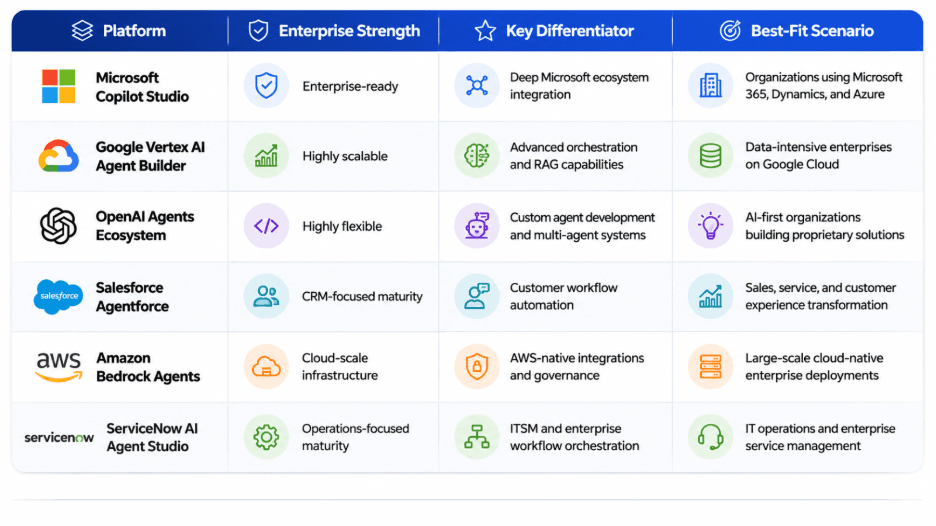
AI agent platforms are evolving rapidly, each shaped by distinct architectural priorities and ecosystem strengths.
Some focus heavily on productivity automation, while others emphasize developer flexibility, workflow orchestration, or enterprise governance.
Below is a side-by-side comparison of the leading AI Solution platforms enterprises are evaluating in 2026.
Microsoft Copilot Studio
Microsoft Copilot Studio has emerged as one of the most enterprise-oriented Digital Workforce platforms that are ideal for businesses working within the Microsoft platform. This platform enables rapid deployment of AI copilots for productivity by virtue of its built-in integration with various Microsoft tools, including Microsoft 365, Teams, SharePoint, Dynamics, Azure AI, and Microsoft Graph.
It provides strong governance, security controls, compliance readiness, and deep workflow integration. The downside of the Microsoft Copilot Studio is the lack of flexibility when customizing the tool for specific orchestration needs and integrations outside Microsoft.
Google Vertex AI Agent Builder
Google Vertex AI Agent Builder is designed for enterprises prioritizing scalability, cloud-native AI orchestration, and advanced machine learning infrastructure. Its core advantage lies in high flexibility for building customized Intelligent Automation Platform and workflows.
Backed by Google’s expertise in search, data engineering, and AI infrastructure, it is best suited for data-driven enterprises, cloud-native organizations, and technically mature AI engineering teams building advanced AI systems.
OpenAI Agents Ecosystem
The OpenAI Agents ecosystem has emerged as a strong platform for building Organizational AI applications, providing more adaptable APIs, orchestration platforms, tools calling capability, and advanced reasoning capabilities rather than an inflexible SaaS application.
The primary advantage of the OpenAI Agents ecosystem lies in its flexibility, allowing organizations to build advanced AI systems with tailored orchestration, memory, retrieval, and multi-agent collaboration capabilities. Nevertheless, additional effort may be required by companies to develop governance mechanisms on top of such systems.
Salesforce Agentforce
Salesforce Agentforce is designed for customer engagement workflows and CRM automation within Salesforce environments. Its key strength is rapid deployment of Enterprise AI System for customer service, sales operations, lead qualification, and Workflow Automation without major infrastructure complexity.
While it excels in business workflow acceleration, highly specialized orchestration may still require external integrations or custom middleware. It is best suited for CRM-centric enterprises, customer support automation, sales enablement, and marketing workflows.
Amazon Bedrock Agents
Amazon Bedrock Agents are the natural choice for enterprises already deep in AWS, they slot directly into existing Lambda, S3 and Redshift workflows without requiring a separate AI infrastructure layer. The tradeoff is that outside AWS, flexibility drops off quickly. Its flexibility makes it well suited for cloud-native organizations, enterprise automation systems, and scalable AI operations.
ServiceNow AI Agent Studio
ServiceNow AI Agent Studio is primarily focused on enterprise workflow orchestration, IT service management, and operational process automation. It excels at streamlining enterprise operations such as ticketing, employee support, compliance workflows, and enterprise service automation. With strong process visibility and built-in governance controls, it is especially valuable for regulated industries and organizations managing complex operational environments.
1. When Buying Wins
Buying ServiceNow AI Agent Studio is most effective for enterprises prioritizing operational efficiency, rapid AI adoption, governance maturity, and workflow standardization. Instead of investing heavily in custom AI infrastructure, organizations can leverage prebuilt orchestration, enterprise integrations, workflow automation, and governance frameworks already embedded within the platform. This approach is particularly valuable for enterprises focused on scaling operational AI across departments without significantly increasing engineering complexity.
2. Faster Time-to-Market
ServiceNow significantly accelerates enterprise AI deployment by offering ready-to-use workflow orchestration, ITSM integrations, employee service automation, knowledge management systems, and governance tooling. Enterprises can deploy AI-powered ticketing systems, employee support agents, compliance workflows, and operational copilots in months instead of spending years building orchestration layers and enterprise automation frameworks internally. Faster deployment also allows organizations to demonstrate measurable ROI earlier in their AI transformation journey.
3. Standardized Enterprise Workflows
The platform is highly effective for standardized enterprise workflows that prioritize operational consistency over deep customization. This includes IT helpdesk automation, HR onboarding, enterprise service management, employee support assistants, compliance approvals, workflow routing, incident management, enterprise search, and internal productivity copilots. Since these processes are often operational rather than strategically differentiating, enterprises benefit from adopting mature workflow templates instead of building highly customized AI systems from scratch.
4. Governance and Compliance Requirements
ServiceNow AI Agent Studio provides strong enterprise governance capabilities including role-based access control, audit trails, workflow visibility, observability, usage monitoring, policy enforcement, and enterprise-grade security controls. These capabilities are especially valuable for regulated industries such as healthcare, banking, insurance, manufacturing, and government sectors where operational transparency, compliance reporting, and AI governance are critical. Built-in governance also reduces the burden on internal security and compliance teams.
5. Lower Operational Complexity
Managing enterprise AI infrastructure internally introduces significant operational complexity involving orchestration reliability, infrastructure scaling, model lifecycle management, prompt versioning, monitoring systems, integrations, security hardening, and ongoing optimization. ServiceNow reduces much of this burden through managed infrastructure, centralized workflow management, integrated observability, enterprise support, and platform-level reliability engineering. This allows enterprises to focus more on business outcomes and process optimization rather than maintaining AI infrastructure.
6. Limited Internal AI Engineering Maturity
Organizations with limited AI engineering expertise often benefit from ServiceNow’s low-code and workflow-centric architecture. Business teams and operational departments can automate enterprise processes without requiring large internal teams of AI engineers, MLOps specialists, or infrastructure architects. This lowers the barrier to enterprise AI adoption and enables organizations to gradually build operational AI maturity before investing in more advanced proprietary AI orchestration and decision intelligence systems.
When Building Wins
Although purchasing speeds up adoption, it becomes imperative to create custom AI agents for competitive differentiation.
The best business processes are never generic.
Competitive advantage is derived from unique knowledge, operational intelligence, internal data systems, and decision-making processes.
Here lies the real value of custom AI Capability creation.
1. Proprietary Workflows
Some companies have highly specialized processes that cannot easily be duplicated using a general-purpose SaaS solution. Applications such as telecom troubleshooting, insurance claim management, industrial maintenance optimization, supply chain coordination, financial modeling, and geospatial intelligence require specialized workflows, domain-specific reasoning, and deep integration with internal systems.
2. Deep Enterprise Integrations
The larger corporations tend to work within fragmented ecosystems of technological solutions that would require developing a tailored AI System for integration with the existing ERP solutions, GIS platforms, Internet of Things technologies, operational databases, APIs and business-specific software solutions. Such integrations cannot be supported out-of-the-box within any of the current AI solutions and require custom development.
3. Domain-Specific Reasoning
Enterprise AIs now need to have a high degree of domain expertise, as generic AI agents often fail in their understanding of industrial nomenclature, regulatory standards, context, workflows, and decision-making processes. Custom reasoning frameworks enable the embedding of domain knowledge into the process of AI operations, thereby making them accurate and meaningful.
Multi-agent systems are common in advanced enterprise scenarios where specific types of agents, including planning agents, execution agents, compliance agents, monitoring agents, retrieval agents, and decision-making agents work together in a series of workflows.
4. Custom Memory and Retrieval Architectures
Context management is becoming a critical component of enterprise AI systems. To improve accuracy and contextual understanding, organizations are increasingly building custom retrieval architectures using vector databases, knowledge graphs, enterprise search systems, real-time operational data, and structured as well as unstructured content pipelines. These systems enable AI agents to deliver more context-aware, reliable, and domain-specific responses across enterprise workflows.
5. Long-Term Optimization and Control
While platforms accelerate deployment, long-term AI strategy often requires balancing vendor dependence with architectural independence. Although custom AI development requires higher upfront investment, it can deliver greater long-term strategic value and operational control.
The Hybrid Path
Enterprise AI is converging toward a blended model that integrates commercial platforms with internally developed capabilities. Top-tier enterprises are adopting hybrid AI models that combine commercial platforms with proprietary orchestration, governance and intelligence layers. Platforms alone are not sufficient; enterprise AI value emerges from layering platform capabilities with internal intelligence and governance systems.
A modern hybrid AI architecture often includes:
1. Commercial AI Agent Platform Layer
Examples of commercial Autonomous Agent platforms include Microsoft Copilot Studio, OpenAI APIs and Agents, Google Vertex AI Agent Builder, Amazon Bedrock Agents, Salesforce Agentforce, and ServiceNow AI Agent Studio.
These platforms provide scalable infrastructure, foundational AI services, orchestration capabilities, and enterprise-grade governance required for operational AI deployment.
2. Enterprise Data and API Layer
This layer connects enterprise systems such as ERP platforms, CRM systems, operational databases, data warehouses, IoT infrastructure, GIS platforms, and knowledge repositories. At this stage, secure API management becomes essential to ensure reliable integration, controlled data access, and seamless communication across enterprise environments.
3. Custom Orchestration Layer
This layer is often where strategic differentiation is created. Organizations develop custom workflow coordination systems, agent routing logic, task planning engines, multi-agent collaboration frameworks, decision-support pipelines, and human-in-the-loop governance systems to align AI operations with proprietary business processes and enterprise goals.
4. Memory and Retrieval Layer
Many organizations now design custom retrieval systems powered by vector databases, knowledge graphs, enterprise search, and operational data pipelines.
These architectures improve contextual accuracy, domain-specific reasoning, and the overall reliability of enterprise AI systems.
5. Governance and Observability Layer
Enterprise AI will neither be exclusively built on platforms nor be custom-made; rather, it will be both. Companies are now moving towards integrating off-the-shelf agent platforms for AI with internally created components of orchestration, governance, and intelligence capabilities.
In this model, commercial AI infrastructure provides foundational capabilities such as model access, authentication, compliance management, workflow connectivity, and observability, while organizations retain control over proprietary intelligence layers.
Conclusion
The enterprise AI market is rapidly evolving from standalone chatbots to integrated AI ecosystems that automate workflows, connect enterprise systems, and drive measurable business outcomes. As organizations scale their AI initiatives, hybrid architectures are emerging as the preferred approach, combining the speed and reliability of commercial AI platforms with the flexibility of proprietary workflows and domain intelligence.
Success in this new landscape depends less on selecting the most popular AI vendor and more on aligning AI investments with business objectives, governance requirements, and operational complexity. While commercial platforms accelerate deployment, proprietary intelligence layers create the differentiation that generates long-term competitive value.
Companies like 12th Wonder play a critical role in helping enterprises operationalize hybrid AI strategies through advanced orchestration, automation, GeoAI, and domain-focused intelligence solutions that bridge the gap between AI capabilities and real-world business impact.
The future of enterprise AI will not belong to companies that build everything themselves. It will belong to organizations that know exactly which layers to standardize and which layers to own.
FAQ
Ready to Build Your Enterprise AI Strategy?
Create a hybrid AI architecture that aligns with your goals and drives measurable outcomes.