

Beyond Model Accuracy: LLM Evaluation and Observability for Business AI
Organizations are moving beyond asking "Can we build it?" and increasingly asking "Can we trust it in production?"
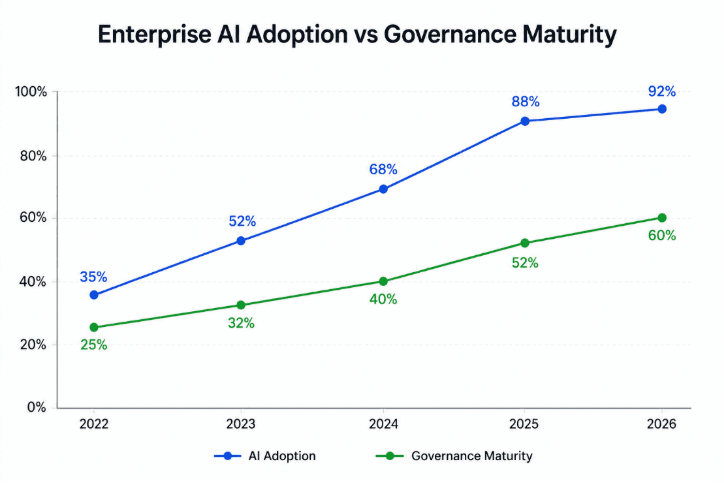
McKinsey’s 2025 report, The State of AI: How Organizations Are Rewiring to Capture Value, found that 88% of organizations use AI in at least one business function. Enterprise spending on generative AI also exceeded $37 billion in 2025. However, only a small percentage of organizations report measurable impact at scale.
This gap shows that widespread adoption and higher investment do not automatically create business value. As AI use expands, the real challenge is building systems that remain reliable, compliant and aligned with measurable business outcomes.
Why "It Looks Right" Fails as an Evaluation Strategy
One of the most common mistakes organizations make when deploying LLM applications is treating a convincing response as a correct one. Unlike traditional software, where outputs can be validated against predefined rules, LLMs generate responses probabilistically. A response may sound fluent and confident while still containing inaccuracies, omissions or misleading information.
This creates a significant challenge for enterprise teams. Human reviewers can identify obvious errors, but manual spot-checking does not scale and often misses subtle issues. A system that performs well during demonstrations may behave very differently when exposed to real-world queries, changing data sources or updated business policies. As AI applications move into production, systematic evaluation becomes essential for maintaining quality and reliability.
Enterprise Example: Customer Support Assistant
Consider a customer support assistant used by an insurance provider. A customer asks:
"How long does it take to process a claim?"
The AI responds:
"Claims are typically processed within five business days."
The answer appears correct, but the company may have recently updated its policy, extending processing times to ten business days for certain claim categories. While the response sounds accurate, it is no longer correct.
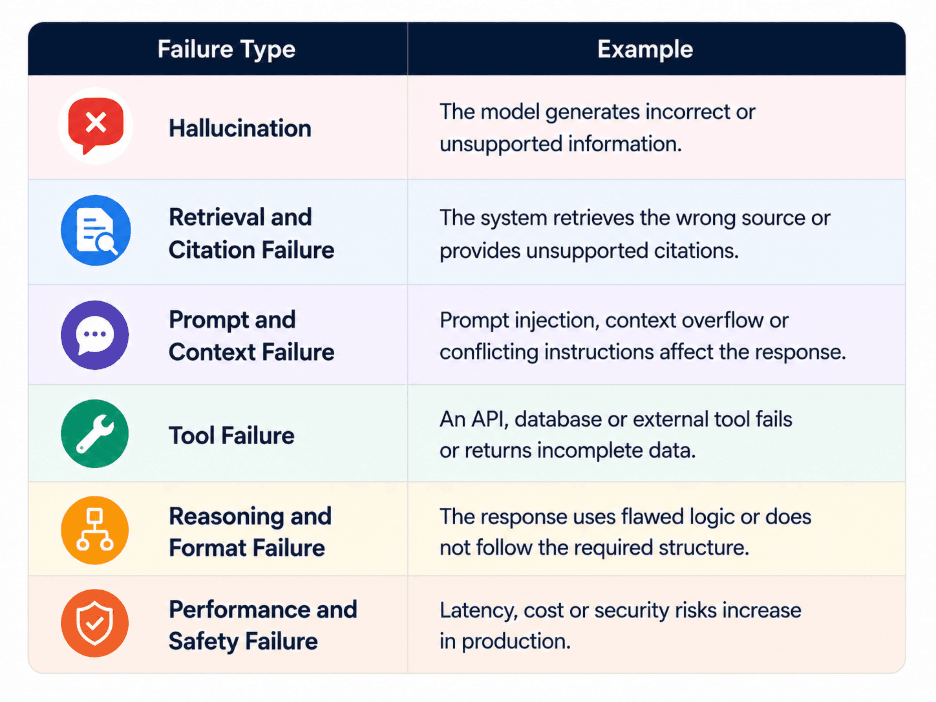
Common LLM Failure Types
The New QA Challenge: Testing Probabilistic Systems
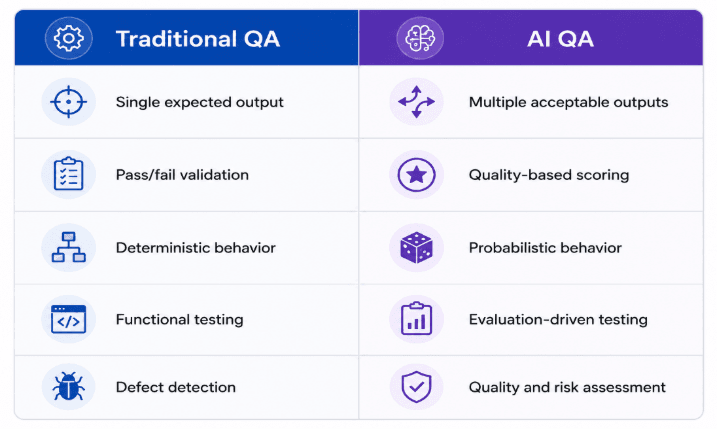
LLM applications can produce different yet valid responses to the same prompt, making fixed pass/fail testing insufficient. AI quality assurance must therefore assess whether outputs meet defined thresholds for accuracy, relevance, groundedness, safety and business suitability.
Traditional QA vs AI QA
The Four Layers of Enterprise AI Evaluation
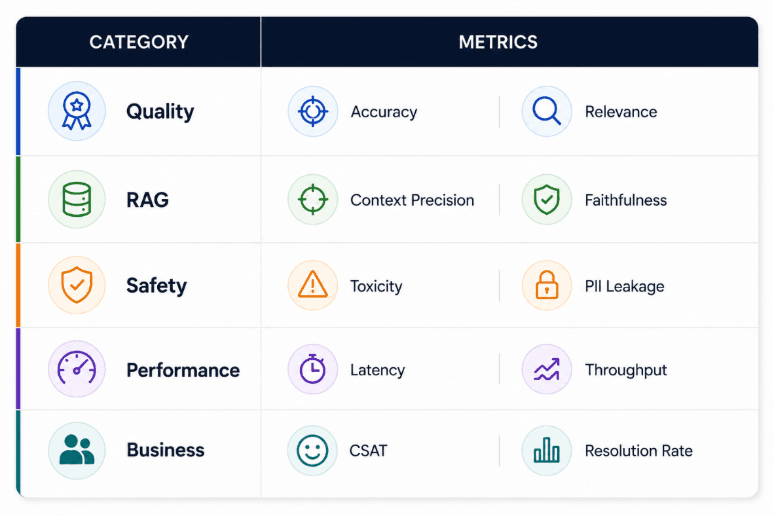
Enterprise AI quality assessment extends beyond response quality alone. Organizations should evaluate AI applications across four interconnected layers to understand both technical performance and business impact.
Layer 1: Response Quality
This layer measures the quality of AI-generated responses, including response quality and safety.
Layer 2: Retrieval Quality
For RAG-based applications, response quality depends on the information retrieved from underlying knowledge sources. This layer measures whether the system retrieves relevant, accurate, and sufficient context to support the final answer.
Layer 3: System Performance
This layer evaluates the runtime performance and reliability of the AI application using metrics such as P95 latency, tokens generated per second, GPU utilization, throughput, timeout rate, availability and cost per request. These metrics help teams identify bottlenecks, control infrastructure costs and maintain consistent production performance.
Layer 4: Business Outcomes
The final layer measures business value through resolution accuracy, deflection rate, escalation rate, CSAT, cost per interaction, time saved, productivity gains, revenue impact and ROI. These metrics help determine whether the system’s financial and operational benefits justify its total implementation and operating costs.
Offline Evaluation Methods
Offline evaluation helps organizations assess AI system quality before deployment by identifying quality issues, regressions, and risks early in the development lifecycle.
1.1 Golden Datasets
Golden datasets are curated collections of prompts and expected outcomes used to measure performance consistently across model versions, prompt updates, and releases. They provide a stable benchmark for tracking quality over time.
1.2 Regression Testing
Regression testing identifies performance degradation after changes to prompts, models, retrieval systems, or application logic. Many organizations integrate these tests into CI/CD pipelines to validate updates before deployment.
1.3 Human Review
Human review remains essential for high-risk use cases where accuracy, safety, and compliance are critical. It is often used as a final validation layer for applications in regulated industries.
1.4 LLM-as-a-Judge
LLM-as-a-Judge uses a language model to evaluate another AI system against criteria such as accuracy, relevance, completeness, and groundedness. While it enables scalable evaluation, it should be complemented by human review and benchmark datasets to reduce bias and improve reliability.
Using LLMs as Evaluation Judges
LLM-as-a-Judge evaluates outputs that cannot be measured reliably through exact-match metrics. The judge model reviews the user input, generated response, reference context and scoring rubric, then assigns a score or compares multiple outputs.
It is especially useful for assessing groundedness, instruction adherence, completeness, reasoning quality and conversational relevance. Pairwise comparison often produces more reliable results than absolute scoring.
However, judge models may favour longer responses, prefer familiar writing styles or change scores when answer order is reversed. Teams should use clear rubrics, randomize response order, calibrate results against human reviewers and validate performance on labelled datasets.
Online Evaluation and Observability
Offline evaluation helps determine whether an AI system is ready for deployment. Observability helps teams understand how the system performs in production and identify issues as they emerge.
2.1 Tracing
Tracing provides end-to-end visibility into AI requests, capturing prompts, retrieved context, model outputs and application interactions. It helps teams identify the source of errors and troubleshoot failures across the AI workflow.
2.2 Drift Detection
AI systems operate in dynamic environments where users, data sources, and business requirements evolve over time. Drift detection identifies changes that may negatively impact performance.
2.3 Production Performance and Cost Monitoring
Operational monitoring focuses on the health and efficiency of AI systems in production. Organizations track metrics such as latency, token consumption, cost, throughput, and availability to ensure applications remain responsive, reliable, and cost-effective.
2.4 User Feedback Monitoring
User feedback monitoring provides insight into real-world AI performance through both explicit feedback, such as ratings and surveys, and implicit signals, such as escalation rates, abandonment rates, and repeat queries.
A Practical 5-Step LLM Evaluation Pipeline
Successful enterprise AI programs treat evaluation as a continuous discipline rather than a one-time exercise. A structured evaluation pipeline helps teams identify quality issues before deployment while continuously improving performance in production.
Step 1: Build and Version Evaluation Datasets
Build version-controlled datasets containing representative prompts, edge cases, compliance-sensitive scenarios, and known failure cases.
Step 2: Standardize Evaluation Criteria
Standardize evaluation criteria to ensure consistent scoring and comparable results across releases.
Step 3: Automate Evaluation Runs
Automate evaluation whenever prompts, models, or retrieval systems change to identify regressions before deployment.
Step 4: Establish Quality Gates
Similar to traditional software testing, AI applications should meet predefined quality thresholds before deployment. Quality gates typically include predefined thresholds for key evaluation metrics.
For example, a deployment may require faithfulness scores above 90%, relevance scores above 85%, and average response times below three seconds before release approval is granted.
Step 5: Continuously Monitor Production
Monitor production performance and incorporate findings into evaluation datasets to drive continuous improvement.
Conclusion
As enterprise AI adoption accelerates, Enterprise leaders increasingly prioritize measurable business value, operational reliability, and long-term AI performance.
This is why evaluation and observability have become essential components of modern AI quality engineering. Structured assessment validates response quality, retrieval effectiveness, system performance and business outcomes before deployment. Observability then provides the visibility needed to identify issues, understand production behaviour and continuously improve AI systems over time.
At 12th Wonder, we help organizations apply proven QA engineering practices to enterprise AI through evaluation frameworks supported by testing, observability, regression validation and continuous monitoring. By combining traditional quality disciplines with modern AI evaluation techniques, we help teams move from experimentation to production with greater confidence.
Sustainable AI success depends on continuous evaluation, monitoring, and improvement practices that support reliability at scale. That is what transforms AI from a promising technology into a trusted business capability.
FAQ
Enterprise AI Success Depends on More Than Model Accuracy
Build reliable, scalable AI systems with evaluation frameworks and continuous monitoring.