
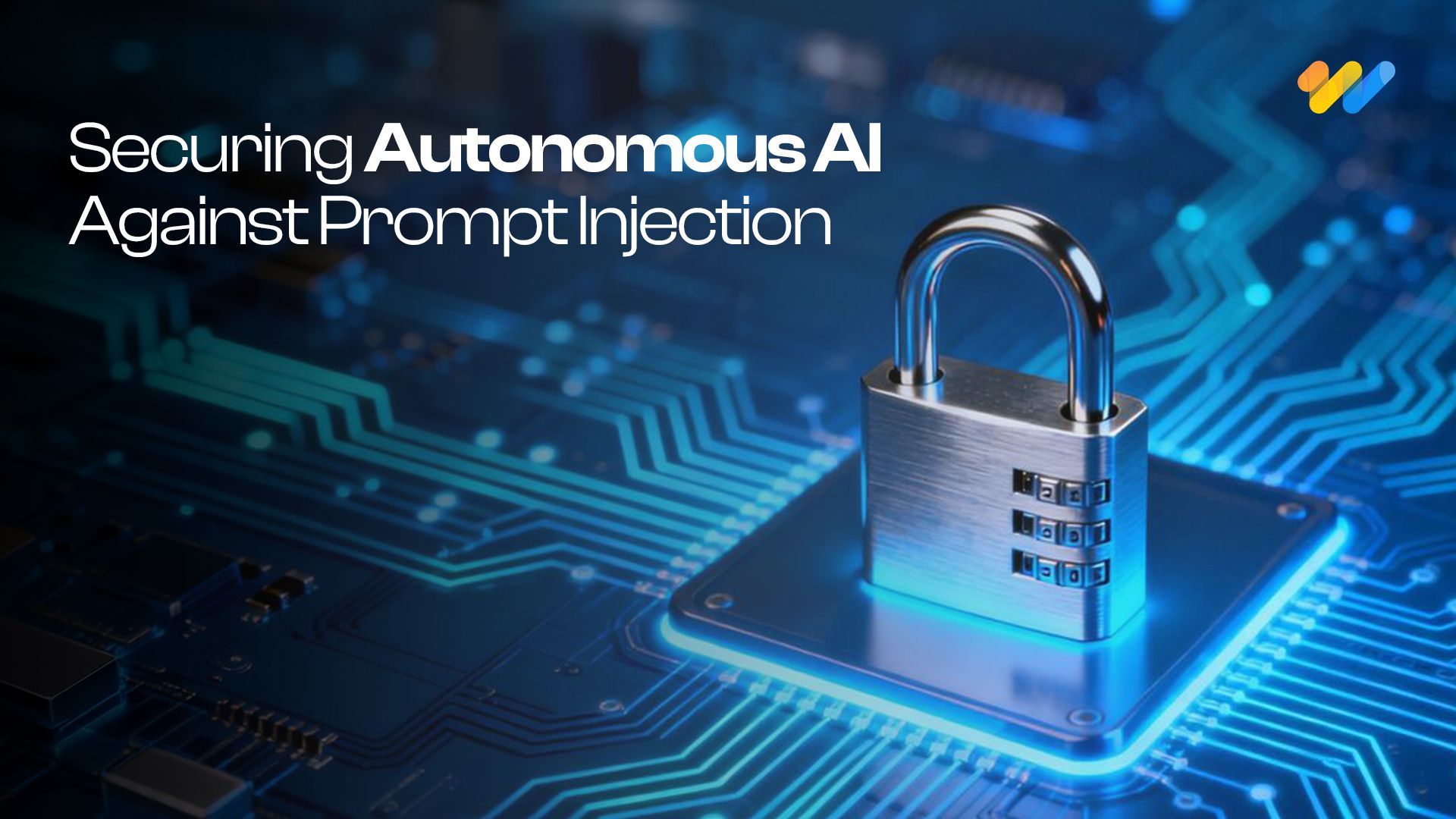

AI Agent Security: Defending Against Prompt Injection in Enterprise AI Systems
As AI agents become more independent, even one harmful prompt can create serious risks.
The rate of adoption of autonomous AI agents by businesses is growing quickly. Autonomous AI agents have become commonplace, where they are being used to automate workflows, engage with customers, retrieve information, perform operations, and coordinate complex decision-making processes.
However, along with the growing power of agentic AI comes increased exposure to security threats. Standard approaches to securing digital assets assume deterministic logic and predictable flow of software execution. However, agentic AI acts and interacts in a completely different way: reasoning, interacting with other applications, maintaining memory, processing dynamic data, and deciding autonomously.
This makes AI agent security one of the most important challenges in modern AI systems.
This means that securing AI technology is not about securing traditional infrastructure and APIs anymore; now companies should defend themselves against such types of AI-specific threats as prompt injection, context alteration, tool misuse, memory tampering, etc.
Why AI Agent Security Is Different From Traditional Application Security ?
Traditional systems run under known rules, predictable paths of logical execution, and well-defined execution flows that make it possible to establish security controls against known behavior of the system.
AI agents turn the paradigm on its head.
Modern AI agents can understand natural language, access external information, retain memory, interact with APIs, select tools, and perform tasks without relying on fixed workflows or predefined logic. While this enables more advanced automation across organizations, it also introduces new security challenges.
Unlike traditional systems, the language itself becomes a threat vector. Attackers do not have to hack into systems directly; prompt injection, context poisoning, malicious content, and adversarial data retrieval can influence AI agents' decision-making.
This is why LLM security and AI agent security require fundamentally different approaches from traditional AppSec practices.
The Expanding Attack Surface of Agentic AI
Autonomous AI agents create security risks on multiple levels, introducing threats that traditional applications were never designed to handle.
Prompts
Prompts essentially provide executable logic to AI agents. Harmful prompts can guide or influence the behavior of an AI agent to act against policy, security, or even against itself.
Memory
Persistent memory stores can be compromised by false, misleading, or even malicious contexts to influence future decisions, responses, and logic throughout its interactions.
Tools
AI agents connected to APIs, databases, browser tools, CRM platforms, and internal business systems can unintentionally misuse these integrations or expose them to security risks.
Retrieval Systems
Any documents, email, websites, databases, and other information stores accessed by an AI agent can potentially provide untrusted input in the form of harmful instruction.
Autonomy
Threats can escalate rapidly in autonomous systems.
Together, these challenges create a new category of Agent AI risks that organizations must actively identify, monitor, and protect against when deploying autonomous AI systems.
Major AI Agent Attack Vectors, Enterprises Must Understand

Securing Autonomous AI Systems
Since there is no one security measure that will provide complete protection for autonomous agents, a multi-layered security architecture must be implemented. To achieve effective security of AI agents, there is a need for protection throughout the entire lifecycle of the AI system such as validation, access control, tooling protection, retrieval security, monitoring, auditing, behavior analysis, and governance.
This will help to not only prevent security breaches but continuously monitor for AI threats.
AI Observability
Traditional observability solutions were built to support deterministic software, not probabilistic AI that can think and make decisions on its own. This means that businesses leveraging agentic AI need a brand-new type of visibility called AI observability.
The core idea behind AI observability is figuring out why the agent reached the conclusion, what inputs affected the agent, what tools were used, how reasoning chains worked, and if there were any deviations in outputs. Otherwise, businesses simply won't be able to troubleshoot failures, detect breaches, confirm agent behavior, and retain operational trust.
Modern solutions offering AI observability should allow organizations to gain insights into prompt flow, information retrieval, memory consumption, tooling, reasoning chain, abnormal responses, and policy violations. In business-grade AI solutions, observability is not an option anymore, but a must-have one.
Tool-Call Monitoring
AI systems utilizing tool access greatly increase their attack surface. Every request to an API, database access operation, browser interaction, or workflow execution through an AI agent can be potentially misused if control is not exercised.
Thus, monitoring of tool calls becomes an important aspect of the security architecture of AI agents. Tool-call monitoring must cover logging of tool interactions, permission-based logging of tool execution, policy enforcement before executing tool calls, rate limiting, risk scoring of high-impact tool calls, and human approval flows for sensitive tool calls.
Tool access via an AI system should be treated the same way that access to privileged infrastructure is. Sensitive actions should never be executed unless validated and monitored from start to finish.
Anomaly Detection
Given that AI agents are dynamic and function on a probabilistic basis, relying on static security policies alone is inadequate anymore. Companies will require highly sophisticated behavior analysis and anomaly detection mechanisms to spot any signs of suspicious activities from the AI agents in real-time.
Such suspicious activities could include unusual prompt patterns, odd usage of tools, abnormal retrieval activities, too many tokens consumed, looping failures, suspicious access attempts, and prompt injection attacks. With increasing autonomy in AI, anomaly detection and behavior monitoring have started becoming critical parts of modern enterprise AI security solutions.
AI Red Teaming
Traditional penetration testing methods are not designed to evaluate the autonomous and dynamic behavior of AI agents. As organizations increasingly adopt generative AI systems, AI red teaming has become essential for testing large language models and autonomous agents against real-world security threats.
AI red teaming simulates attacks such as prompt injection, jailbreaks, retrieval manipulation, context poisoning, tool abuse, adversarial workflows, and data exfiltration to uncover vulnerabilities and unsafe AI behaviors before they are exploited in production.
As organizations adopt AI at scale, AI red teaming is becoming a critical part of modern LLM security strategies.
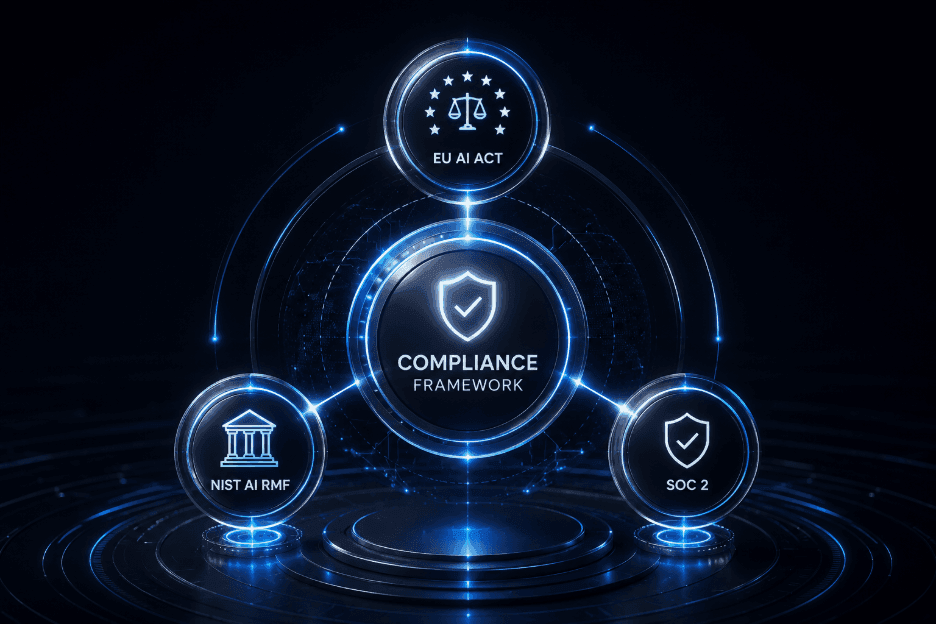
Compliance Frameworks: EU AI Act, NIST AI RMF, and SOC 2
How 12th Wonder Approaches AI Agent Security
With 12th Wonder, AI agent security is seen as critical infrastructure, not something built as an add-on after development. Secure AI systems require much more than state-of-the-art models. They require scalable architecture, strong safeguards, monitoring, governance, and risk management built into the AI system from the very beginning.
From prompt validation and secure access pipelines to tool call monitoring and AI red teaming, businesses require multi-layered security solutions that will adapt as AI agents become more autonomous.
The future of business relies on agentic AI integrated into key business processes. However, while successful scaling will require the most advanced AI models, it will also depend on the ability of businesses to build secure and governed systems right from the start. In the AI era, security will become a core foundation for successful AI adoption.
FAQ
Secure Your Enterprise AI Systems
Protect AI agents with prompt injection defense, monitoring and governance for AI adoption.