

AI-Ready Data: What Agents Need from Your Data Layer
| Key Findings | ᐯ |
- AI agents need clear business definitions, metadata and relationships to interpret enterprise data correctly.
- Data quality and freshness must be visible so agents can recognise incomplete, outdated or unreliable information.
- Access should depend on the user, task and action, with human approval required for higher-risk actions.
- Structured and unstructured data must be connected through consistent identifiers and suitable retrieval methods.
- Organisations should begin with one measurable workflow, monitor its performance and strengthen the data layer through traceability and user feedback.
An employee asks an AI agent to identify delayed customer orders, determine the reasons and notify the relevant account managers.
To complete the task, the agent must find the right order data, interpret delivery codes, connect customer records to account ownership, verify the latest status, follow access rules and confirm that it can send notifications.
This level of business understanding depends on the definitions, metadata, permissions and controls built into the organisation’s data environment.
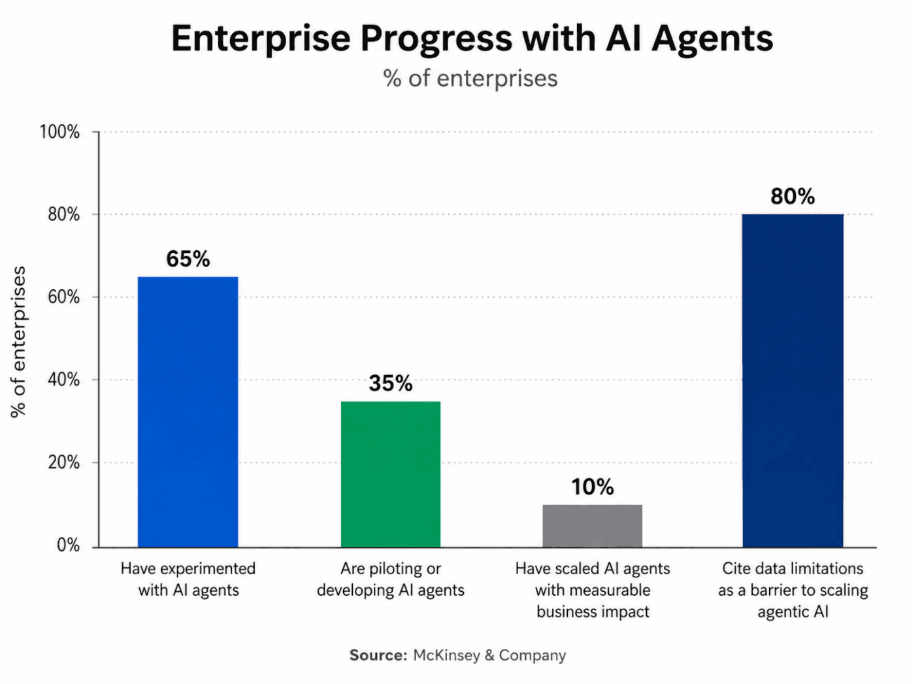
McKinsey reports that nearly two-thirds of enterprises worldwide have experimented with AI agents, while fewer than 10% have scaled them to deliver tangible value.
AI-ready data must enable agents to find, interpret and use enterprise information reliably within a business workflow.
Agents Need Data They Can Find and Understand
Many organisations store enterprise data across warehouses, cloud platforms and operational systems. AI agents also need business context to use that data correctly.
Consider a field called “CUSTOMER STATUS” with values such as Active, Inactive, Pending, Suspended and Closed. The agent needs to understand what each status means, which system owns the definition, how often the value changes and which exceptions apply to it.
A semantic layer provides this context by connecting technical structures with business concepts, definitions, relationships and rules that AI systems can apply consistently.
Snowflake’s Cortex Agents, for example, use semantic models to connect business language with structured and unstructured data. In Snowflake’s testing across four production datasets, agentic semantic models improved Text-to-SQL accuracy by more than 20% on average compared with agents operating without schema understanding.
An enterprise may also have several revenue tables. One may update continuously; another may support financial reporting and a third may reflect month-end reconciliation. The appropriate source depends on the purpose, timing and governance requirements of the request.
Agents Need Visible Data Quality and Freshness
Data freshness requirements vary by workflow. A customer service agent may need information from the last few minutes, while a financial reporting agent may rely on an approved month-end dataset. A strategic planning agent may work with quarterly data.
Each critical dataset should therefore expose its update frequency, last refresh time, expected availability and acceptable latency. The agent should also know how much delay is acceptable for the task.
An agent recommending a stock transfer could make a poor decision if one warehouse’s data was updated five minutes ago while another source has not refreshed since the previous night.
Quality signals may include completeness levels, validation results, duplicate rates, schema changes, anomaly alerts, reconciliation status, confidence scores and known limitations.
A low-risk agent preparing a preliminary summary may continue while flagging uncertain data. An agent approving a payment may need to stop when required information is missing or unreliable.
Freshness and quality should therefore form part of the agent’s decision context. The system should be able to recognise stale or incomplete inputs, select a suitable source or request human review when data falls outside defined thresholds.
Agents Need Access Based on Identity and Purpose
An AI agent should receive access based on the requesting user, the task and the action it is expected to perform. An AI agent should receive access based on the user, the task and the action it is expected to perform.
An HR agent helping a manager review team availability may need access to leave records, but it should not automatically receive access to medical information or compensation data. A finance agent reviewing invoices may need to read supplier records, payment approval should require stronger controls and where appropriate, human authorisation.
Effective access management should establish who requested the task, which agent is performing it, what information it can retrieve, which tools it can use, what actions it can perform and which decisions require approval.
Governance platforms such as Databricks Unity Catalogue can support centralised discovery, compliance and monitoring across data and AI assets.
Permissions should also be limited by time and purpose. Access granted for one workflow should remain active only for as long as the task requires.
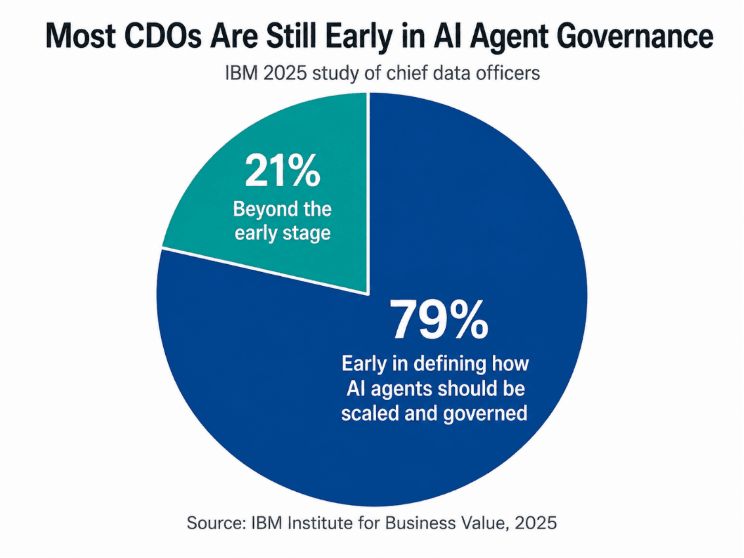
The governance challenge is still developing. IBM’s 2025 study found that 79% of surveyed chief data officers were in the early stages of defining how AI agents should be scaled and governed.
Agents Need Structured and Unstructured Data to Work Together
Customer details may live in a CRM. Contract conditions may appear in PDF documents. Product guidance may be stored in a knowledge portal. Recent decisions may be buried inside support notes or project messages.
Consider an agent reviewing a supplier invoice. It may need structured purchase-order data, an unstructured contract, goods-receipt records and the organisation’s approval policy.
A vector search across documents may retrieve the contract. A SQL query may locate the purchase order. A business rule may determine whether the difference requires escalation.
The data layer must help the agent connect these results around common entities such as supplier, contract, product, location or transaction.
Slight variations in customer names, supplier codes or product identifiers can lead the agent to combine unrelated records or overlook relevant information.
AI-ready architecture therefore needs consistent identifiers, entity relationships and retrieval methods suited to each type of data.
Agents Need Traceability and Feedback
When an AI agent provides an answer or completes an action, the organisation should be able to reconstruct what happened.
Traceability should record who initiated the request, which data sources and records were used, which tools and rules were applied, which model handled the task, what action was taken and whether a human approved the outcome.
It also helps teams identify whether an error came from the model, prompt, retrieval process, business definition, source data or tool access.
A United Nations digital technology initiative launched in July 2026 is developing frameworks focused on identifiable, trustworthy agents that remain subject to meaningful human control.
When users correct an output, the organisation should examine the cause and update the relevant part of the system.
This feedback may improve business definitions, data descriptions, search indexes, entity mappings, retrieval rules, access policies, workflow instructions and evaluation datasets.
A Practical AI-Ready Data Framework
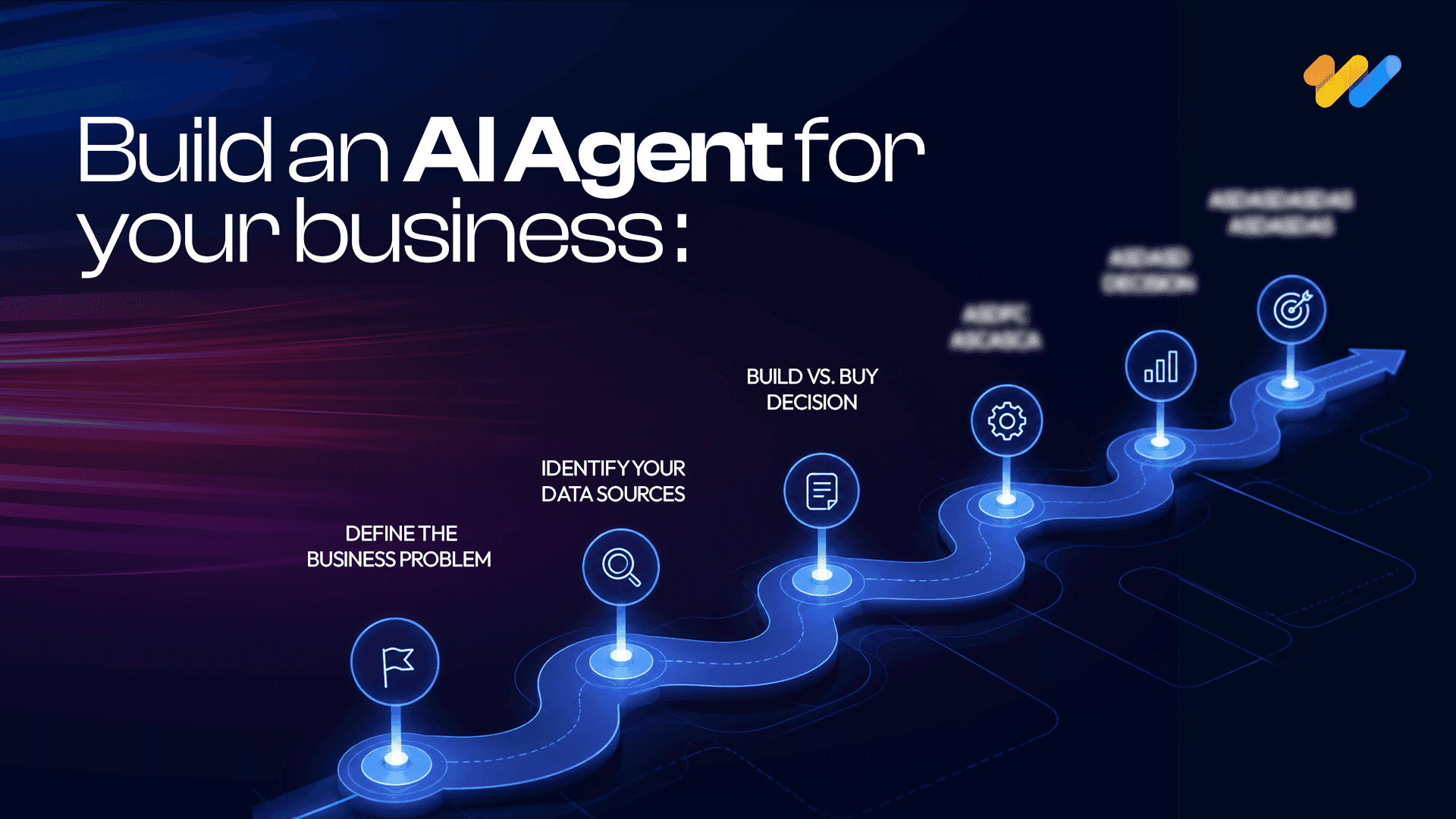
A focused approach can begin with one workflow.
Choose a business process with a clear owner, measurable value and manageable risk. Identify the data sources involved, then document their ownership, business meaning, update frequency, quality expectations, access restrictions and relationships.
Next, define the agent’s operating boundary. Specify what it can read, recommend and execute, along with the conditions that require human review.
Test the workflow using realistic scenarios, including stale data, missing records, conflicting sources and unusual requests.
Once the agent is in production, monitor retrieval accuracy, action success, data quality failures, user corrections and escalation rates.
Conclusion
AI-ready data gives agents the context and controls required to work reliably inside real business processes.
That requires more than connected systems. Organisations need clear business definitions, trusted data sources, visible quality signals, appropriate permissions, traceability and feedback from production use.
The most practical approach is to begin with one workflow. Define the data it depends on, the actions the agent can take, the conditions that require human review and the measures used to evaluate performance.
At 12th Wonder, we help enterprises design this foundation across data engineering, cloud platforms, analytics, AI and automation. Our work includes improving data discovery, building semantic context, strengthening governance and creating agent workflows that can be tested, monitored and scaled.
The result is a data environment that helps AI agents retrieve the right information, interpret it accurately and act within clearly defined business boundaries.
FAQ
Build a Data Foundation Ready for AI Agents
Prepare enterprise data with the context, quality, governance and access controls agents need to work reliably.