
Agentic GeoAI: AI Agents Transforming Enterprise GIS Workflows (2026)

Author

Author

Veera Nagi Reddy Mekala

Director of Tech. Innovation

AI agents for enterprise GIS visual Agentic GeoAI combining LLMs, spatial reasoning and multi-agent systems in 2026

Agentic GeoAI: AI Agents Transforming Enterprise GIS Workflows (2026)

A flood warning is issued. By the time analysts collect satellite imagery, run spatial models, validate results and distribute reports, the situation has already changed. Similar delays occur during wildfire response, infrastructure failures and disaster recovery, where decisions often depend on how quickly geospatial information can be transformed into actionable insights.

Agentic GeoAI addresses this challenge by introducing AI agents that can plan, reason and execute complex geospatial workflows with minimal human intervention. Instead of simply generating outputs, these agents automate spatial analysis, coordinate tasks across enterprise GIS systems and support faster, more consistent decision-making.

By combining large language models, geographic reasoning and enterprise geospatial platforms, Agentic GeoAI enables intelligent spatial workflows while maintaining human oversight for governance and accuracy.

In this blog, we explore how Agentic GeoAI works, the technologies behind it and how it is reshaping enterprise spatial intelligence.

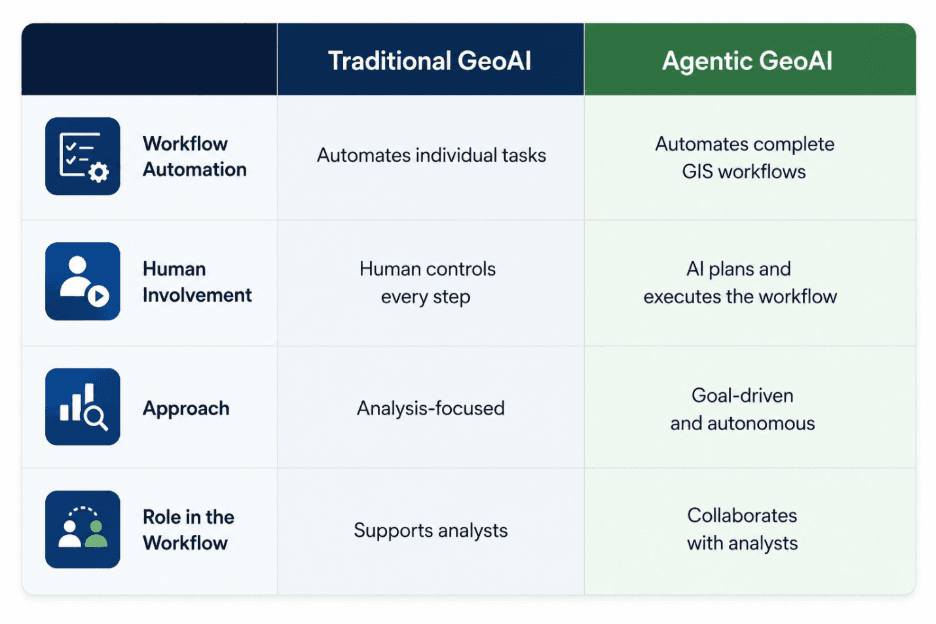
How Agentic GeoAI Differs from Traditional GeoAI?
blog-Agentic-GeoAI-inside1-preprod.png

Enterprise GIS has evolved through four distinct stages, with each generation introducing greater intelligence and automation.

Traditional GIS relied entirely on human analysts. Every step, from collecting data and running spatial analyses to creating maps and reports, required manual execution using GIS software.

GeoAI introduced machine learning and deep learning to improve tasks such as image classification, feature extraction and predictive spatial analysis. However, these AI models remained task-specific and still depended on users to initiate and coordinate workflows.

Agentic GeoAI represents the next stage of evolution. Instead of assisting with individual GIS tasks, AI agents can plan, coordinate and execute complete geospatial workflows. They retrieve data, select analytical methods, generate maps, produce reports and interact with other enterprise systems while keeping humans involved for oversight and approvals.

The next step is Autonomous Geospatial Systems, where multiple AI agents continuously monitor spatial data, respond to changing conditions and optimize workflows with minimal human intervention. Although many of these capabilities are still emerging, advances in AI agents, real-time geospatial platforms and digital twins indicate the direction enterprise GIS is heading.

This progression reflects a broader shift from human-operated GIS to AI-assisted GIS, then to AI-orchestrated workflows, and ultimately to autonomous geospatial operations.

Why Traditional GIS Workflows Are No Longer Enough?

Modern GIS platforms are more powerful than ever, yet many enterprise workflows remain largely manual. Analysts still spend considerable time locating datasets, integrating multiple data sources, running geoprocessing tools, validating outputs and preparing reports before meaningful insights can be delivered. As spatial data volumes grow and decision cycles become shorter, these traditional workflows struggle to keep pace.

The challenge extends beyond manual effort. Organizations often face analyst bottlenecks, where advanced spatial analysis depends on a limited pool of GIS specialists. At the same time, disconnected tools across GIS platforms, satellite imagery, databases and reporting systems create fragmented workflows, while coding dependency makes advanced automation inaccessible to many business users. As the volume of Earth observation data continues to grow beyond what can be efficiently managed using local systems, organizations are increasingly adopting cloud-native geospatial workflows and AI-driven automation to keep pace. Even after the analysis is complete, static reporting means insights can quickly become outdated as new spatial data becomes available.

These limitations are driving the transition to AI-driven GIS. Instead of executing every step manually, organizations can define a business objective while intelligent systems retrieve data, perform autonomous spatial analysis, generate maps and produce reports with minimal intervention. This shift lays the foundation for Agentic GeoAI, where AI agents’ complete workflows rather than simply assisting with individual GIS tasks.

From Single Agents to Multi-Agent GIS Systems

As location-based workflows become more sophisticated, a single AI agent is no longer sufficient to manage complex GIS operations. Modern GIS platforms increasingly rely on multi-agent systems, where specialized AI agents collaborate to improve scalability, accuracy and operational efficiency.

A typical system includes agents for mapping, routing, imagery analysis, risk assessment, reporting and continuous monitoring. A central planning agent orchestrates these specialized agents by assigning tasks, managing data exchange and combining their outputs into a unified workflow.

For example, during a flood response, the Imagery Agent identifies affected areas, the Risk Analysis Agent estimates impacts, the Routing Agent generates evacuation routes, the Mapping Agent visualizes the results and the Reporting Agent produces a situational report. By working together, these agents deliver faster, more accurate and context-aware insights than a single AI agent operating independently.

How Geospatial AI Agents Actually Work?

Unlike traditional GIS software, AI agents automate end-to-end workflows. Users define a business objective and the AI translates it into coordinated tasks using GIS tools, spatial data and reasoning models.

The agent plans the workflow, discovers relevant datasets, performs geographic assessment, applies spatial reasoning and generates maps, visualizations and reports. Before any critical action is taken, human experts validate the outputs to ensure accuracy, governance and compliance.

By ochestrating these steps, AI agents transform traditional mapping and analysis into intelligent, scalable workflows that deliver faster and more consistent outcomes.

The Building Blocks of Agentic GeoAI
blog-Agentic-GeoAI-inside2-preprod.png

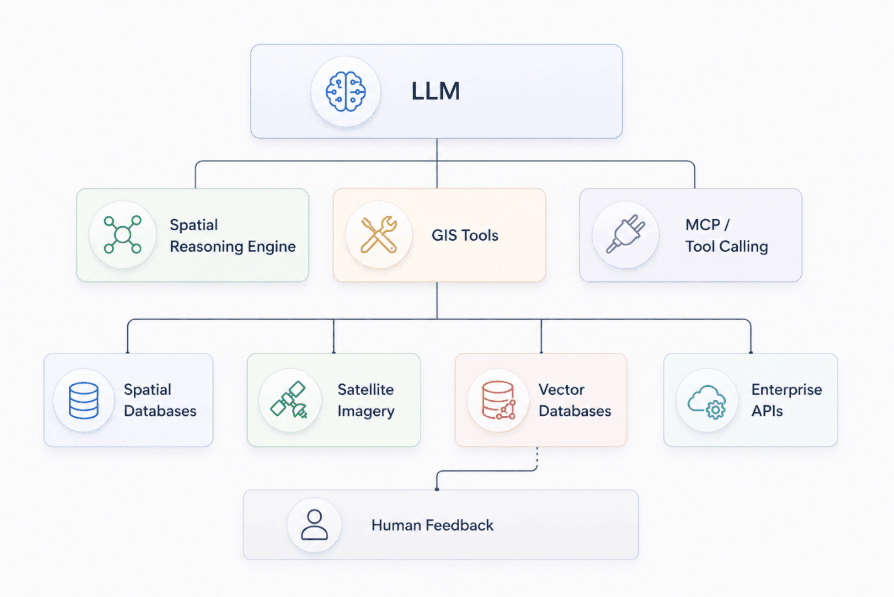
At the core of Agentic GeoAI is a layered architecture that combines AI reasoning, enterprise GIS and connected data ecosystems.

Intelligence

The LLM serves as the orchestration layer, interpreting user intent and coordinating workflows, while the Spatial Reasoning Engine adds geographic context by evaluating topology, proximity, connectivity, terrain and other spatial relationships.

Execution

GIS tools perform core spatial operations, while Model Context Protocol (MCP) enables AI agents to securely connect with GIS software, enterprise APIs and external services to automate end-to-end workflows.

Data

Spatial databases, satellite imagery and contextual knowledge sources provide the data required for accurate geospatial analysis and decision-making.

Enterprise Connectivity

Enterprise APIs integrate Agentic GeoAI with business systems such as ERP, IoT and asset management platforms, allowing spatial intelligence to support enterprise-wide operations.

Governance

Human feedback provides validation, strengthens governance and ensures AI-generated outputs remain accurate, transparent and compliant before critical decisions are executed.

Agentic GeoAI in Action

The true value of Agentic GeoAI lies in its ability to orchestrate complete GIS workflows rather than automate isolated tasks. By coordinating multiple data sources, analytical tools and AI-driven decision processes, AI agents enable faster, more accurate and context-aware outcomes across industries.

Disaster Response

Emergency agencies increasingly use AI, satellite imagery and GIS to support disaster response. Following major hurricanes and wildfires, organizations such as FEMA and the National Geospatial-Intelligence Agency (NGA) have used geospatial AI to rapidly assess damage, prioritize response efforts and improve situational awareness.

Utilities

Electric utilities are adopting AI and GIS to monitor grid assets, detect outages and optimize field operations. Companies including National Grid and Duke Energy have invested in AI-enabled inspection and asset management to improve infrastructure reliability.

Urban Planning

Cities including Singapore use AI, digital twins and geospatial data to support urban planning, evaluate development scenarios and optimize land use through data-driven decision-making.

Infrastructure Monitoring

Transportation agencies increasingly combine satellite imagery, drones and AI to monitor bridges, railways and roads, enabling predictive maintenance and reducing the risk of unexpected asset failures.

Environmental Monitoring

Organizations such as Global Forest Watch use satellite imagery and AI to detect deforestation and monitor land-use change, providing near real-time environmental intelligence for governments and conservation agencies.

Geospatial Reasoning: What Makes AI Agents Different?

Large Language Models (LLMs) excel at understanding and generating text, but they do not inherently understand geographic space. An LLM may interpret a request correctly, yet it cannot determine whether locations are connected, whether terrain is suitable for development, or whether a proposed route is physically feasible. This is where geographic reasoning becomes essential.

By combining LLMs with spatial reasoning engines, AI agents evaluate geographic context before making decisions. They apply spatial rules and relationships to produce accurate, real-world outcomes rather than relying solely on language.

Rather than relying solely on language, geographic reasoning incorporates concepts such as topology, proximity, connectivity, terrain, temporal reasoning, spatial relationships and uncertainty to produce geographically accurate, context-aware and operationally reliable outcomes.

Why Agentic GeoAI Matters for Enterprises

As organizations collect larger volumes of spatial data from satellites, drones, IoT sensors and enterprise systems, traditional GIS workflows are becoming harder to scale. Agentic GeoAI addresses this challenge by enabling AI agents to coordinate data retrieval, spatial analysis, visualization and reporting with minimal human intervention. Recent research on autonomous GIS demonstrates that AI agents can independently perform tasks such as geospatial data retrieval, spatial analysis and map generation, pointing toward a new generation of intelligent GIS workflows.

For enterprises, the value extends beyond automation. AI agents can execute repetitive geoprocessing tasks, combine information from multiple spatial datasets and generate actionable outputs much faster than manual workflows. This allows GIS professionals to spend less time on routine processing and more time interpreting results and supporting business decisions. Esri also identifies workflow automation, predictive analytics and real-time operational monitoring as key benefits of GeoAI across enterprise environments.

Another important advantage is continuous situational awareness. Instead of relying on periodic manual analysis, AI agents can monitor satellite imagery, sensor feeds and enterprise spatial databases to detect meaningful changes and trigger follow-up analyses. Natural language interfaces further lower the barrier to GIS by allowing users to request complex spatial analyses without extensive scripting or GIS expertise.

Is Your GIS Platform Ready for AI Agents?

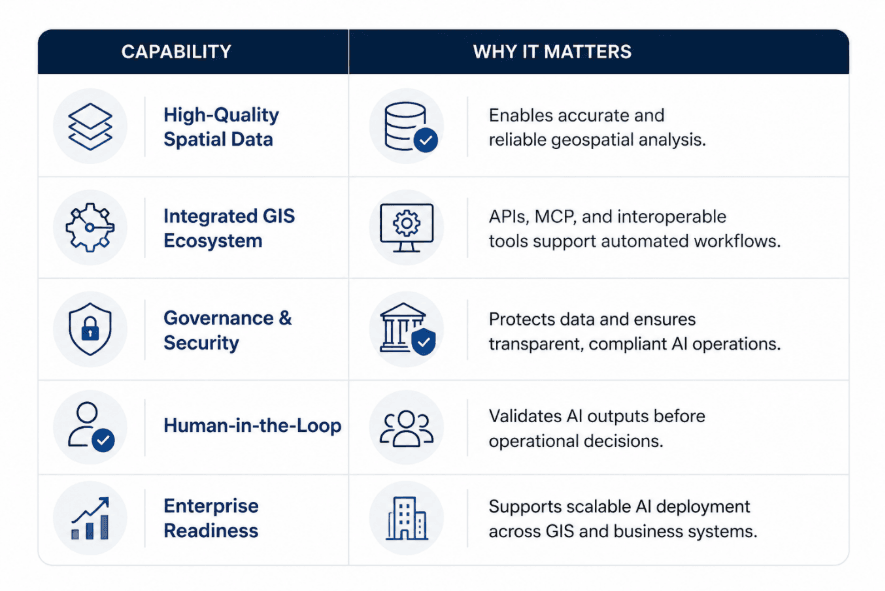
Adopting Agentic GeoAI involves more than integrating a large language model into an existing GIS environment. Organizations need a modern geospatial architecture that enables AI agents to access reliable data, interact with enterprise systems and operate within well-defined governance frameworks. Before implementing AI-driven GIS workflows, organizations should evaluate whether their platform is prepared for autonomous operations.

A practical readiness checklist includes:
blog-Agentic-GeoAI-inside3-preprod.png

Where Agentic GeoAI Is Heading?

The next evolution of enterprise GIS is shifting from AI-assisted tools to AI-driven workflows. Major GIS and cloud providers are already embedding generative AI, natural language interfaces and workflow automation into their platforms, indicating that autonomous GIS capabilities are moving from research to commercial adoption.

As these capabilities mature, AI agents will increasingly automate data discovery, spatial analysis, visualization and reporting while continuously monitoring satellite imagery, sensor networks and enterprise spatial databases to identify changes and trigger follow-up actions. At the same time, the growing adoption of digital twins and real-time geospatial platforms will enable organizations to simulate scenarios, monitor assets and support operational decision-making with continuously updated spatial intelligence.

Rather than replacing GIS professionals, Agentic GeoAI is expected to augment their expertise by automating repetitive workflows and enabling faster, more scalable decision-making. Organizations that adopt AI-native GIS platforms will be better positioned to manage growing spatial data volumes while maintaining governance, security and human oversight.

Conclusion

Agentic GeoAI marks a significant shift in how enterprise GIS operates. Rather than replacing GIS professionals, it transforms spatial workflows from manual, step-by-step processes into intelligent systems capable of planning, reasoning and executing geospatial tasks with human oversight. As organizations adopt AI agents the focus will move from operating GIS tools to supervising autonomous spatial analysis and making faster, data-driven decisions.

Success depends on integrating AI agents securely with existing GIS platforms, spatial data and business systems while maintaining governance, scalability and interoperability.

At 12th Wonder, we help organizations accelerate this transition by designing AI-powered geospatial solutions that integrate seamlessly with enterprise ecosystems. From workflow automation and platform modernization to AI integration and scalable application development, we enable businesses to build secure, intelligent GIS capabilities that deliver measurable operational value.

FAQ

1. What is Agentic GeoAI?

Agentic GeoAI combines AI agents, large language models, and spatial reasoning to automate end-to-end GIS workflows with minimal human intervention.

2. How is Agentic GeoAI different from traditional GeoAI?

Traditional GeoAI automates individual tasks, while Agentic GeoAI plans, coordinates, and executes complete geospatial workflows based on business objectives.

3. What are geospatial AI agents?

Geospatial AI agents are autonomous systems that use GIS tools and spatial data to perform mapping, analysis, routing, monitoring, and reporting.

4. What is autonomous spatial analysis?

Autonomous spatial analysis enables AI agents to independently retrieve data, perform spatial analysis, and generate actionable insights with limited human input.

5. Why is spatial reasoning important in Agentic GeoAI?

Spatial reasoning enables AI to understand geographic relationships such as proximity, connectivity, terrain, and topology, leading to more accurate decisions.

6. Which industries can benefit from Agentic GeoAI?

Agentic GeoAI supports industries including utilities, telecommunications, transportation, construction, urban planning, environmental monitoring, and disaster response.

Talk to an Expert

Transform GIS with AI Agents

Automate spatial analysis, accelerate decision-making and scale GIS with Agentic GeoAI.

Recent Blogs

Frontier AI Models guide cover image

Frontier AI Models Guide: OpenAI vs Claude vs Gemini (2026)

Every major AI provider is promising to be your enterprise AI platform. Many organizations initially evaluat
Read more...
Enterprise AI agent platform comparison illustration — build vs buy decision framework for 2026 with hybrid architecture.

Build vs Buy: AI Agent Platforms Compared (2026)

Enterprise AI has evolved beyond simple chatbots into operational ecosystems capable of workflow automation, system integration, and real-time decision-making

Read more...
Claude Fable 5 illustration, Anthropic's Mythos-class AI model for autonomous workflows and enterprise use

Claude Fable 5: The Mythos-Class AI Model You Can Use in 2026

Anthropic's Claude Fable 5 is the first publicly available Mythos-class AI model, representing a significant step beyond traditional AI assistants.

Read more...
Multi-agent systems blog thumbnail — 2026 enterprise guide to multi-agent AI

Multi-Agent Systems for Business: A Practical Enterprise Guide (2026)

Enterprise AI is quietly moving away from the idea of one system doing everything. The future of enterprise AI is increasingly being shaped by coordinated intelligence

Read more...
Blog cover

AI Agent Security: Defending Against Prompt Injection in Enterprise AI Systems

The rate of adoption of autonomous AI agents by businesses is growing quickly. Autonomous AI agents have become commonplace, where they are being used to automate workflows, engage with customers,

Read more...
AI agent ROI blog thumbnail — how to measure AI value before you build

AI Agent ROI: How to Measure It Before You Build

What was once considered cutting-edge technology reserved for large tech firms has now become part of everyday business operations

Read more...
Blog cover

RAG Explained: The Complete Guide to Retrieval-Augmented Generation for Enterprise AI (2026)

Somewhere in your organization right now, an AI assistant just answered a question with complete confidence and complete inaccuracy. It cited a policy from two years ago, a product that was discontinued last quarter,

Read more...
Blog cover

Small Language Models vs LLMs: A Practical Guide to Choosing the Right AI Model for Your Business

The conversation around enterprise AI in 2026 has shifted. While large language models like GPT-4 and Claude still dominate headlines, a quieter revolution is happening at the edge.

Read more...
Blog cover

EU AI Act Compliance Checklist: Everything Enterprises Need to Know Before 2027

AI governance has moved from a boardroom discussion to a legal obligation. The EU AI Act is the most comprehensive artificial intelligence policy framework enacted anywhere in the world and enforcement is already underway.

Read more...
Blog cover

How to Build an AI Agent for Your Business: A Practical Guide (2026)

AI agents are no longer a future-facing experiment. Businesses across industries are using them to handle real workflows right now, and the

Read more...
Blog cover

AI and the Energy Crisis: How Data Centers Are Reshaping the Global Power Grid in 2026

AI data center energy consumption has become one of the defining infrastructure challenges of this decade. The numbers are no longer abstract.

Read more...
Blog cover

AI in the Supply Chain: Where Value Is Actually Created

AI adoption across supply chains is accelerating. Investment is growing, pilots are expanding, and technical capability is improving quickly.

Read more...
Blog cover

Vibe Coding in 2026: The Complete Guide to AI-Powered Development

Vibe coding is a natural-language-first approach to software development where you describe what you want in plain English and AI generates functional code for you.

Read more...
Blog cover

AI Trends in 2026: 7 Predictions That Will Reshape Every Industry

The most important AI predictions for 2026, agents, generative AI, industry transformation, governance and what's next. A practical guide for business and technology leaders.

Read more...
Blog cover

Real-Time Visibility in Logistics: Why Your Architecture Is Costing You More Than You Think

Here is a number worth pausing on: 45% of logistics organizations have real-time visibility into fewer than half their shipments.

Read more...
Blog cover

Why Field Operations Break When You Can’t See Them on a Map

Field operations rarely fail because teams are not working hard enough. They fail when leaders lose visibility into what is happening, where it is happening, and why.

Read more...
Blog cover

What Your GIS Data Actually Needs for GeoAI

We examined why many GeoAI projects fail before they even get started in the previous blog. Let's now discuss what makes GeoAI function in the real world.

Read more...
Why GeoAI projects fail blog banner — common reasons GeoAI initiatives stall before launch

Why GeoAI Projects Fail Before They Even Start

GeoAI is currently omnipresent. In order to anticipate failures, automate decision-making, and make sense of intricate networks, utilities,

Read more...
GIS drone mapping blog banner — drones powering real-time geospatial intelligence

GIS Drone Mapping: How Drones Are Powering the Next Era of Real-Time Geospatial Intelligence

GIS drone mapping is rapidly transforming how organizations collect, analyze, and act on geospatial data.

Read more...
Blog cover

Digital Twins & 3D GIS Modeling: Global Benefits, Challenges & Solutions

Digital twins and 3D GIS modeling are redefining how organizations plan, operate, and maintain physical asset

Read more...
Blog cover

GeoAI Explained: How Geospatial AI is Solving Real-World Challenges in the U.S.

GeoAI: short for Geospatial Artificial Intelligence is the convergence of geospatial data (location, maps, remote sensing, GPS, GIS systems)

Read more...
Blog cover

The ROI of Implementing a GIS Solution: A Business Case Study Approach

Relying on fragmented data and outdated mapping tools is no longer sustainable for organizations navigating complex,

Read more...
Blog cover

Building a Future-Ready Telecom Data Migration Framework: Tools, Automation, and Real-World Lessons

Telecom data migration is not just about moving data it's about ensuring scalability, security,

Read more...
Blog cover

The Telecom Data Migration Imperative: Challenges, Best Practices & Future-Ready Strategies

As telecom networks rapidly evolve from 4G to 5G and legacy OSS/BSS stacks shift

Read more...
Blog cover

Top 7 Emerging AI Trends to Watch in 2025

Pushing deeper into 2025, artificial intelligence continues to sprint from being a promising tool to

Read more...
Blog cover

Geospatial Revolution: Top 10 Industries Benefiting from GIS

Geographic Information Systems (GIS) have emerged as a powerful tool for businesses and organizations across various sectors.

Read more...
Blog cover

Empowering Smarter Cities: The Role of Geospatial Digital Twins in Urban Planning

Geographic Information Systems (GIS) have emerged as a powerful tool for businesses and organizations across various sectors.

Read more...
Blog cover

Enhancing Customer Experience with Location-Based Services Powered by GIS

Customer experience has emerged as a key differentiator for organizations across industries be it in utilities, retail or public services.

Read more...
Blog cover

Transforming Field Operations with Mobile GIS

Be it in utilities, transportation, or environmental management, field operations are complex and challenging.

Read more...
Blog cover

Emerging trends in GIS: Navigating the geospatial landscape

GIS or Geographical information systems has helped turn maps into advanced tools for problem-solving.

Read more...
Blog cover

How GIS is transforming predictive maintenance in the utility sector

The utility sector is the backbone of the modern economy providing vital services like electricity, water, and gas to people and businesses.

Read more...
Blog cover

Case study spotlight: Streamlining HFC network management with GIS for a US-based Telecom Service Provider

GIS (Geographical Information System) has been crucial to the growth of the telecom sector, providing invaluable geospatial data that benefits even

Read more...
Blog cover

GIS In Action: Real-World Examples of How It's Used

Geographic Information Systems (GIS) have become indispensable tools across a multitude of industries, revolutionizing the way we understand, analyze, and interact with spatial data.

Read more...
Blog cover

Case Study Spotlight: Revolutionizing Utility Asset Management

At 12th Wonder, we are transforming the way utility companies manage their assets. In one of our recent projects, we partnered with a leading utility

Read more...
Blog cover

The Cutting-Edge Benefits of GIS For Telecom Networks

Geographic Information Systems (GIS) are making a big impact in the telecommunications world. Think of GIS as a powerful tool that transforms heaps of data into clear, useful maps.

Read more...
Blog cover

What is Mobile GIS? Here’s what you should know.

The world of Geographic Information Systems (GIS) is changing quickly, and mobile GIS is leading the way. At 12thWonder, we’re using this exciting technology to transform how field data

Read more...
Blog cover

A mix of Introductory and Advanced Geospatial Solutions: 12W's Approach

Geospatial solutions are revolutionizing the way we understand and interact with the space around us. We are at the forefront of this transformative wave, a company that has seamlessly integrated technology

Read more...
Blog cover

The Importance of Data Interoperability in Today’s Geospatial Solutions

Have you ever wondered what makes the digital world tick seamlessly? It’s the magic of data interoperability, especially in the realm of geospatial solutions.

Read more...
Blog cover

Leading Top 10 Best Geospatial Companies

This guide highlights the top 15 GIS (Geographic Information Systems) companies leading the way with their cutting-edge solutions in mapping and spatial analysis.

Read more...
Blog cover

Getting Started in QA Test Automation: Essential Tips for Beginners

Starting on the journey of Quality Assurance (QA) test automation can be both exciting and challenging, especially for companies taking their first steps in this domain.

Read more...
Blog cover

How to Choose the Right QA Services Provider for Your Business: Including a Checklist

In today’s competitive market, software quality assurance (QA) is vital for ensuring robust, reliable, and high-performing software solutions.

Read more...
Blog cover

Solve Your Business Challenges with 12th Wonder's Tailored Digital Transformation Solutions!

Ready to elevate your business with cutting-edge digital solutions? At 12th Wonder we offer a suite of innovative software services. Our goal is to empower your workforce and lead your business towards

Read more...
Blog cover

Integrating QA Test Automation and Manual Testing: A Balanced Approach in Software Development

In software development, you can achieving the highest quality of product by using a strategic blend of both QA test automation and manual testing. While automation is offers speed and repeatability

Read more...
Blog cover

5 Ways QA Automation Can Transform Your Business

Staying ahead of the competition requires including innovative approaches to improve efficiency and quality. This is where QA automation comes into play.

Read more...
Blog cover

Dictionary of GIS Terms

Aerial Photography Mapping: The creation of maps based on the interpretation and analysis of aerial photographs, utilizing differences in vantage points and angles to construct detailed

Read more...
Blog cover

Leading Top 15 Best Software Testing & Quality Assurance Global Companies

This guide highlights the top 15 software testing companies that consistently deliver high value from small, mighty teams. It emphasizes the critical role of QA testing in ensuring software quality

Read more...
Blog cover

Navigating the Pitfalls of Application Development: How We Ensure a Smooth Journey

The process of application development can be both exciting and daunting. From the spark of an idea to the polished end product, there are numerous stages where errors might occur.

Read more...
Blog cover

Maximizing Business Value: The Transformative Power of Automation in Quality Assurance Services

The integration of automation in Quality Assurance (QA) services has transformed industries by enhancing efficiency, accuracy, and cost-effectiveness.

Read more...
Blog cover

Quality Assurance Redefined: Your Path to Success with 12thWonder

Are you ready for help with ensuring the highest quality for your products? Collaborating with 12thWonder for Quality Assurance (QA) services opens the door to a transformative experience that

Read more...
Blog cover

Streamline Your Testing Process with 12th Wonder's Test Automation Services

In this ever-evolving world of software development, where changes happen at the drop of a hat, ensuring quality, speed, and reliability is absolutely essential.

Read more...
Blog cover

7 Ways QA Services Can Reduce Costs in Software Development

In today’s fast-paced world of software development, your company faces a myriad of challenges. Balancing quality and cost-effectiveness is a perpetual struggle.

Read more...