


Claude Opus 5 vs Fable 5: Pricing, Performance and Enterprise Comparison
| Key Findings | ᐯ |
- Claude Opus 5 delivers the lowest API cost of Anthropic's flagship models at $5 per million input tokens and $25 per million output tokens, making it the stronger choice for large-scale production workloads.
- Claude Fable 5 costs twice as much as Opus 5, making careful workload selection essential to control enterprise AI costs.
- Both models support a 1-million-token context window and up to 128,000 output tokens, so context capacity is not the key differentiator.
- Opus 5 is the preferred production default, while Fable 5 is better suited to exceptionally complex, open-ended and long-running AI workloads.
- A routed model strategy can optimise cost and capability, using Opus 5 for standard workloads and escalating demanding tasks to Fable 5.
Fable 5 is built for workloads where sustained reasoning, longer task duration and deeper autonomy can materially affect the outcome. This matters for enterprises running complex research, multi-step engineering or long-running agents where losing context or direction can increase retries, human intervention and operational cost.
Model selection should therefore reflect workload complexity, latency requirements, cost, control and operational risk. These factors determine whether the additional capability of Fable 5 creates enough value to justify its higher price.
For most enterprises, Opus 5 will be the preferred production model. Fable 5 becomes more relevant when tasks are unusually difficult, long-running or require greater reasoning depth. Some enterprise architectures may use both through workload-based model routing.
For teams comparing Claude Opus 5 vs Fable 5, the choice ultimately depends on workload complexity, operating cost and the level of autonomy required.
What Is Claude Opus 5?
A Released in July 2026, Claude Opus 5 is Anthropic's flagship model for production-grade coding, enterprise automation and agentic workflows.
Its defining strength is not simply producing a strong first answer. Opus 5 is designed to verify its work, identify gaps and continue iterating until the task is completed more reliably.
In production environments, this behaviour can reduce failures by prompting the model to verify its reasoning and identify gaps before completing a task. A coding agent may need to trace the root cause of a defect rather than patch a visible symptom. A research agent may need to question conflicting evidence, while an operations agent may need to use several tools and confirm whether each action succeeded.
These capabilities position Opus 5 relevant for organisations evaluating Claude models for coding, enterprise AI agents and production-scale agentic AI workflows.
What Is Claude Fable 5?
Claude Fable 5 is Anthropic's highest-capability public model, designed for reasoning-intensive AI systems that operate over long time horizons. Anthropic launched Claude Fable 5 on June 9, 2026. It is a Mythos-class model made safe for general use and is described by Anthropic as its most capable widely released model.
Fable 5 is designed for tasks that require sustained reasoning over longer periods. It is well suited to long-running agents, research, software engineering and workflows that involve many connected steps.
According to Anthropic, its advantage becomes more visible as tasks grow longer and more complex, making Fable 5 particularly relevant for long-running AI agents and autonomous workflows where sustained reasoning matters more than response speed.
The model also uses broader safety classifiers. Selected cybersecurity, biology, chemistry and model-distillation requests may be routed to another Claude model. Enterprises operating in specialist environments should therefore test representative workflows before deployment.
Claude Opus 5 vs Fable 5: What's Actually Different?
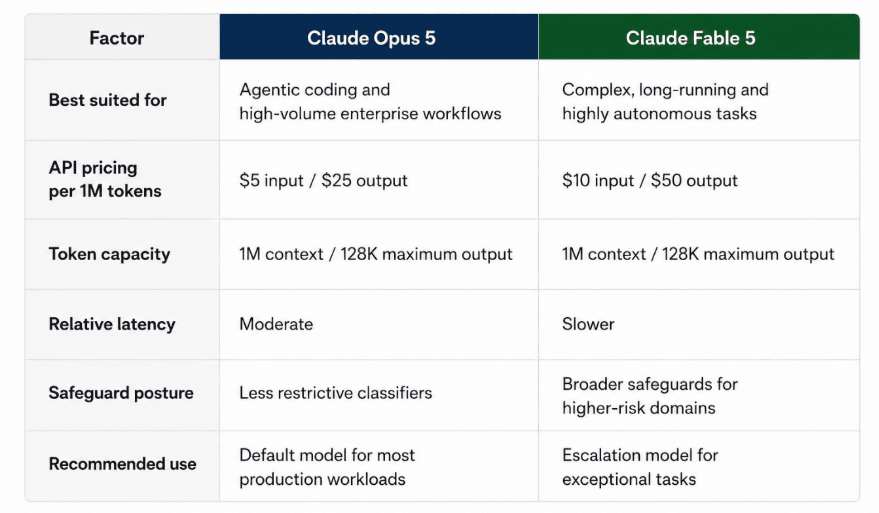
For enterprise teams, the key point is that context capacity is not the main differentiator between the two models. Both support a one-million-token context window and outputs of up to 128,000 tokens through the standard synchronous API. Both are also available through the Claude API for integration into enterprise applications and agentic workflows.
Opus 5 prioritises advanced capability with stronger cost efficiency. Fable 5 is built for workloads where solving ambiguous engineering or research problems justifies higher cost. reasoning depth and longer autonomous operation can justify higher cost and slower responses.
For organisations searching for the best Claude model for enterprise use, these differences become particularly important when planning an enterprise LLM deployment.
Coding, AI Agents and Tool-Based Workflows
Claude Opus 5 is designed for software engineering and agentic workflows that go beyond code generation. It can inspect repositories, invoke APIs, interact with business systems, validate outputs and execute multi-step tasks where reliable tool use matters.
For recurring production workloads such as code review, debugging, test generation and application modernisation, Opus 5 offers a practical balance of reliability, latency and cost. Its ability to verify work and identify underlying issues can also reduce avoidable failures during execution.
These capabilities also make Opus 5 well suited to enterprise agents. Opus 5 can support customer service, IT operations, contract processing and enterprise search where the model must retrieve information, interact with tools and confirm that actions have been completed successfully.
This positions Opus 5 as a production-ready Claude model for AI agents operating across repeatable, tool-based enterprise workflows.
Claude Fable 5 delivers greater value when work is unusually open-ended or requires sustained effort over extended periods. Major system redesign, unfamiliar codebases, complex research and multi-agent development may benefit from its ability to maintain direction across extended tasks.
The key distinction is often how complex the task is and how frequently it runs. A software team may run thousands of code-analysis, testing and bug-resolution requests every month. Using Fable 5 for every task could increase costs without delivering a proportional improvement for routine tasks.
A more practical approach is to use Opus 5 as the standard model and escalate difficult, unresolved or long-running tasks to Fable 5.
This can form the basis of an AI model routing strategy, where requests are directed according to complexity, confidence and business requirements.
However, model capability alone does not create a reliable enterprise system. Organisations still need permission controls, restricted tool access, human approval points, observability, rollback mechanisms and clear escalation rules.
Pricing and Production Economics
According to Anthropic’s current API pricing, Claude Opus 5 costs $5 per million input tokens and $25 per million output tokens, while Claude Fable 5 costs $10 and $50 respectively. Fable 5 is therefore twice as expensive at standard API rates.
This cost difference becomes significant when organisations estimate the economics of running AI workloads at production scale.
At standard API rates, the same workload would cost approximately:
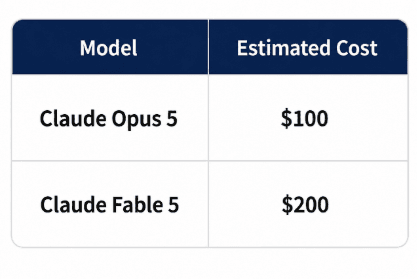
This simplified calculation excludes caching, discounts, tool charges and repeated attempts.
The difference becomes more important for production AI workloads because agentic systems may make multiple model calls for planning, retrieval, tool use and validation.
Enterprises should therefore measure cost per successful outcome rather than cost per API call. A more expensive model may still be economical if it reduces failures or human intervention. Paying for frontier-level capability on predictable tasks can have the opposite effect.
The right model is the one that meets the required quality level at the lowest total operating cost.
Which Claude Model Should Your Enterprise Choose?
Choose Claude Opus 5 when:
1. Production volume is high.
Opus 5 is better suited to recurring workloads where cost and response time matter at scale.
2. Coding and tool use are central.
It fits software engineering, analysis and multi-step agentic tasks requiring consistent execution.
3. Cost efficiency matters.
Lower API pricing makes it a practical default for applications generating large token volumes.
4. You need a production default.
Opus 5 can handle day-to-day enterprise AI while more difficult cases are escalated.
Choose Claude Fable 5 when:
1. The problem is unusually complex.
Fable 5 is suited to ambiguous tasks where deeper reasoning can materially improve the outcome.
2. The workflow requires extended autonomy.
It is relevant for autonomous workflows that must maintain direction across many steps.
3. The work is exploratory.
Complex research, unfamiliar codebases and open-ended engineering are stronger candidates.
4. Additional capability justifies the premium.
Fable 5 makes sense when testing demonstrates enough improvement to justify higher cost and latency.
Conclusion
Claude Opus 5 is the preferred starting point for most enterprise AI workloads. Its combination of advanced capability, moderate latency and lower API costs makes it well suited to coding, analysis and multi-step agentic workflows.
Claude Fable 5 has a different role. Its value is strongest when tasks become unusually complex, open-ended or long-running enough to justify additional reasoning and higher operating costs.
For enterprises, the two models can serve different roles within the same architecture. Opus 5 can handle routine production workloads, while Fable 5 can be introduced when complexity, low confidence or repeated failures require higher capability.
A well-designed LLM model routing approach can make this dynamic, matching model capability with workload complexity while controlling the cost of production AI workloads.
Ultimately, enterprises should evaluate which model delivers the required business outcome while balancing accuracy, speed, cost and control.
How 12th Wonder Can Help
12th Wonder helps enterprises move from model selection to production-ready AI through a structured approach to evaluation, integration, routing, governance and deployment.
Models are evaluated against real workflows, cost, latency and task complexity, then integrated with enterprise data, applications and tools. Workloads can be routed based on complexity, confidence and business requirements, while permissions, observability, approval points and operational controls provide the required governance. The resulting architecture can then be deployed across production environments with reliability, cost and performance continuously measured.
FAQ
Choosing the Right AI Model for Your Enterprise?
Evaluate model performance, workload fit and production costs before you scale.