
EU AI Act Compliance Checklist: Everything Enterprises Need to Know Before 2027

Author

Author

Veera Nagi Reddy Mekala

Director of Tech. Innovation

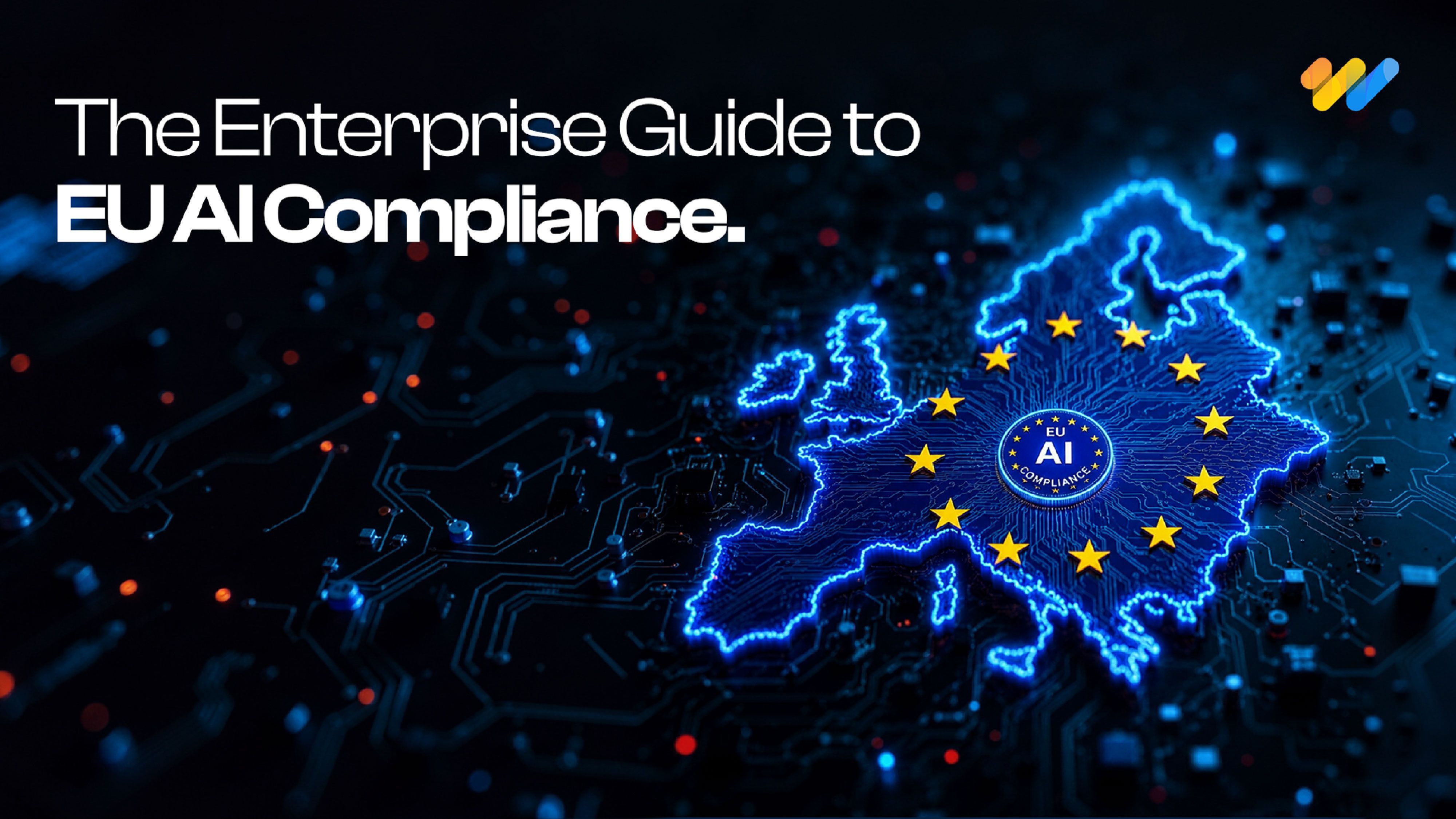
EU AI Act Compliance Checklist

EU AI Act Compliance Checklist: Everything Enterprises Need to Know Before 2027

AI governance has moved from a boardroom discussion to a legal obligation. The EU AI Act is the most comprehensive artificial intelligence policy framework enacted anywhere in the world and enforcement is already underway. For enterprises deploying AI systems in or affecting the European Union, full compliance is required by 2027. The penalties for non-compliance reach up to €35 million or 7% of global annual revenue, whichever is higher.

This guide breaks down what the EU AI Act requires, how it compares to US AI policy and what your organization needs to do right now.

Understanding the EU AI Act and Its Timeline

The EU AI Act takes a risk-based approach to regulating artificial intelligence. Rather than applying uniform rules across all AI applications, it classifies systems into four risk tiers and applies proportionate obligations to each.

The enforcement timeline is already in motion. Provisions banning unacceptable-risk AI systems took effect in early 2025. Obligations for high-risk AI systems and general-purpose AI models are phasing in through 2025 and 2026. Full compliance across all categories is required by August 2027.

Risk Classification: Where Does Your AI System Fall?

Small Language Models vs LLMs

Understanding your AI system's risk classification is the starting point for any EU AI Act compliance program.

Unacceptable Risk (Prohibited)

These systems are banned outright. The category includes social scoring by public authorities, real-time remote biometric identification in public spaces by law enforcement (with narrow exceptions) and AI that manipulates individuals through subliminal techniques. If your organization operates any system in this category, immediate action is required.

High Risk

This is the most regulated category and the one most relevant to enterprise AI teams. High-risk AI systems include those used in employment decisions (CV screening, performance monitoring), credit scoring, healthcare diagnostics, critical infrastructure management, educational assessment and law enforcement tools. If your AI system influences decisions that significantly affect individuals' rights or safety, it is almost certainly high-risk.

Limited Risk

Chatbots and deepfake-generating tools fall into this tier. The primary obligation is transparency. Users must be informed they are interacting with an AI system.

Minimal Risk

Spam filters, AI in video games and similar applications carry no specific obligations under the Act, though general data protection rules still apply.

A practical test: Ask whether your AI system makes or influences consequential decisions about people in regulated domains. If the answer is yes, assume high-risk classification and scope your compliance program accordingly.

EU AI Act Requirements for High-Risk Systems

High-risk AI systems face the most detailed set of EU AI Act requirements. Compliance is not a one-time exercise. It requires ongoing documentation, monitoring and governance infrastructure.

Conformity Assessment

Before deploying a high-risk AI system, organizations must conduct a conformity assessment demonstrating the system meets the Act's technical and governance standards. For many system types, self-assessment is permitted. Some categories require third-party audit.

Technical Documentation

A complete technical file must be maintained covering system design, training data sources, development methodology, performance metrics, known limitations and intended use cases. This documentation must be kept current and made available to regulators on request.

Data Governance

Training data must meet quality standards. Bias testing is mandatory. Organizations must demonstrate that datasets are representative and that data management practices reduce discriminatory outcomes.

Human Oversight

High-risk systems must be designed to allow human intervention. Automated decisions cannot be fully insulated from human review. Oversight mechanisms must be built into the system and documented.

Post-Market Monitoring

Compliance does not end at deployment. Organizations must monitor system performance in production, log incidents and report serious malfunctions to relevant authorities.

General-Purpose AI Models

Foundation models used in EU-facing products carry their own obligations, including training data transparency, safety evaluations and energy consumption reporting for the largest models.

How the EU AI Act Compares to US AI Policy

Global enterprises face the challenge of operating across two regulatory environments with different approaches to artificial intelligence policy.

The United States does not yet have comprehensive federal AI legislation equivalent to the EU AI Act. The US approach relies on executive orders, sector-specific regulation and voluntary frameworks. The NIST AI Risk Management Framework provides a structured methodology for identifying and managing AI risk, but adoption is voluntary for most industries. Sector regulators like the FDA for healthcare AI and the SEC for financial AI apply their existing authority to AI systems within their domains.

DimensionEU AI ActUS Approach
ScopeComprehensive, cross-sectorFragmented, sector-specific
Legal basisBinding regulationExecutive orders + voluntary frameworks
Risk classificationMandatory, tieredSector-dependent
PenaltiesUp to €35M or 7% revenueVaries by sector regulator
TimelinePhased enforcement through 2027No unified deadline
Foundation model rulesYes, explicit obligationsLimited, still developing


For organizations operating in both markets, the practical approach is to build compliance against the EU AI Act's requirements as a baseline. Meeting the EU standard typically satisfies or substantially advances US compliance obligations, particularly for organizations using the NIST AI risk management framework as a reference.

The EU AI Act Compliance Checklist

Use this AI compliance checklist to assess your organization's current readiness and identify gaps.

1. Build a Model Registry

Document every AI system your organization deploys or procures. Include system name, vendor (if third-party), use case, deployment geography and data inputs. Without a complete inventory, risk classification is impossible.

2. Classify Each System by Risk Tier

Apply the EU AI Act's classification criteria to every system in your registry. Flag all probable high-risk systems for deeper assessment.

3. Conduct Risk Assessments for High-Risk Systems

For each high-risk system, complete a formal AI risk assessment framework review covering intended use, foreseeable misuse, impact on fundamental rights and technical robustness.

4. Establish Bias and Fairness Testing Protocols

Define testing methodology, acceptable thresholds and remediation procedures. Testing must occur before deployment and at defined intervals during operation.

5. Document Data Governance Practices

Capture data sourcing, labeling methodology, quality controls and retention policies. This documentation forms part of the required technical file.

6. Define Human Oversight Mechanisms

Identify who has authority to override or pause AI-driven decisions. Build escalation paths into operational processes and document them.

7. Create Transparency Notices

Where the Act requires disclosure (chatbots, AI-generated content, high-risk decisions), draft user-facing notices and integrate them into relevant interfaces.

8. Assess Third-Party AI Vendors

If you deploy AI systems built by third parties, assess whether those vendors have met their obligations under the Act. Contractual responsibility for compliance does not automatically transfer to vendors.

9. Establish Incident Reporting Procedures

Define what constitutes a reportable incident, who is responsible for reporting and how reports are filed with relevant national authorities.

10. Schedule Post-Deployment Monitoring Reviews

Set a cadence for reviewing production system performance against documented benchmarks. Assign ownership within your governance function.

Building a Responsible AI Governance Function

A checklist creates a starting point. Sustained EU AI Act compliance requires an operational governance function.

Assign clear ownership. In most enterprises, AI governance sits across legal, engineering and compliance teams with unclear accountability. Designate a lead responsible for maintaining the model registry, coordinating risk assessments and tracking regulatory developments. Larger organizations are building dedicated AI governance teams.

Implement a governance maturity model to assess and improve your program over time. At the foundational level, organizations have ad hoc AI use with no formal documentation. A developing program has basic inventory and some risk classification in place. A defined program has documented processes, assigned ownership and regular review cycles. An optimized program integrates AI governance into product development from the start and uses continuous monitoring to surface issues proactively.

Most enterprises are currently at the foundational or developing stage. The 2027 deadline requires reaching at least the defined level across all high-risk systems.

Looking ahead, three trends will shape AI governance policy through 2027 and beyond. Regulators will increase enforcement activity as the 2027 deadline approaches, with early enforcement actions likely targeting high-profile industries like financial services and healthcare. The US will move closer to sector-specific binding requirements even without comprehensive federal legislation. AI governance will increasingly be treated as a procurement requirement, with enterprises demanding compliance documentation from AI vendors before deployment.

Organizations that build governance infrastructure now will find ongoing compliance significantly easier. Those that delay will face compressed timelines, higher remediation costs and greater regulatory risk.

12th Wonder works with enterprise teams navigating AI governance policy, responsible AI framework design and compliance readiness across regulated industries. If you are building or scaling an AI governance function, our team can help you move from checklist to operational program.

Request Demo

EU AI Act Compliance Checklist Before 2027

A practical guide to AI governance and compliance readiness under the EU AI Act.

Recent Blogs

Small Language Models vs LLMs

Small Language Models vs LLMs: A Practical Guide to Choosing the Right AI Model for Your Business

The conversation around enterprise AI in 2026 has shifted. While large language models like GPT-4 and Claude still dominate headlines, a quieter revolution is happening at the edge.

Read more...
AI Agent for Your Business

How to Build an AI Agent for Your Business: A Practical Guide (2026)

AI agents are no longer a future-facing experiment. Businesses across industries are using them to handle real workflows right now, and the

Read more...
AI and the Energy Crisis

AI and the Energy Crisis: How Data Centers Are Reshaping the Global Power Grid in 2026

AI data center energy consumption has become one of the defining infrastructure challenges of this decade. The numbers are no longer abstract.
Read more...
predictive analytics supply chain

AI in the Supply Chain: Where Value Is Actually Created

AI adoption across supply chains is accelerating. Investment is growing, pilots are expanding, and technical capability is improving quickly.

Read more...
AI-Powered Development

Vibe Coding in 2026: The Complete Guide to AI-Powered Development

Vibe coding is a natural-language-first approach to software development where you describe what you want in plain English and AI generates functional code for you.

Read more...
Blog cover

AI Trends in 2026: 7 Predictions That Will Reshape Every Industry

The most important AI predictions for 2026, agents, generative AI, industry transformation, governance and what's next. A practical guide for business and technology leaders.

Read more...
Supply Chain & Logistics Intelligence

Real-Time Visibility in Logistics: Why Your Architecture Is Costing You More Than You Think

Here is a number worth pausing on: 45% of logistics organizations have real-time visibility into fewer than half their shipments.

Read more...
Blog cover

Why Field Operations Break When You Can’t See Them on a Map

Field operations rarely fail because teams are not working hard enough. They fail when leaders lose visibility into what is happening, where it is happening, and why.

Read more...
GeoAI powered geospatial analytics and mapping intelligence

What Your GIS Data Actually Needs for GeoAI

We examined why many GeoAI projects fail before they even get started in the previous blog. Let's now discuss what makes GeoAI function in the real world.

Read more...
Artificial intelligence in geospatial data analysis

Why GeoAI Projects Fail Before They Even Start

GeoAI is currently omnipresent. In order to anticipate failures, automate decision-making, and make sense of intricate networks, utilities,

Read more...
Blog cover

GIS Drone Mapping: How Drones Are Powering the Next Era of Real-Time Geospatial Intelligence

GIS drone mapping is rapidly transforming how organizations collect, analyze, and act on geospatial data.

Read more...
digital twins and 3d gis

Digital Twins & 3D GIS Modeling: Global Benefits, Challenges & Solutions

Digital twins and 3D GIS modeling are redefining how organizations plan, operate, and maintain physical asset

Read more...
Blog cover

GeoAI Explained: How Geospatial AI is Solving Real-World Challenges in the U.S.

GeoAI: short for Geospatial Artificial Intelligence is the convergence of geospatial data (location, maps, remote sensing, GPS, GIS systems)

Read more...
Blog cover

The ROI of Implementing a GIS Solution: A Business Case Study Approach

Relying on fragmented data and outdated mapping tools is no longer sustainable for organizations navigating complex,

Read more...
Blog cover

Building a Future-Ready Telecom Data Migration Framework: Tools, Automation, and Real-World Lessons

Telecom data migration is not just about moving data it's about ensuring scalability, security,

Read more...
Blog cover

The Telecom Data Migration Imperative: Challenges, Best Practices & Future-Ready Strategies

As telecom networks rapidly evolve from 4G to 5G and legacy OSS/BSS stacks shift

Read more...
Top 7 Emerging AI Trends to Watch in 2025

Top 7 Emerging AI Trends to Watch in 2025

Pushing deeper into 2025, artificial intelligence continues to sprint from being a promising tool to

Read more...
Geospatial Revolution: Top 10 Industries Benefiting from GIS

Geospatial Revolution: Top 10 Industries Benefiting from GIS

Geographic Information Systems (GIS) have emerged as a powerful tool for businesses and organizations across various sectors.

Read more...
Blog cover

Empowering Smarter Cities: The Role of Geospatial Digital Twins in Urban Planning

Geographic Information Systems (GIS) have emerged as a powerful tool for businesses and organizations across various sectors.

Read more...
Blog cover

Enhancing Customer Experience with Location-Based Services Powered by GIS

Customer experience has emerged as a key differentiator for organizations across industries be it in utilities, retail or public services.

Read more...
Blog cover

Transforming Field Operations with Mobile GIS

Be it in utilities, transportation, or environmental management, field operations are complex and challenging.

Read more...
Emerging trends in GIS: Navigating the geospatial landscape

Emerging trends in GIS: Navigating the geospatial landscape

GIS or Geographical information systems has helped turn maps into advanced tools for problem-solving.

Read more...
Blog cover

How GIS is transforming predictive maintenance in the utility sector

The utility sector is the backbone of the modern economy providing vital services like electricity, water, and gas to people and businesses.

Read more...
Blog cover

Case study spotlight: Streamlining HFC network management with GIS for a US-based Telecom Service Provider

GIS (Geographical Information System) has been crucial to the growth of the telecom sector, providing invaluable geospatial data that benefits even

Read more...
Blog cover

GIS In Action: Real-World Examples of How It's Used

Geographic Information Systems (GIS) have become indispensable tools across a multitude of industries, revolutionizing the way we understand, analyze, and interact with spatial data.

Read more...
Blog cover

Case Study Spotlight: Revolutionizing Utility Asset Management

At 12th Wonder, we are transforming the way utility companies manage their assets. In one of our recent projects, we partnered with a leading utility

Read more...
Blog cover

The Cutting-Edge Benefits of GIS For Telecom Networks

Geographic Information Systems (GIS) are making a big impact in the telecommunications world. Think of GIS as a powerful tool that transforms heaps of data into clear, useful maps.

Read more...
Blog cover

What is Mobile GIS? Here’s what you should know.

The world of Geographic Information Systems (GIS) is changing quickly, and mobile GIS is leading the way. At 12thWonder, we’re using this exciting technology to transform how field data

Read more...
Blog cover

A mix of Introductory and Advanced Geospatial Solutions: 12W's Approach

Geospatial solutions are revolutionizing the way we understand and interact with the space around us. We are at the forefront of this transformative wave, a company that has seamlessly integrated technology

Read more...
Blog cover

The Importance of Data Interoperability in Today’s Geospatial Solutions

Have you ever wondered what makes the digital world tick seamlessly? It’s the magic of data interoperability, especially in the realm of geospatial solutions.

Read more...
Blog cover

Leading Top 10 Best Geospatial Companies

This guide highlights the top 15 GIS (Geographic Information Systems) companies leading the way with their cutting-edge solutions in mapping and spatial analysis.

Read more...
Blog cover

Getting Started in QA Test Automation: Essential Tips for Beginners

Starting on the journey of Quality Assurance (QA) test automation can be both exciting and challenging, especially for companies taking their first steps in this domain.

Read more...
Blog cover

How to Choose the Right QA Services Provider for Your Business: Including a Checklist

In today’s competitive market, software quality assurance (QA) is vital for ensuring robust, reliable, and high-performing software solutions.

Read more...
Blog cover

Solve Your Business Challenges with 12th Wonder's Tailored Digital Transformation Solutions!

Ready to elevate your business with cutting-edge digital solutions? At 12th Wonder we offer a suite of innovative software services. Our goal is to empower your workforce and lead your business towards

Read more...
Blog cover

Integrating QA Test Automation and Manual Testing: A Balanced Approach in Software Development

In software development, you can achieving the highest quality of product by using a strategic blend of both QA test automation and manual testing. While automation is offers speed and repeatability

Read more...
Blog cover

5 Ways QA Automation Can Transform Your Business

Staying ahead of the competition requires including innovative approaches to improve efficiency and quality. This is where QA automation comes into play.

Read more...
Blog cover

Dictionary of GIS Terms

Aerial Photography Mapping: The creation of maps based on the interpretation and analysis of aerial photographs, utilizing differences in vantage points and angles to construct detailed

Read more...
Blog cover

Leading Top 15 Best Software Testing & Quality Assurance Global Companies

This guide highlights the top 15 software testing companies that consistently deliver high value from small, mighty teams. It emphasizes the critical role of QA testing in ensuring software quality

Read more...
Blog cover

Maximizing Business Value: The Transformative Power of Automation in Quality Assurance Services

The integration of automation in Quality Assurance (QA) services has transformed industries by enhancing efficiency, accuracy, and cost-effectiveness.

Read more...
Blog cover

Navigating the Pitfalls of Application Development: How We Ensure a Smooth Journey

The process of application development can be both exciting and daunting. From the spark of an idea to the polished end product, there are numerous stages where errors might occur.

Read more...
Blog cover

Quality Assurance Redefined: Your Path to Success with 12thWonder

Are you ready for help with ensuring the highest quality for your products? Collaborating with 12thWonder for Quality Assurance (QA) services opens the door to a transformative experience that

Read more...
Blog cover

Streamline Your Testing Process with 12th Wonder's Test Automation Services

In this ever-evolving world of software development, where changes happen at the drop of a hat, ensuring quality, speed, and reliability is absolutely essential.

Read more...
Blog cover

7 Ways QA Services Can Reduce Costs in Software Development

In today’s fast-paced world of software development, your company faces a myriad of challenges. Balancing quality and cost-effectiveness is a perpetual struggle.

Read more...