

Beyond Time Saved: How to Measure AI ROI
An AI assistant reviews a 60-page supplier contract in five minutes instead of an hour. The dashboard records 55 minutes saved. But if legal approvals still take three days, has the business really become faster?
This question highlights a limitation in how AI ROI is often measured. Time saved is easy to quantify, but it does not necessarily show whether the organisation gained meaningful value. Faster work matters when it improves accuracy, supports better decisions, removes delays or allows employees to focus on higher-value responsibilities.
This distinction is becoming more important as AI moves into finance, supply chains, customer operations and other core business functions. In these environments, performance depends on reliability, governance, LLM evaluation and measurable business impact.
Time saved remains one of the easiest and most useful leading indicators of AI adoption, but it is only the beginning of the ROI story.
A stronger measurement model must also examine how AI improves the wider workflow, influences business outcomes and expands what the organisation can achieve with its existing people and resources.
Why Time Saved Became the Default Metric
Time is easy to measure. A task previously took three hours and now takes one hour. The difference can be converted into a percentage, multiplied by labour cost and presented as an estimated saving.
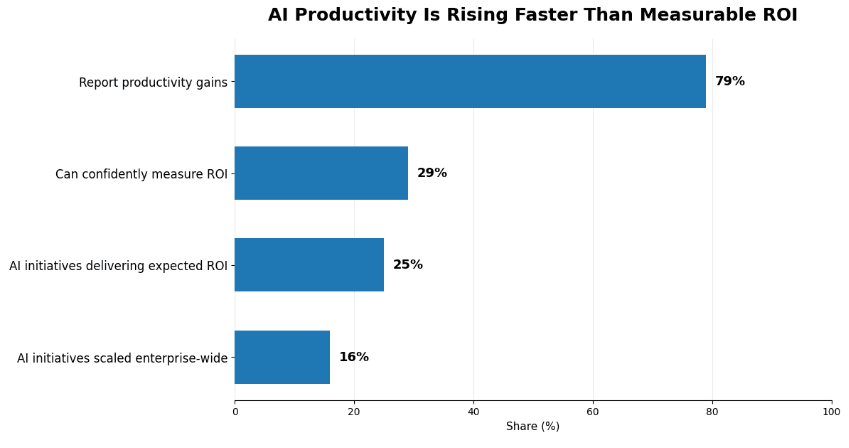
Research also supports the productivity case. A Federal Reserve Bank of St. Louis analysis found that workers using generative AI reported saving an average of 5.4% of their working hours, equivalent to about 2.2 hours in a 40-hour week, with a potential 1.1% increase in aggregate productivity. McKinsey’s 2024 State of AI survey also found that organisations using generative AI were reporting revenue gains, with supply chain and inventory management most commonly seeing increases of more than 5%. Together, these findings show why AI value should be measured beyond time saved.
These findings provide a useful baseline. The financial value of released time still depends on what happens next. An employee may use the available time for additional reviews, administrative work or delayed assignments. The organisation may continue operating with the same output and cost structure. New approval requirements may absorb the available time.
A company receives measurable value when released time supports greater output, better decisions, improved quality or additional capacity.
The First Unit: Workflow Improvement
A stronger AI ROI model begins with the entire workflow. Consider an insurance claim. AI may summarise documents within seconds, while the claim must still pass through verification, fraud screening, approval and payment. A faster summary creates limited value when the file remains in an approval queue for two days.
Workflow-level measurement examines how efficiently work moves from the initial request to the result. Useful indicators include total cycle time, the number of handoffs, rework rate, error frequency, escalation rate and cost per completed case. These measures show whether AI has reduced friction across the process.
This same principle extends to supplier onboarding as well. AI may review documents, extract compliance data and flag missing information within minutes, while the supplier still waits days for risk, legal and procurement approvals. Cycle time, exception rate, rework, approval delays and onboarding quality provide a clearer view. AI creates measurable value when suppliers move through the process faster, teams resolve exceptions earlier and approval bottlenecks decline.
Workflow improvement therefore offers a more reliable unit of measurement than task speed alone.
The Second Unit: Business Outcomes
Workflow improvement becomes financially relevant when it influences an outcome the organisation already values. For a sales team, that outcome may be increasing proposal acceptance from 32% to 39% or shortening the sales cycle. In procurement, it may involve lower purchasing costs, fewer contract exceptions or improved supplier performance. Finance teams may focus on reducing month-end close from eight days to five, improving forecast accuracy or detecting unusual transactions earlier.
Every AI Agent ROI framework should have a visible connection to an operational or financial result. For example, an AI system that helps account managers prepare for customer meetings could be evaluated through qualified opportunities, proposal acceptance, account growth, customer retention and follow-up speed.
This creates a clear value pathway. Faster research improves meeting preparation, which supports more relevant customer conversations and may increase proposal acceptance or account growth. A business outcome does not need to be immediate revenue. Reduced regulatory exposure, better service quality, fewer errors and improved forecasting can also create significant economic value. The selected outcome should therefore be specific, measurable and connected to the workflow in which AI is used.
The Third Unit: Organisational Capacity
Capacity answers a simple question: can your organisation handle more work without adding more people?
A compliance team may use AI to review more documents without immediately increasing headcount. A customer operations team may handle seasonal demand while maintaining service quality, while a product team may analyse more feedback and test more ideas within the same planning cycle.
This capacity can be measured through output per employee, cases handled per team, the number of experiments completed, the ability to absorb demand increases, reduced dependence on external services and the time employees can allocate to judgement-intensive work. These indicators show whether AI is helping the organisation achieve more without a proportional increase in resources.
Capacity also includes the speed at which an organisation learns. AI tools and multi-agent systems can help teams analyse customer feedback, operational performance and market developments more frequently. This allows problems to be identified earlier and decisions to be updated using recent evidence. Leaders should therefore measure whether AI helps the organisation manage greater complexity, respond faster and pursue opportunities that were previously limited by available resources.
A Practical AI ROI Scorecard
A useful AI ROI scorecard should show where value is created and where it disappears. An AI tool may have high usage and impressive task-level speed gains, yet still produce little business value if approvals, rework or downstream bottlenecks remain unchanged. The reason becomes clear when AI is evaluated at the process level rather than the task level.
1. Adoption
Start by checking whether the AI system is actually being used in the workflow it was designed to improve. Track active users, repeat usage, task coverage and training completion. For example, if a contract-review assistant is available to 200 employees but only 35 use it regularly, weak adoption may explain why expected ROI has not appeared.
2. Workflow KPIs
Next, measure what changed across the full process. Track cycle time, handoffs, rework, errors, escalations and cost per completed workflow. If AI reduces contract review from 60 minutes to five minutes but the approval process still takes three days, the workflow has not improved materially. This layer identifies whether AI has removed an actual bottleneck or simply accelerated one step.
3. Business Impact
Then connect the workflow change to an outcome the organisation already measures. A finance team might track whether AI helps reduce month-end close from eight days to five. A sales team might examine whether proposal acceptance increases from 32% to 39%. Procurement may measure contract exceptions, purchasing cost or supplier onboarding time. The metric should reflect the reason the AI initiative was funded in the first place.
4. Organisational Capacity
Finally, measure whether the organisation can handle more work with the same resources. A compliance team might increase the number of files reviewed per analyst without adding headcount. A procurement team may onboard more suppliers during a demand spike without increasing external support. Capacity gains show whether AI has created usable operating leverage rather than simply freed isolated minutes.
Each layer needs a baseline recorded before deployment. Leaders should then trace the value pathway from usage to workflow change to business result. For example, faster document review should reduce approval time, faster approval should shorten supplier onboarding and shorter onboarding should allow the business to activate suppliers sooner.
The scorecard is most useful when one layer exposes a break in that chain. High adoption with unchanged cycle time points to a workflow problem. Faster workflows with no movement in revenue, cost, risk or service quality suggest that the use case may be solving the wrong problem. That is the difference between measuring AI activity and measuring AI ROI.
Conclusion: Measure What the Organisation Can Accomplish
AI ROI cannot be fully understood through a record of hours saved.
The value appears when faster work improves the surrounding process, influences a meaningful business result or creates additional organisational capacity. Leaders should examine the complete value pathway. They need to identify how the workflow changed, which outcome improved and how the released capacity was used.
This approach also supports better investment decisions. Use cases with strong adoption, but limited workflow impact may require process redesign. Projects that improve cycle time without influencing a business result may need a clearer strategic purpose. Initiatives that expand output, quality and responsiveness may deserve further investment.
A time-saving figure explains how quickly one task was completed. A complete ROI model explains how the organisation became more productive, responsive and capable. The real unit of AI ROI is the measurable improvement in what an organisation can accomplish with its people, systems and resources.
FAQ
Build an AI ROI Framework That Measures Business Value
Learn how to connect AI initiatives to measurable workflow improvements, business outcomes and organisational capacity.