
Small Language Models vs LLMs: A Practical Guide to Choosing the Right AI Model for Your Business

Author

Author

Veera Nagi Reddy Mekala

Director of Tech. Innovation

Small Language Models vs LLMs

Small Language Models vs LLMs: A Practical Guide to Choosing the Right AI Model for Your Business

The conversation around enterprise AI in 2026 has shifted. While large language models like GPT-4 and Claude still dominate headlines, a quieter revolution is happening at the edge. Small language models are winning real-world deployments across industries where cost, speed and data privacy matter more than raw capability. IBM has predicted 2026 as the year frontier and efficient model classes diverge and technical leaders are paying close attention.

If your team is evaluating AI architecture, the small language models vs LLM debate is no longer academic. It is a practical infrastructure decision with direct impact on your budget, your compliance posture and your product performance.

What Are Small Language Models?

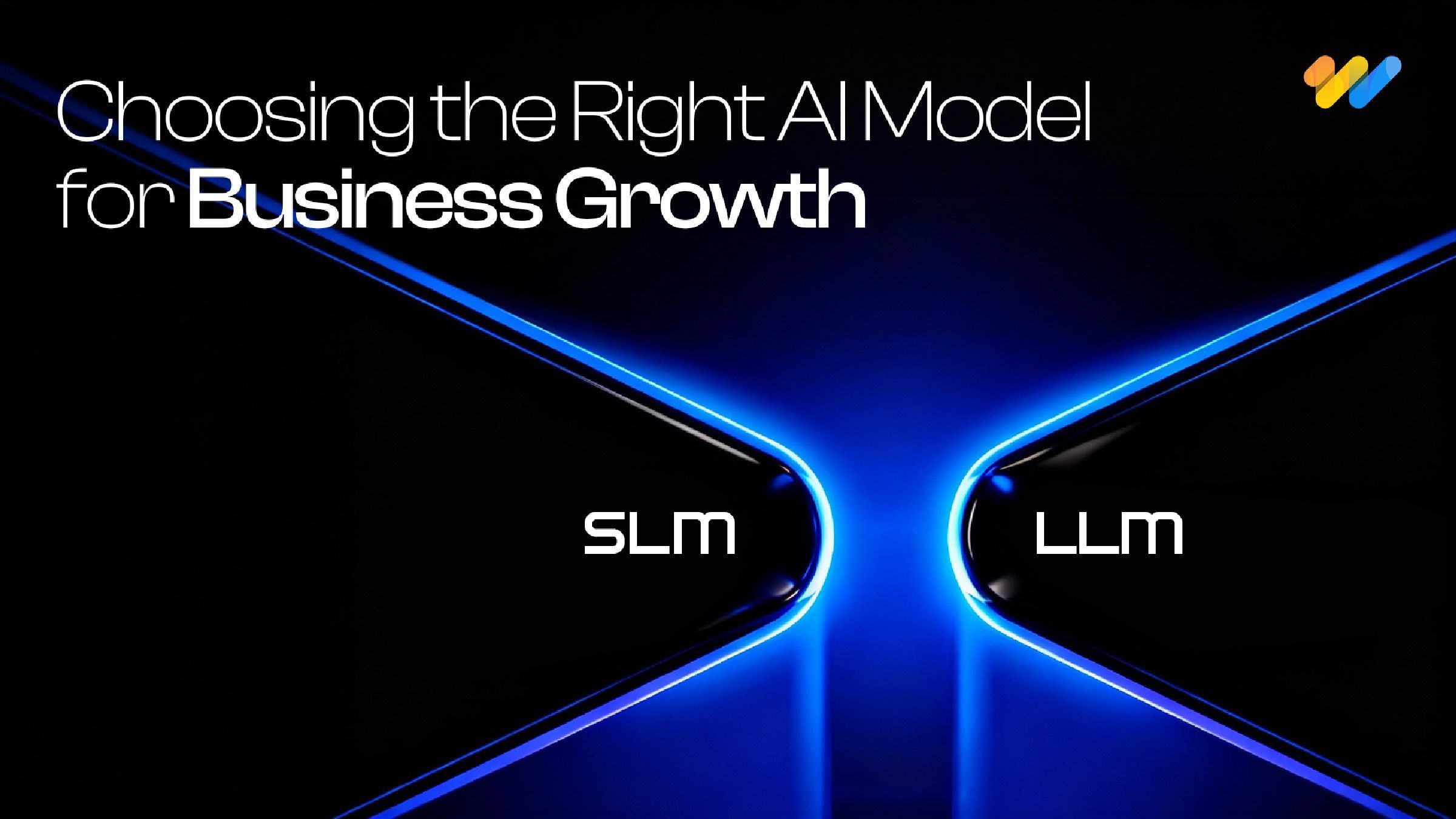
Small language models (SLMs) are AI models with fewer than 10 billion parameters. Large language models typically sit at 70 billion parameters and above. That size difference translates into a significant gap in compute requirements, infrastructure cost and deployment flexibility.

Popular SLMs in active enterprise use today include Microsoft's Phi-3 family, Google's Gemma, Meta's Llama 3.2 and Mistral. These models are purpose-built for efficiency without sacrificing usefulness for targeted tasks. They run on consumer-grade hardware, on mobile devices and in edge environments where cloud connectivity is limited or restricted.

The rise of small language models reflects a maturing AI market. Early adopters chased capability above all else. The next wave of enterprise AI adoption is being led by organizations that need reliable, cost-efficient and compliant systems.

SLM vs LLM: A Direct Comparison

Understanding the practical differences between SLMs and LLMs helps teams make informed architecture decisions rather than defaulting to the largest available model.

DimensionSmall Language ModelsLarge Language Models
Parameter countUnder 10B70B and above
Inference cost$0.01–$0.10 per 1M tokens$0.50–$5.00 per 1M tokens
LatencyReal-time on edge devicesHigher, often cloud-dependent
Complex reasoningLimitedStrong
Deployment optionsCloud, edge, mobile, offlinePrimarily cloud
Data privacyOn-device, data never leavesRequires cloud transmission
Fine-tuning easeFaster, lower costResource-intensive
Maintenance overheadLowHigh

Running SLMs can be 10 to 50 times cheaper than equivalent LLM inference at scale. For high-volume workloads like customer support automation, document classification or field data processing, that cost differential determines whether a project is economically viable at all.

When Small Language Models Win

Small Language Models vs LLMs /></p><h5 class=Real-Time Edge and Field Operations

Edge AI models are critical for environments where cloud connectivity is unreliable or unavailable. Manufacturing floors, field operations, logistics hubs and remote infrastructure all require AI that can process data locally and return results immediately. SLMs fit this profile precisely because they run on-device without requiring round-trips to a cloud API.

For organizations using GeoAI or field operations technology, on-device AI reduces dependency on network conditions and cuts per-query costs substantially. A model processing thousands of sensor readings or field reports per day becomes financially sustainable only when inference happens locally.

Mobile Applications with Offline Capability

On-device AI is one of the fastest growing deployment patterns for mobile applications. Users expect AI features to work without a signal. SLMs enable intelligent autocomplete, real-time translation, document parsing and personalized recommendations without sending data to external servers. This matters both for user experience and for app store compliance in privacy-sensitive categories.

Privacy-Sensitive Domains

Healthcare, legal services and financial institutions face strict data residency and regulatory requirements. Local AI models allow these organizations to run inference without exposing patient records, legal documents or financial data to third-party cloud infrastructure. GDPR, HIPAA and similar frameworks create real legal risk when data crosses jurisdictional or organizational boundaries. SLMs running on-premise or on-device eliminate that risk by design.

High-Volume Classification and Automation

LLM cost optimization becomes a primary concern when AI is integrated into workflows at scale. Sentiment analysis, intent detection, content moderation, ticket routing and document tagging are tasks that require millions of inferences per month. Running these through a large language model is often unnecessary from a capability standpoint and expensive from a cost standpoint. Fine-tuned small language models match or exceed LLM performance on these narrow tasks at a fraction of the cost.

Low-Latency Applications

Chatbots, autocomplete engines and interactive assistants require sub-second response times to feel natural. LLMs introduce latency due to the compute required per token. SLMs respond faster, making them better suited for conversational interfaces where delay directly degrades the user experience.

When Large Language Models Are Still the Right Choice

Choosing an efficient AI model does not mean using a small one for every task. LLMs retain clear advantages in several scenarios.

Complex multi-step reasoning, legal analysis across large document sets, advanced code generation and nuanced creative tasks still favor large models. When a task requires synthesizing ambiguous information from multiple sources and drawing reliable conclusions, scale matters. LLMs have broader contextual understanding and stronger generalization across domains.

Multilingual support is another area where large models lead. SLMs trained on narrower datasets often underperform on low-resource languages or on tasks requiring seamless code-switching between languages.

The most practical enterprise AI architecture in 2026 is a hybrid model routing system. Simple queries and high-volume classification go to SLMs. Complex reasoning tasks, multi-turn analysis and edge-case handling route to LLMs. This approach captures the cost benefits of small language models enterprise deployment while preserving LLM capability where it genuinely adds value.

Model distillation is worth considering here as well. Organizations can train smaller models using outputs from large models as a form of knowledge transfer. The result is an SLM that performs well on a specific task domain at a significantly lower inference cost.

How to Choose: A Decision Framework

When evaluating small language models vs LLM options for a specific use case, five questions clarify the decision quickly.

What is your latency requirement? If the task requires real-time or near-real-time response (under 500ms), a small language model running locally is almost always the right starting point.

Where does the data need to stay? If data cannot leave a device, a facility or a jurisdiction, local AI models are required. Cloud-based LLMs are not viable in this scenario regardless of their capability.

What is your inference budget? Calculate projected monthly query volume and multiply by cost per query. If total inference cost exceeds 15 to 20 percent of the feature's expected revenue contribution, the cost profile of LLMs likely makes the project unsustainable.

How complex is the reasoning required? Single-domain tasks with clear inputs and outputs suit SLMs. Tasks requiring synthesis across multiple knowledge domains or nuanced judgment benefit from LLMs.

Do you need offline capability? If the application must function without internet access, on-device AI is the only viable architecture. SLMs are the practical choice.

Quick Reference Decision Matrix

ScenarioRecommended Approach
Edge or field deploymentSLM on-device
Regulated data (healthcare, legal, finance)SLM on-premise or local
High-volume classification or automationFine-tuned SLM
Complex reasoning or multi-step analysisLLM
Mobile app with offline supportSLM on-device
Mixed workload with variable complexityHybrid routing (SLM + LLM)
Multilingual or broad generalizationLLM
Cost-sensitive high-frequency tasksSLM

Building for the Efficient AI Era

The efficient AI models landscape in 2026 gives technical leaders more options than ever. The decision between small language models and LLMs is rarely all-or-nothing. Most enterprise AI architectures benefit from a tiered approach: SLMs handling the workload majority and LLMs reserved for tasks that genuinely require their capabilities.

Getting this right reduces infrastructure costs, improves response times, simplifies compliance and creates AI systems that scale with business growth rather than against it.

At 12th Wonder, our teams work with organizations at every stage of this decision, from initial architecture scoping to production deployment of edge AI models and hybrid inference systems. Whether you are building your first on-device AI feature or redesigning an existing AI stack for cost efficiency, the right model selection framework is where the work starts.

Request Demo

Small Language Models vs LLMs: Choosing the Right AI Model

A practical guide to cost, performance and deployment tradeoffs for enterprise AI systems.

Recent Blogs

EU AI Act Compliance Checklist

EU AI Act Compliance Checklist: Everything Enterprises Need to Know Before 2027

AI governance has moved from a boardroom discussion to a legal obligation. The EU AI Act is the most comprehensive artificial intelligence policy framework enacted anywhere in the world and enforcement is already underway.

Read more...
AI Agent for Your Business

How to Build an AI Agent for Your Business: A Practical Guide (2026)

AI agents are no longer a future-facing experiment. Businesses across industries are using them to handle real workflows right now, and the

Read more...
AI and the Energy Crisis

AI and the Energy Crisis: How Data Centers Are Reshaping the Global Power Grid in 2026

AI data center energy consumption has become one of the defining infrastructure challenges of this decade. The numbers are no longer abstract.

Read more...
predictive analytics supply chain

AI in the Supply Chain: Where Value Is Actually Created

AI adoption across supply chains is accelerating. Investment is growing, pilots are expanding, and technical capability is improving quickly.

Read more...
AI-Powered Development

Vibe Coding in 2026: The Complete Guide to AI-Powered Development

Vibe coding is a natural-language-first approach to software development where you describe what you want in plain English and AI generates functional code for you.

Read more...
Blog cover

AI Trends in 2026: 7 Predictions That Will Reshape Every Industry

The most important AI predictions for 2026, agents, generative AI, industry transformation, governance and what's next. A practical guide for business and technology leaders.

Read more...
Supply Chain & Logistics Intelligence

Real-Time Visibility in Logistics: Why Your Architecture Is Costing You More Than You Think

Here is a number worth pausing on: 45% of logistics organizations have real-time visibility into fewer than half their shipments.

Read more...
Blog cover

Why Field Operations Break When You Can’t See Them on a Map

Field operations rarely fail because teams are not working hard enough. They fail when leaders lose visibility into what is happening, where it is happening, and why.

Read more...
GeoAI powered geospatial analytics and mapping intelligence

What Your GIS Data Actually Needs for GeoAI

We examined why many GeoAI projects fail before they even get started in the previous blog. Let's now discuss what makes GeoAI function in the real world.

Read more...
Artificial intelligence in geospatial data analysis

Why GeoAI Projects Fail Before They Even Start

GeoAI is currently omnipresent. In order to anticipate failures, automate decision-making, and make sense of intricate networks, utilities,

Read more...
Blog cover

GIS Drone Mapping: How Drones Are Powering the Next Era of Real-Time Geospatial Intelligence

GIS drone mapping is rapidly transforming how organizations collect, analyze, and act on geospatial data.

Read more...
digital twins and 3d gis

Digital Twins & 3D GIS Modeling: Global Benefits, Challenges & Solutions

Digital twins and 3D GIS modeling are redefining how organizations plan, operate, and maintain physical asset

Read more...
Blog cover

GeoAI Explained: How Geospatial AI is Solving Real-World Challenges in the U.S.

GeoAI: short for Geospatial Artificial Intelligence is the convergence of geospatial data (location, maps, remote sensing, GPS, GIS systems)

Read more...
Blog cover

The ROI of Implementing a GIS Solution: A Business Case Study Approach

Relying on fragmented data and outdated mapping tools is no longer sustainable for organizations navigating complex,

Read more...
Blog cover

Building a Future-Ready Telecom Data Migration Framework: Tools, Automation, and Real-World Lessons

Telecom data migration is not just about moving data it's about ensuring scalability, security,

Read more...
Blog cover

The Telecom Data Migration Imperative: Challenges, Best Practices & Future-Ready Strategies

As telecom networks rapidly evolve from 4G to 5G and legacy OSS/BSS stacks shift

Read more...
Top 7 Emerging AI Trends to Watch in 2025

Top 7 Emerging AI Trends to Watch in 2025

Pushing deeper into 2025, artificial intelligence continues to sprint from being a promising tool to

Read more...
Geospatial Revolution: Top 10 Industries Benefiting from GIS

Geospatial Revolution: Top 10 Industries Benefiting from GIS

Geographic Information Systems (GIS) have emerged as a powerful tool for businesses and organizations across various sectors.

Read more...
Blog cover

Empowering Smarter Cities: The Role of Geospatial Digital Twins in Urban Planning

Geographic Information Systems (GIS) have emerged as a powerful tool for businesses and organizations across various sectors.

Read more...
Blog cover

Enhancing Customer Experience with Location-Based Services Powered by GIS

Customer experience has emerged as a key differentiator for organizations across industries be it in utilities, retail or public services.

Read more...
Blog cover

Transforming Field Operations with Mobile GIS

Be it in utilities, transportation, or environmental management, field operations are complex and challenging.

Read more...
Emerging trends in GIS: Navigating the geospatial landscape

Emerging trends in GIS: Navigating the geospatial landscape

GIS or Geographical information systems has helped turn maps into advanced tools for problem-solving.

Read more...
Blog cover

How GIS is transforming predictive maintenance in the utility sector

The utility sector is the backbone of the modern economy providing vital services like electricity, water, and gas to people and businesses.

Read more...
Blog cover

Case study spotlight: Streamlining HFC network management with GIS for a US-based Telecom Service Provider

GIS (Geographical Information System) has been crucial to the growth of the telecom sector, providing invaluable geospatial data that benefits even

Read more...
Blog cover

GIS In Action: Real-World Examples of How It's Used

Geographic Information Systems (GIS) have become indispensable tools across a multitude of industries, revolutionizing the way we understand, analyze, and interact with spatial data.

Read more...
Blog cover

Case Study Spotlight: Revolutionizing Utility Asset Management

At 12th Wonder, we are transforming the way utility companies manage their assets. In one of our recent projects, we partnered with a leading utility

Read more...
Blog cover

The Cutting-Edge Benefits of GIS For Telecom Networks

Geographic Information Systems (GIS) are making a big impact in the telecommunications world. Think of GIS as a powerful tool that transforms heaps of data into clear, useful maps.

Read more...
Blog cover

What is Mobile GIS? Here’s what you should know.

The world of Geographic Information Systems (GIS) is changing quickly, and mobile GIS is leading the way. At 12thWonder, we’re using this exciting technology to transform how field data

Read more...
Blog cover

A mix of Introductory and Advanced Geospatial Solutions: 12W's Approach

Geospatial solutions are revolutionizing the way we understand and interact with the space around us. We are at the forefront of this transformative wave, a company that has seamlessly integrated technology

Read more...
Blog cover

The Importance of Data Interoperability in Today’s Geospatial Solutions

Have you ever wondered what makes the digital world tick seamlessly? It’s the magic of data interoperability, especially in the realm of geospatial solutions.

Read more...
Blog cover

Leading Top 10 Best Geospatial Companies

This guide highlights the top 15 GIS (Geographic Information Systems) companies leading the way with their cutting-edge solutions in mapping and spatial analysis.

Read more...
Blog cover

Getting Started in QA Test Automation: Essential Tips for Beginners

Starting on the journey of Quality Assurance (QA) test automation can be both exciting and challenging, especially for companies taking their first steps in this domain.

Read more...
Blog cover

How to Choose the Right QA Services Provider for Your Business: Including a Checklist

In today’s competitive market, software quality assurance (QA) is vital for ensuring robust, reliable, and high-performing software solutions.

Read more...
Blog cover

Solve Your Business Challenges with 12th Wonder's Tailored Digital Transformation Solutions!

Ready to elevate your business with cutting-edge digital solutions? At 12th Wonder we offer a suite of innovative software services. Our goal is to empower your workforce and lead your business towards

Read more...
Blog cover

Integrating QA Test Automation and Manual Testing: A Balanced Approach in Software Development

In software development, you can achieving the highest quality of product by using a strategic blend of both QA test automation and manual testing. While automation is offers speed and repeatability

Read more...
Blog cover

5 Ways QA Automation Can Transform Your Business

Staying ahead of the competition requires including innovative approaches to improve efficiency and quality. This is where QA automation comes into play.

Read more...
Blog cover

Dictionary of GIS Terms

Aerial Photography Mapping: The creation of maps based on the interpretation and analysis of aerial photographs, utilizing differences in vantage points and angles to construct detailed

Read more...
Blog cover

Leading Top 15 Best Software Testing & Quality Assurance Global Companies

This guide highlights the top 15 software testing companies that consistently deliver high value from small, mighty teams. It emphasizes the critical role of QA testing in ensuring software quality

Read more...
Blog cover

Maximizing Business Value: The Transformative Power of Automation in Quality Assurance Services

The integration of automation in Quality Assurance (QA) services has transformed industries by enhancing efficiency, accuracy, and cost-effectiveness.

Read more...
Blog cover

Navigating the Pitfalls of Application Development: How We Ensure a Smooth Journey

The process of application development can be both exciting and daunting. From the spark of an idea to the polished end product, there are numerous stages where errors might occur.

Read more...
Blog cover

Quality Assurance Redefined: Your Path to Success with 12thWonder

Are you ready for help with ensuring the highest quality for your products? Collaborating with 12thWonder for Quality Assurance (QA) services opens the door to a transformative experience that

Read more...
Blog cover

Streamline Your Testing Process with 12th Wonder's Test Automation Services

In this ever-evolving world of software development, where changes happen at the drop of a hat, ensuring quality, speed, and reliability is absolutely essential.

Read more...
Blog cover

7 Ways QA Services Can Reduce Costs in Software Development

In today’s fast-paced world of software development, your company faces a myriad of challenges. Balancing quality and cost-effectiveness is a perpetual struggle.

Read more...