

AI Agent ROI: How to Measure It Before You Build
What was once considered cutting-edge technology reserved for large tech firms has now become part of everyday business operations. In the year 2025, AI agents are quietly revolutionizing the way companies conduct their operations through automation, rapid decision-making, increased efficiencies, and scalable customer operations.
With applications ranging from customer service and sales operations to internal processes and enterprise-scale automation, firms are using AI to increase efficiency, eliminate bottlenecks, and operate more effectively in an increasingly competitive environment.
However, as the adoption of enterprise AI grows, one key question that always influences any major AI investment is:
Will investing in AI deliver measurable business value?
Many businesses adopt AI without clearly measuring its operational impact. If AI does not improve efficiency, reduce costs, or create measurable operational value, the investment becomes difficult to justify. ROI is based on results.
Here, we examine the ways to measure ROI of an AI Agent, reasons why many AI implementations do not provide such ROI, the hidden costs that are often not considered by companies when implementing AI, as well as a practical framework for 90 days for validating ROI before implementing large-scale AI.
The Hidden Problem with AI ROI Calculations
In most businesses, AI Return on Investment is measured by its effect on reducing manpower and saving costs that become apparent. This is important; however, it gives an incomplete picture of ROI. The actual value generated by an AI agent includes not only labour savings, but also efficiency and scalability. In fact, in many situations, these benefits can produce a more significant return on investment compared to replacing employees.
Typically, enterprise AI projects do not succeed due to the lack of performance indicators and effective planning of the implementation. Many organizations make huge investments into AI, without paying enough attention to their operational inefficiencies.
For instance, a company uses an artificial intelligence chatbot, which manages to make the conversation efficient. At the same time, however, the processes for escalations are conducted manually, leading to inefficiency. As such, although the technology works perfectly, its business value remains undetermined.
The Real Purpose of AI Agent ROI

The value of ROI of AI Agent cannot be measured only in terms of expenditure on technology. The real value of ROI of AI Agent comes in terms of minimizing operational friction, enhancing scalability of businesses and facilitating fast decision-making processes. With AI investments growing exponentially by 2025, companies have moved beyond just automation buzz to focus more on optimizing workflows.
The 5-Variable ROI Formula
1. Decision Velocity
A reliable AI ROI calculation requires more than estimating cost savings. To evaluate AI Agent ROI properly, businesses need to measure multiple variables that directly influence operational and financial performance.
First and foremost, there is the issue of time saved. In the business world, the time saved by AI agents through the reduction of manual intervention and hours saved on repetitive tasks is one of the ways that companies assess their return on investment from the use of these technologies. For instance, an AI agent employed to triage issues arising from IT operations could cut response times from 25 minutes to just 5 minutes, thus leading to enormous cost savings. Even small changes in workflow time in enterprise settings could lead to business process automation savings.
Nevertheless, this metric does not give an entire snapshot of AI Agent ROI.
2. Operational Efficiency Gains
The benefits of AI’s improved efficiency are usually more important compared to labour savings. The true benefit of AI agents is derived from the improvement in efficiency, decrease in delays, better coordination, and increased throughput.
This can be measured by the organization through quicker approvals, minimal downtime, better execution of workflow activities, and fewer bottlenecks. In the same way, banks and logistics firms have also started employing AI agents for monitoring their workflows and making real-time adjustments. For instance, logistics companies can make use of AI agents for dynamically re-routing delivery shipments based on weather, storage facilities, and cost of fuel; while a bank can utilize AI agents for detecting any irregularity in transactions and conducting fraud investigations.
Not only is the usefulness of AI being realized in terms of automating tasks, but also through the improvement of organizational responses, reducing delays, and quicker business decision-making.
It therefore means that labour savings should not be prioritized when implementing AI solutions. Instead, focus should be on reducing operational costs AI techniques.
3. Error Reduction
Error minimization is one of the key factors that drive AI Agent ROI. The use of AI to automate routine processes makes it possible to minimize errors caused by non-compliance, data entry mistakes, and operational inconsistencies.
This can be gauged in terms of low error rates, minimized expenses on fixing errors, compliance fines, and more accurate service. In many instances, savings from automation within enterprises are not a result of reduced workforce, but rather of avoiding costly operational mistakes.
This is specially important for sectors such as healthcare, financial services, telecommunications, logistics, utilities, and others.
For instance, a hospital network that leverages AI agents for managing documentation and verifying insurance coverage will make very few mistakes related to record duplication and other administrative challenges. Rather than manually checking all patient intake sheets and claims management information, AI agents will be able to perform such processes much more effectively, eliminating errors in real time.
In healthcare facilities, where any mistakes in operational management could influence patient health and compliance with regulations, minimizing mistakes through AI technologies is quite beneficial.
4. Revenue Impact
ROI of AI Agents is not restricted to cost savings alone. AI agents can generate revenue growth as well through improved sales responsiveness, lead scoring, customer loyalty, product recommendations, and enhanced customer experience. Intelligent business intelligence AI platforms can additionally support quick and well-informed revenue decisions.
Typically, these benefits are quantified through improved conversion ratios, increased customer loyalty, upselling opportunities, and efficient sales processes. For instance, an AI agent sales assistant that reduces the time taken to respond from two hours to five minutes can make a huge difference in conversion results.
These factors are an important component of the AI transformation ROI picture, especially for companies looking to scale and grow as a customer-oriented organization.
5. Scalability Value
Scalability is an often-underestimated aspect of ROI for AI Agent. Contrary to the traditional business model where growth in operations means growth in staffing too, AI agents make possible the scaling of operations despite a relatively unchanged number of employees.
The result is reflected in the enhanced capability of operational processes, higher amounts of workload supported, and cross-functional automation of processes. While a manual workforce would manage 500 tickets within a day, an AI-driven process could easily handle thousands of requests with more efficiency.
All that helps generate long-term value and improve the ROI on enterprise AI.
A Simple AI Agent ROI Formula
A practical ROI formula looks like this:
ROI = ((Time Savings + Efficiency Gains + Error Reduction + Revenue Impact + Scalability Value) - Total AI Investment) / Total AI Investment × 100
This formula creates a broader and more realistic AI ROI calculation model.
The Hidden Costs of Enterprise AI Adoption
Most businesses do not consider the real expense associated with the adoption of AI technology. The adoption cost may end up being much more expensive than what was anticipated because most businesses only focus on the advantages and cost savings associated with AI while ignoring other factors.
1. Integration Costs
The AI agent is very rarely designed to operate alone within the enterprise environment. For an AI agent to work properly, it requires to be integrated into the current CRM system, ERP system, API, database, cloud service, or other relevant monitoring system.
As organizations adopt more AI technology within their processes, the lack of proper integration planning will likely become one of the biggest sources of increased costs.
2. Data Preparation Costs
The success of AI applications is highly contingent on having good quality data but too often companies underestimate the amount of work necessary to prepare this data. Aspects like data cleansing, knowledge structuring, and establishing governance frameworks often demand considerable investment for AI applications to be efficient. In fact, poor quality of data is one of the most common reasons for the failure of corporate AI initiatives.
3. AI Monitoring and Maintenance
A common fallacy about AI integration is that implementation ends when it is deployed. However, the reality is that the implementation of AI needs to be ongoing. Having appropriate monitoring tools, monitoring model performance, ensuring compliance, and handling human escalation are crucial steps for sustainable operation and efficient functioning.
4. Infrastructure Investment
Often, many companies fail to appreciate the infrastructure implications that come with the implementation of large-scale AI. Enterprise AI infrastructure often requires GPU computing, cloud scalability, vector databases, observability tools, and secure storage systems. When it comes to big enterprise AI investments, the costs related to infrastructure are quite high.
5. Organizational Change Costs
The adoption of artificial intelligence is also associated with substantial operational and organisational changes in addition to the actual implementation of technologies. The firm will need to consider employee training costs, change management issues, process design, resistance within the organisation, and other operational considerations before adopting AI technologies. The successful adoption of artificial intelligence is thus not only about implementing AI tools but also being prepared operationally to use AI agents.
Hidden Value Companies Underestimate
While organizations often focus on immediate savings, they frequently underestimate the long-term value of AI agents and enterprise AI investment. Beyond automation, AI improves scalability, decision-making, operational visibility, and competitive advantage.
1. Real-Time Decision Support
One major long-term advantage from the use of artificial intelligence in the long term is increased decision velocity. Decision velocity refers to making better decisions faster by leveraging AI technology to speed up processes such as incident resolution, customer support, financial decision making, and operations management.
2. Institutional Knowledge Retention
One of the most important advantages of investing in enterprise AI solutions lies in knowledge management. AI solutions contribute to knowledge management by helping enterprises retain their vital know-how, rather than having it dissipate due to employee churn and corporate shifts.
3. Cross-Department Automation
A good AI workflow is never confined within the walls of one department alone. Several companies first implement AI solutions to deal with their customers and then use automation processes in sales, HR, IT, and accounting departments. Business automation ROI becomes more effective as this implementation takes place throughout the company.
4. Improved Analytics and Visibility
AI-based analytical tools offer visibility into processes that businesses were unable to access previously. Through detecting the weaknesses within workflows, identifying process efficiencies, analyzing customer behavior, and forecasting trends in operations, AI bots deliver greater visibility into business operations. Enhanced visibility leads to better strategy formulation, quicker decision-making, and optimized operations.
5. Competitive Positioning
Early adopters of AI agents stand to gain much from their use due to enhanced speed, efficiency, and automation. As Google investments in AI and company deployment of AI solutions become faster on a global level, companies that lag behind with their adoption of AI solutions may have an increasingly difficult time competing.
How to Measure AI Success Properly
For an effective AI agent ROI measurement, well-defined KPIs need to be developed before AI implementation. Usually, organizations consider performance indicators like task execution time, error rate improvement, operational costs, number of escalations, adoption rates, and client satisfaction for AI analysis.
The benchmarking process must involve the pre-implementation period, pilot, and post-pilot periods of the AI. Otherwise, the AI ROI would just remain as an assumption due to the lack of benchmarking.
The 90-Day Pilot Framework
Pilot testing for the validation of ROI for AI agents is recommended prior to large investment decisions related to the enterprise AI strategy. Pilot testing allows businesses to determine the ROI and minimize risks in the implementation process.
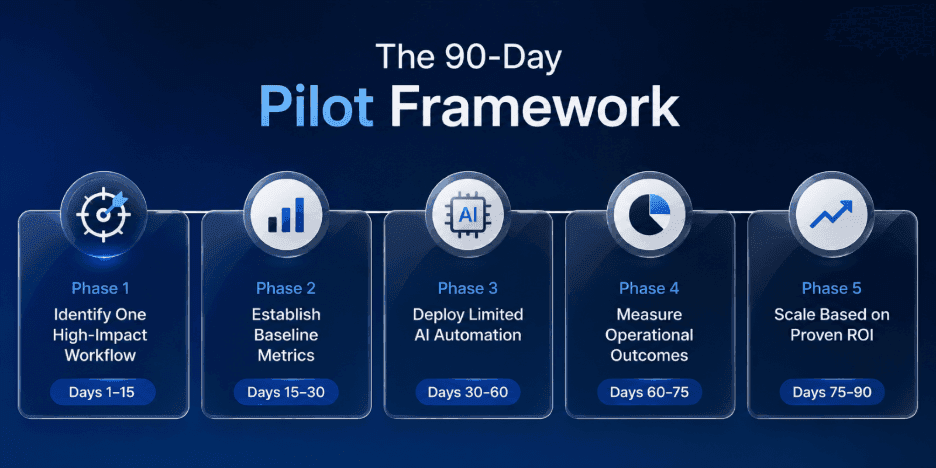
Phase 1: Identify One High-Impact Workflow (Days 1–15)
The first thing to do is to identify a workflow that is repetitive, takes much time, can be measured, and operationally critical. Typical applications range from helpdesk ticket routing, sales qualifying, document management, IT incident investigation, and internal company information search.
For example, the customer support team at an enterprise-level organization getting hundreds of tickets per day can use an AI-powered agent to automatically classify the requests, pull relevant knowledge base articles, and prioritize the high priority issues. As compared to eliminating the customer support team, the use of AI agent enables them to respond quicker, resolve the tickets faster, and engage with more valuable customers.
Hence, it brings about tangible benefits even during the pilot stage. In this early phase of implementation, companies are advised to keep the scope narrow and simple.
Phase 2: Establish Baseline Metrics (Days 15–30)
The organization needs to determine its baseline metrics in terms of costs, completion time, frequency of mistakes, workload, rate of escalations, and customer response time before employing AI systems. This ensures that you have set up a proper AI benchmarking framework and can easily measure any operational gains after adopting AI.
Phase 3: Deploy Limited AI Automation (Days 30–60)
In the next step, organizations need to implement controlled automation using AI. In the stage, one must concentrate on performance consistency, workflow reliability, operational impact, AI analytics insights, and human escalations. The emphasis must be on measuring business success, not just the technical success.
Phase 4: Measure Operational Outcomes (Days 60–75)
Upon successful implementation of the pilot, the organization can analyze measurable gains like reductions in time and cost, operational efficiency, improved processes, increased productivity, and business automation ROI. The analysis helps to get a better understanding of the return on investment of AI Agent.
Phase 5: Scale Based on Proven ROI (Days 75–90)
However, if the pilot shows value in terms of operation and finance, the process of scaling of AI begins. Once the pilot proves successful, companies can expand automation gradually across teams and workflows. Large-scale scaling of AI is only possible after achieving validation of measurable ROI and being ready to scale.
Common Pitfalls with AI Agent Return on Investment
Considering Cost Reduction in Employees Only
Many companies look at the return on investment in AI Agent from just labour savings point of view. However, the actual benefit often comes from operational improvements and scalability.
Neglecting Workflow Improvement
Poor workflow optimization hardly makes a good automation candidate for AI Agent. Companies should first make sure their workflow processes are optimized before AI deployment.
Not Considering Governance
Unmanaged Enterprise AI systems pose many operational risks for businesses as time goes by.
Assuming Full Automation of Operations
Full automation works better in theory than in practice. Hybrid human and AI processes often prove more effective in the real world.
Scaling Up Prematurely
Premature AI expansion can significantly increase the AI implementation budget without proven business outcomes. Organizations should validate AI Agent ROI first and scale only after measurable success.
Final Thoughts
Over the next few years, the companies that succeed with AI will not necessarily be the ones deploying the most advanced models. They will be the organizations that understand their workflows deeply enough to measure operational impact before scaling automation.
AI Agent ROI is not about hype, futuristic demonstrations, or replacing human teams overnight. Its real value lies in transforming operations through measurable efficiency, workflow optimization, and sustainable business impact.
What separates companies that truly benefit from enterprise AI investment is not how cutting-edge their AI systems are, but how effectively they measure outcomes, optimize processes before automation, and scale AI based on proven operational success rather than assumptions.
In the years ahead, the leading organizations will treat AI not as experimental innovation, but as foundational business infrastructure. Companies that focus on measurable impact, operational efficiency, and intelligent workflow transformation will build the strongest long-term competitive advantage.
Before adopting AI agents, measure your workflows. Before scaling automation, measure your ROI. And before increasing your AI investment, measure the business value your AI systems actually create.
FAQ
AI Agent ROI Starts with Operational Clarity
A practical approach to measuring efficiency, automation impact and business value.