
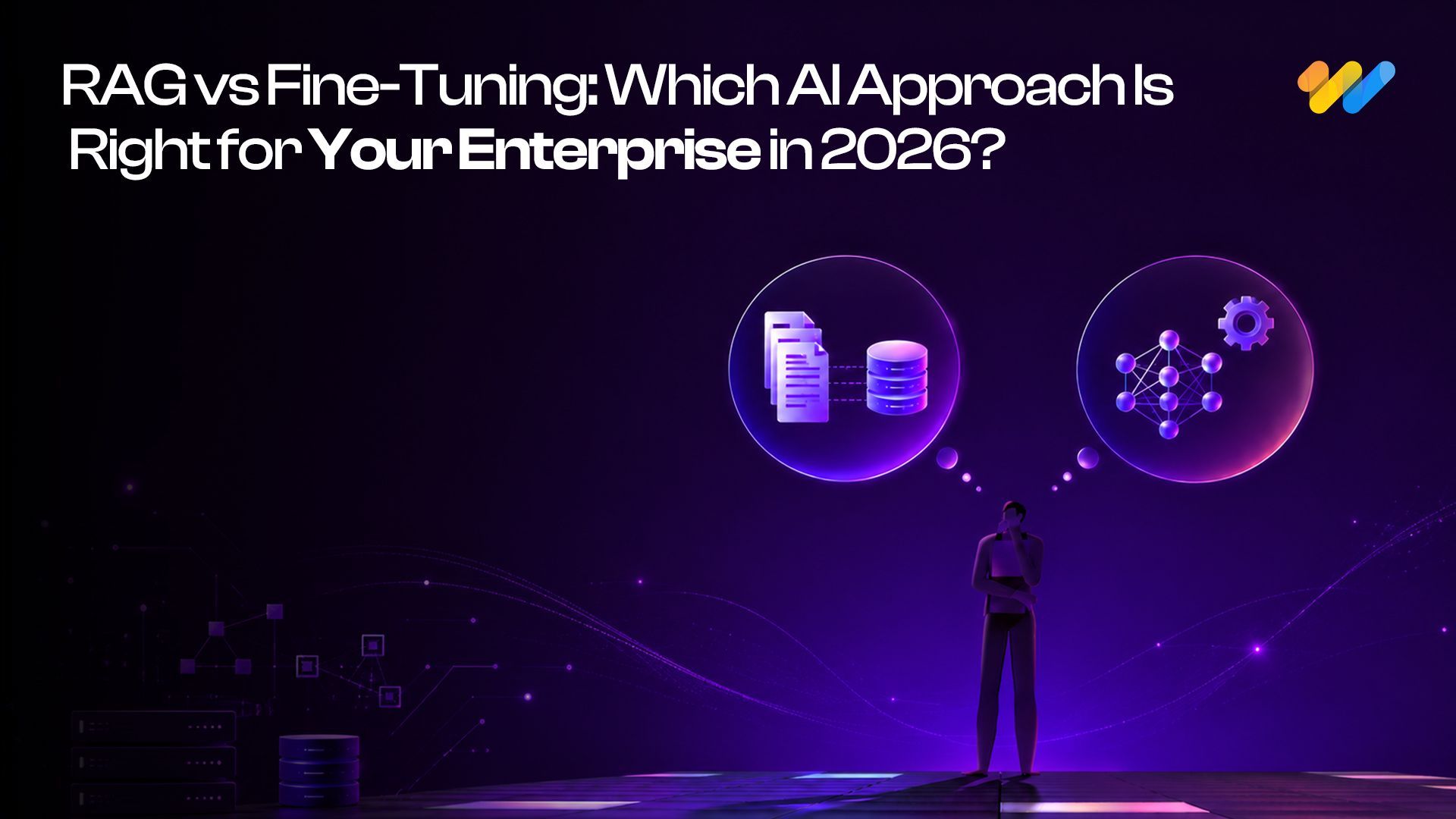

RAG vs Fine-Tuning: Which Approach Fits Your Enterprise Use Case?
| Key Takeaways | ᐯ |
- RAG provides access to current and frequently changing information.
- Fine-tuning improves specialized behaviour and output consistency.
- Common failures come from poor retrieval design or unsuitable training data.
- Architecture choices should reflect real implementation requirements and constraints.
- Hybrid systems improve capability but add engineering and maintenance complexity.
- The right approach depends on data, use case, scalability and budget.
In 2025, enterprise AI moved beyond experimentation and into real business workflows. McKinsey reported that 71% of organizations were regularly using generative AI in at least one business function, increasing the pressure on enterprises to build AI systems that are reliable, scalable and suited to production environments.
As organizations deploy AI assistants, enterprise search platforms, copilots and autonomous agents, one architecture decision becomes increasingly important: should the system use Retrieval-Augmented Generation, fine-tuning or both?
RAG gives AI applications access to current information from enterprise knowledge sources, while fine-tuning improves specialized behaviour, task performance and output consistency.
Choosing between them determines implementation cost, maintenance effort, scalability and long-term business value. This guide compares how each approach works, where it performs best, its limitations and when a hybrid architecture offers the stronger enterprise solution.
What Is RAG?
Retrieval-Augmented Generation (RAG) is an AI architecture that improves large language models by retrieving relevant information from external sources during inference and providing that information as context before generating a response.
This allows AI applications to access current, domain-specific knowledge without retraining the underlying model whenever business information changes, reducing maintenance effort and making updates faster.
How RAG Works
RAG combines information retrieval and language generation to produce responses that are accurate, relevant and grounded in trusted data sources. The model retrieves relevant information from internal data repositories at the time of a request and uses that information to generate a response.
Example: An employee asks an AI assistant, "What is our current travel reimbursement policy for international business trips?"
Step 1: User Submits a Query
The process begins when a user asks a question or submits a request to the AI application.
Step 2: Query Is Converted into Embeddings
The query is transformed into vector embeddings, which capture its semantic meaning and enable similarity-based searches across large collections of information.
Step 3: Relevant Information Is Retrieved
The system searches enterprise knowledge sources such as vector databases, document repositories, internal knowledge bases, or business systems to identify the most relevant information. In this example, it retrieves the latest travel policy document and related reimbursement guidelines.
Step 4: Retrieved Context Is Added to the Prompt
The retrieved information is supplied to the language model as additional context, ensuring the model has access to current and relevant business information before generating a response.
Step 5: The Model Generates a Grounded Response
Using both the user's query and the retrieved context, the model generates a response based on the latest policy documentation rather than relying solely on its training data.
Why Organizations Use RAG?
Organizations use RAG when business knowledge changes too frequently to be embedded and maintained inside the model itself. By retrieving relevant information from trusted business data at the time of a request, it improves accuracy, reduces hallucinations and keeps responses grounded in trusted data.
Because the knowledge layer is managed separately, teams can update policies, procedures and product information without modifying the underlying model. This makes the architecture practical for environments where approved content changes regularly.
The effectiveness of a RAG system depends on the quality of its retrieval process. Poor retrieval can affect response quality and implementing RAG typically requires supporting infrastructure such as embedding models, vector databases and retrieval pipelines.
In addition, retrieved information must fit within the model's context window, which can limit the amount of information available for a single response. Despite these considerations, RAG remains a widely adopted approach for enterprise AI applications that rely on current and continuously evolving information.
What Is Fine-Tuning?
Fine-tuning is the process of training a pre-trained language model on additional domain-specific data to improve its performance on particular tasks, workflows, or communication styles. By updating the model's internal weights, organizations can customize how the model responds, enabling more predictable responses and stronger performance on defined tasks.
This process updates the model’s weights using curated examples, helping it learn industry terminology, business processes and preferred response patterns.
It is particularly valuable when outputs must follow defined formats, terminology, compliance rules or repeatable workflows. Because desired behaviours are incorporated directly into the model, it can also reduce the need for complex prompt engineering.
However, fine-tuning requires high-quality training data and additional effort for dataset preparation, training, evaluation and deployment. Knowledge learned during training can also become outdated over time, meaning significant changes to products, policies, or business information may require retraining.
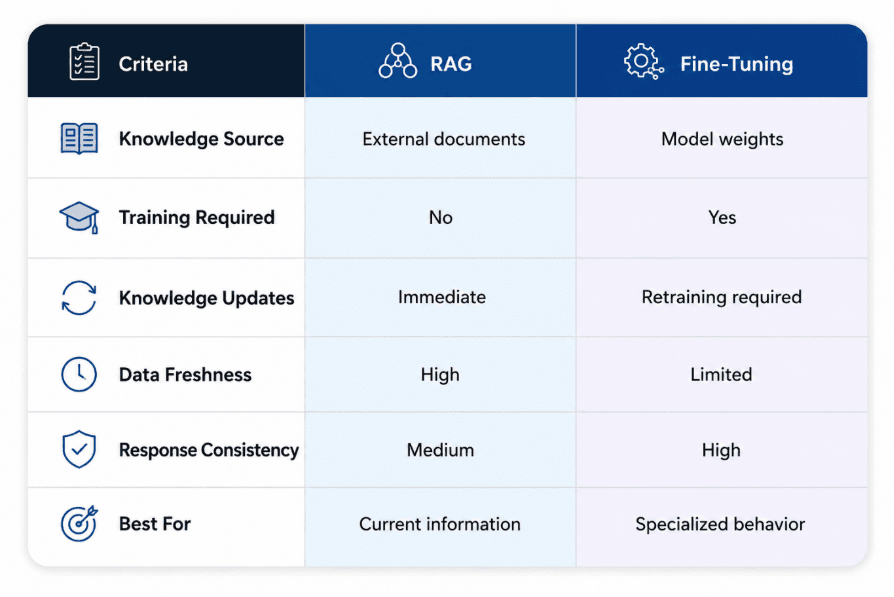
RAG vs Fine-Tuning: What Is the Core Difference?
Although both approaches can improve enterprise AI performance, they solve different architectural problems. RAG gives the model access to relevant external knowledge, while fine-tuning changes how it behaves and performs specific tasks. RAG and fine-tuning are often discussed together because both can significantly improve AI application performance. However, they address different aspects of an AI system. RAG focuses on providing access to relevant information by supplying relevant external context for each query. Fine-tuning adapts model behaviour by learning from curated domain-specific examples.
The most important distinction is how knowledge is incorporated into the system. With RAG, information remains external to the model and can be updated independently through documents, databases, knowledge bases, or business systems. With fine-tuning, patterns, behaviours and task-specific capabilities are learned during training and become part of the model itself.
As a result, RAG is typically used when AI applications depend on current and frequently changing information, while fine-tuning is commonly used when organizations require greater consistency, specialized behaviour, or adherence to specific formats and workflows. Understanding this distinction is essential for selecting the right approach for enterprise AI applications.
Comparison Table
A Simple Analogy
RAG is like giving an employee access to a company knowledge base before answering a question. Fine-tuning is like training that employee to follow a specific process or communication style.
6 Enterprise Use Cases: Which Approach Should You Choose?
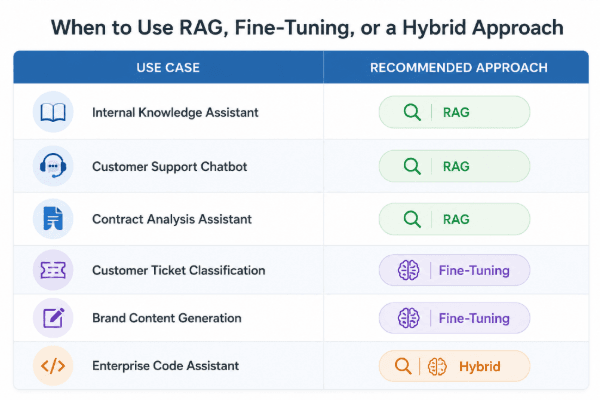
1. Enterprise Knowledge Assistants: Use RAG
Knowledge assistants must answer questions using the latest policies, manuals, product information and internal documentation. RAG keeps responses grounded in approved sources without retraining the model whenever content changes.
2. Customer Support Automation: Use a Hybrid Approach
Support systems need current product information and consistent customer-facing responses. RAG retrieves the latest account, policy or troubleshooting context, while fine-tuning helps maintain tone, structure and escalation rules.
3. Document Classification: Use Fine-Tuning
Fine-tuning is well suited to repetitive classification tasks such as routing support tickets, identifying contract types, categorizing claims or tagging compliance documents.
4. Regulatory and Compliance Assistants: Use RAG
Compliance applications depend on information that changes across regulations, policies and internal controls. RAG allows teams to update the knowledge layer without changing the underlying model.
5. Structured Content Generation: Use Fine-Tuning
Fine-tuning is effective when outputs must follow a defined format, terminology or style. Common examples include reports, summaries, product descriptions and standardized business communications.
6. Enterprise Copilots and AI Agents: Use a Hybrid Approach
Copilots and agents often need access to current business data while also following specific workflows and operational rules. RAG provides the context, while fine-tuning improves task execution and response consistency.
When a Hybrid Architecture Makes Sense
A hybrid architecture is valuable when an application needs both current knowledge and controlled behaviour. The retrieval layer supplies relevant business context, while the fine-tuned model applies organizational terminology, workflows and output standards.
This combination can improve grounding and consistency in production, but it also adds infrastructure, evaluation and maintenance requirements. Enterprises should use it when neither approach can meet the use case independently.
Hybrid Architecture Overview
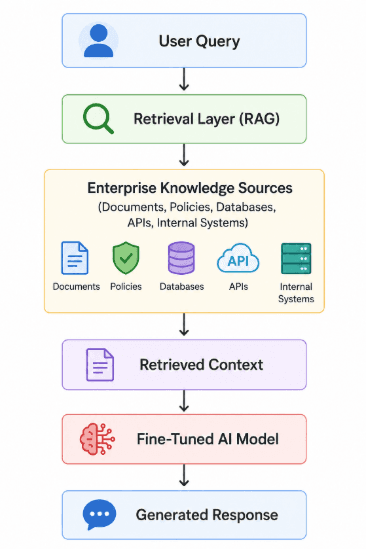
Many enterprise AI applications combine RAG and fine-tuning to benefit from both current knowledge and specialized behaviour. In a hybrid architecture, RAG retrieves relevant information from enterprise data sources. The fine-tuned model then uses that information to generate responses that follow organizational standards, workflows, or formats.
Conclusion
The right architecture depends on whether the primary requirement is better knowledge access, more controlled model behaviour or a combination of both. It enables AI systems to access current, business-specific information. Fine-tuning improves consistency, specialization and task performance. For many organizations, the most effective approach is a hybrid architecture that combines the strengths of both.
The right choice depends on your use case, data environment, operational requirements and long-term AI goals. By aligning the architecture with business needs, organizations can build AI solutions that are accurate, scalable and easier to maintain.
At 12th Wonder, we help organizations design, build and scale enterprise AI solutions, from RAG-powered knowledge assistants and AI agents to fine-tuned models and end-to-end AI platforms. Our focus is on delivering practical AI solutions that create measurable business outcomes.
Find the Right AI Architecture for Your Business
Explore whether RAG, Fine-Tuning, or a Hybrid Approach suits your enterprise goals.