

Start with pgvector: When Enterprise RAG Needs a Dedicated Vector Database
A RAG system can have a powerful LLM and still fail because the retrieval layer brings the wrong context.
Vector databases influence retrieval by determining how embeddings are indexed, filtered and ranked. Their support for metadata filters, hybrid search, access controls and index tuning affects which information reaches the LLM, how quickly it is returned and whether restricted content remains protected.
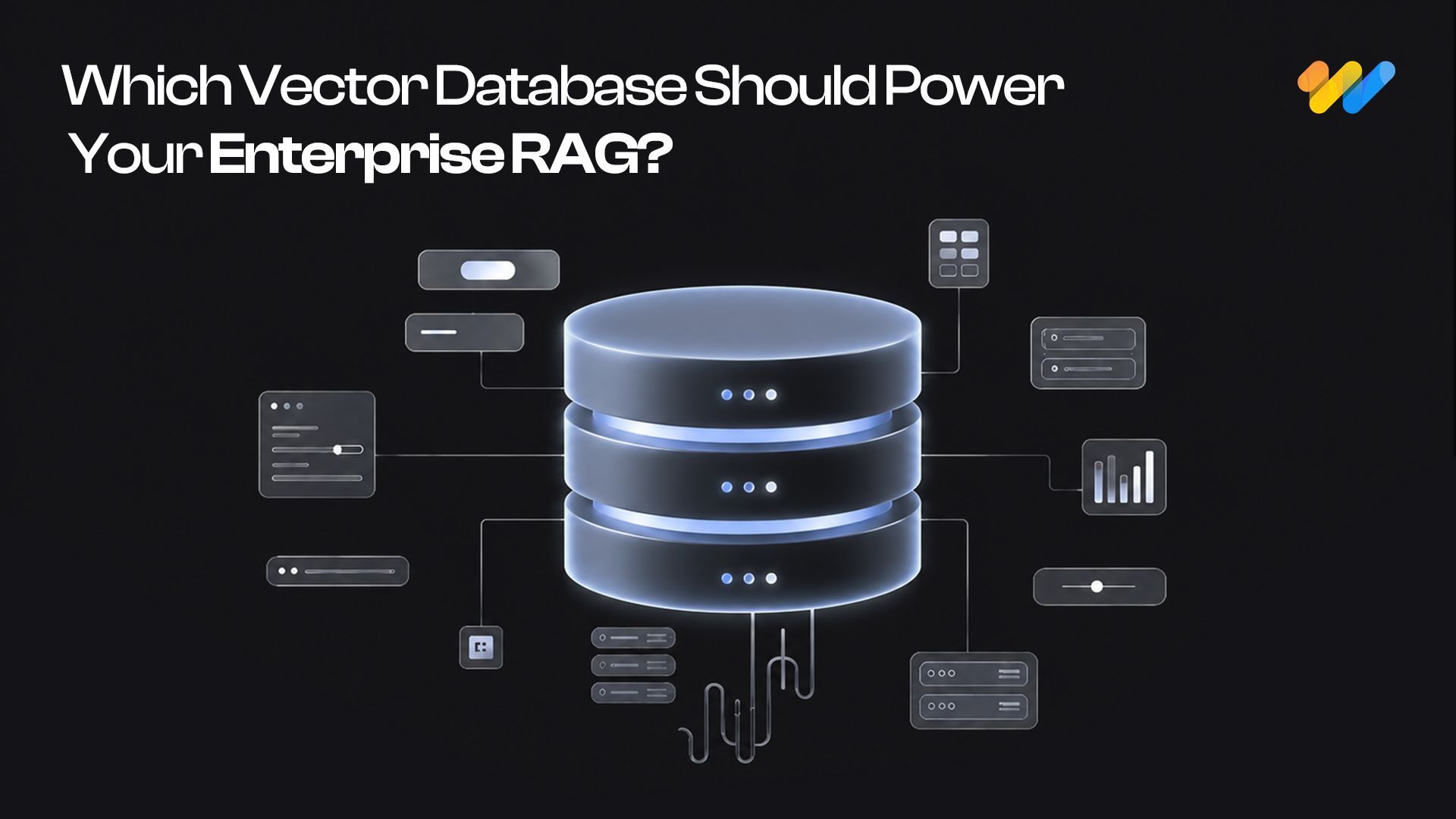
This comparison evaluates Pinecone, pgvector, Milvus and OpenSearch across retrieval quality, scale, cost, operational effort and enterprise controls. The recommendation is clear: start with pgvector unless your workload presents a specific reason to choose a more specialized platform.
In the early stages, retrieval design, chunking strategy, metadata quality and access control usually matter more than database specialization. A specialized vector database cannot compensate for poorly divided documents, missing metadata, weak permission filters or retrieval logic that consistently selects irrelevant context. Teams should first prove that the system retrieves the right information for the right user before optimizing the infrastructure underneath it.
Why Vector Database Selection Matters in Enterprise RAG
A RAG system depends on the quality of the context it retrieves. When the retrieval layer brings incomplete, outdated or irrelevant content, the final answer becomes unreliable.
A vector database stores embeddings and helps the system find semantically similar content. In enterprise use cases, that job extends beyond similarity search. The retrieval layer also needs filters, permissions, ranking controls, monitoring and stable performance under real usage.
Consider a US healthcare provider building an internal RAG assistant. A billing team member may need insurance claim guidelines, while a clinical operations manager may need procedure documents. The system cannot retrieve every policy for every user. It has to understand permissions, document type, department and freshness before the LLM generates an answer.
The right vector database affects recall, latency, operational effort, cost and migration flexibility. A poor choice can slow delivery, increase infrastructure burden and make retrieval harder to tune later.
Do You Need a Dedicated Vector Database?
Many teams assume every RAG system needs a dedicated vector database. That assumption can add infrastructure before the workload actually demands it.
If your organization already uses PostgreSQL, pgvector can support many early and mid-stage RAG workloads. It provides exact similarity search and approximate indexes such as HNSW and IVFFlat, making it practical for datasets ranging from thousands to several million vectors.
With sufficient memory, indexing and partitioning, pgvector can sometimes scale into tens of millions of vectors. Its limits become more visible when concurrency rises, metadata filters become complex, indexes consume excessive memory or the application requires consistently low latency at scale.
Consider a mid-sized US SaaS company that already stores customer accounts, support tickets and product documentation metadata in PostgreSQL. If its first RAG use case is an internal support copilot for 50 to 100 agents, pgvector offers a practical starting point. The team can validate retrieval quality without introducing a separate database, monitoring stack or vendor contract.
A dedicated vector database becomes more useful once these workload pressures are measurable. Pinecone may suit teams that want managed scaling, Milvus may fit large self-hosted workloads and OpenSearch may be stronger when hybrid search and keyword relevance are central requirements.
The same decision should be considered within the wider build-versus-buy evaluation for enterprise AI platforms, where control, speed, operational effort and vendor dependency must be assessed together.
Selection Criteria That Matter
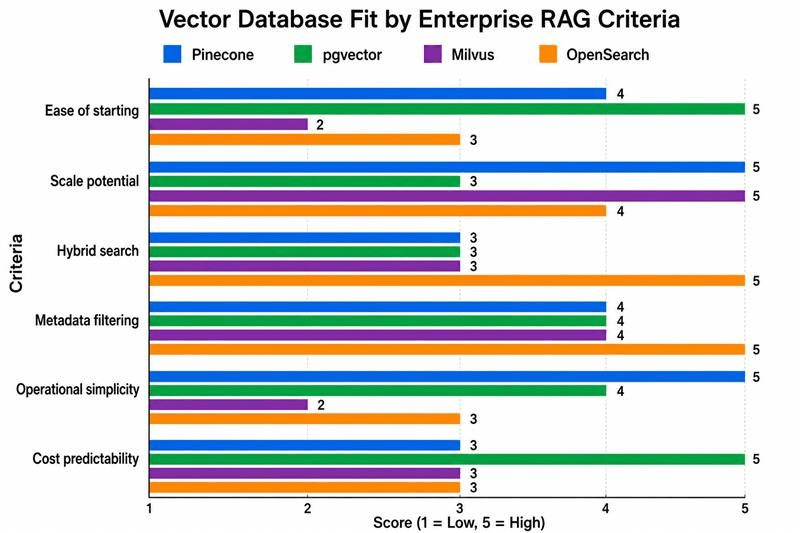
Choosing a vector database becomes easier when teams begin by evaluating the workload.
Consider a company building an internal RAG assistant for a few hundred employees. It may only need to search a few hundred thousand vectors, apply basic access filters and return results within a reasonable time. An e-commerce platform with millions of products, thousands of simultaneous searches and strict latency targets faces a very different challenge.
Scale is only part of the decision. The index also affects retrieval speed, memory use and result quality. HNSW can provide fast search and strong recall, while IVF-based indexes may require more tuning. Teams should evaluate latency alongside recall, ensuring fast responses still retrieve the most relevant context.
The database must also understand who is making the request. A financial services employee may need policies based on role, region or product line. Metadata filtering and access controls help ensure that the system retrieves useful information without exposing restricted content.
Hybrid search matters when users enter exact terms such as product codes, policy clauses or machine models. Semantic retrieval may understand the broader meaning of a query but still miss a precise identifier. Combining keyword and vector signals can improve results in these situations.
Operations and cost complete the evaluation. Infrastructure, monitoring, backups, engineering effort, service fees and future migration work all contribute to the actual cost of the platform.
Teams should connect these costs to measurable business outcomes by evaluating AI agent ROI before committing to the architecture.
These criteria help explain where each database fits.
Pinecone
Pinecone is designed for teams that want scalable vector search without operating specialized infrastructure themselves. Its managed model can reduce deployment and maintenance work, while dense and sparse retrieval support makes it suitable for workloads that combine semantic and keyword signals.
It is most useful when operational simplicity and managed scaling are priorities. Teams should still evaluate pricing, usage limits and vendor dependency before committing.
Pgvector
Pgvector brings vector search into PostgreSQL, allowing embeddings, metadata, permissions and application data to remain in the same environment. This can simplify development for organizations that already rely on Postgres.
It works well for internal assistants, support copilots and moderate-scale RAG systems. As vector volume, concurrency or latency demands increase, teams may eventually need more specialized infrastructure.
Milvus
Milvus is an open-source vector database built for large-scale similarity search. It supports several index types, metadata filtering, BM25 full-text search and dense-sparse hybrid retrieval.
This flexibility gives engineering teams more control over deployment and tuning. It also introduces greater operational responsibility, which makes Milvus more suitable for mature workloads than early-stage pilots.
OpenSearch
OpenSearch is a strong option when vector retrieval is part of a broader search experience. It combines semantic search with keyword matching, filters, ranking controls and search observability.
This makes it particularly useful for document-heavy systems and products where exact terms remain important. For teams that only need basic vector similarity search, it may introduce more complexity than necessary.
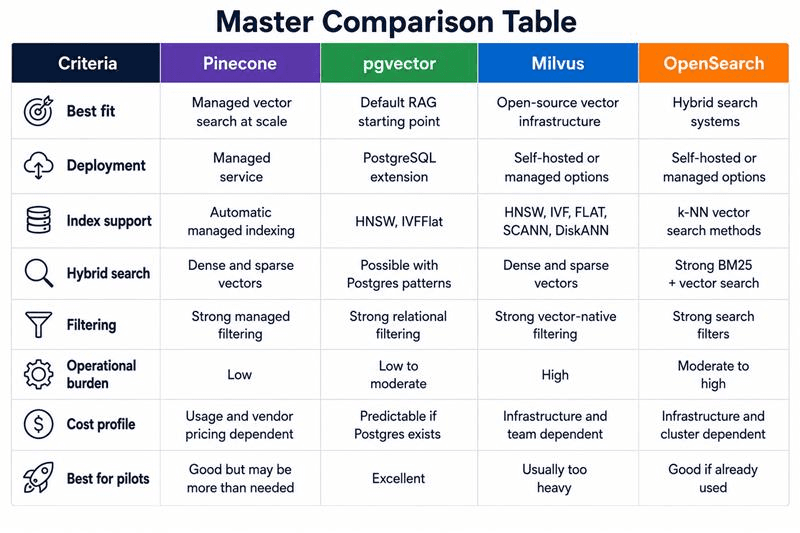
Master Comparison Table
Why pgvector Should Be the Default Starting Point?
Most enterprise RAG projects fail because retrieval quality was unclear, documents were poorly chunked, metadata was incomplete or access control was weak. The first vector database is rarely the main problem.
That is why pgvector should be the default starting point for many teams.
It keeps the architecture simple. Teams can validate chunking strategy, embedding models, metadata filters, ranking logic and user feedback loops before adding a new database layer. PostgreSQL is already familiar to many engineering teams, which reduces onboarding and operational risk.
pgvector also supports a practical growth path. Teams can start with exact search, add HNSW or IVFFlat indexes and tune performance as usage grows. PostgreSQL’s existing ecosystem can support backups, monitoring, permissions and data governance.
This makes pgvector a strong first choice for enterprise teams that want to prove the RAG workflow before expanding the infrastructure.
Choose pgvector first and evaluate other options when measurable workload requirements emerge. Strong reasons include very large vector scale, strict low-latency requirements, heavy concurrent search, advanced hybrid retrieval or a clear need for managed vector infrastructure.
When pgvector Is Not Enough
pgvector may stop being the right choice when the workload outgrows PostgreSQL comfort.
For example, a US e-commerce marketplace may begin with pgvector for product search across a few hundred thousand listings. As the catalogue grows into tens of millions of products, with high traffic, personalization, filters, image embeddings and strict latency targets, the team may need Pinecone, Milvus or OpenSearch. At that point, workload evidence provides a clear basis for migration.
Warning signs include unpredictable query latency, expensive filter plus vector search combinations, high concurrent retrieval load, multi-tenant pressure and search workloads affecting transactional database performance.
Another signal is retrieval complexity. If the system needs advanced vector-native features, distributed indexing, specialized ranking or large-scale hybrid retrieval, a dedicated vector database may become necessary.
Retrieval demands may increase further when organizations introduce multi-agent systems for enterprise workflows, where several agents access different data sources, tools and permission layers.
This should be treated as a success milestone. Starting with pgvector helps teams learn what the workload actually needs before committing to specialized infrastructure.
Migration Realities
Migration is easier when teams design for it early.
Store original documents, chunks, embeddings, metadata, source IDs and access control fields cleanly. Avoid hiding retrieval logic deep inside one database-specific implementation. Keep stable document IDs so results can be compared across systems.
Teams should also maintain retrieval evaluation sets. These sets help compare recall, ranking quality and latency before and after migration.
Expect ranking differences between pgvector, Pinecone, Milvus and OpenSearch. Similarity scores, filtering behaviour and index tuning can produce different results.
Migration requires careful attention to both retrieval quality and database implementation.
Conclusion
The right vector database for enterprise RAG depends on workload scale, retrieval complexity and operational capacity.
Pinecone is suited to managed vector search, Milvus supports large-scale open-source deployments, OpenSearch is strong for hybrid retrieval and pgvector offers a practical starting point for teams already using PostgreSQL.
For many enterprises, the best approach is to begin with a simple architecture that can deliver reliable retrieval. As data volume, concurrency and search complexity grow, the database can evolve according to measurable workload requirements.
12th Wonder helps enterprises evaluate these options, design the right retrieval architecture and build RAG systems with reliable metadata, access controls, integrations and performance testing.
The right vector database is the one that reliably supports the retrieval workload your business actually needs.
FAQ
Want to Build a RAG System That Delivers Reliable Answers
12th Wonder helps you build a secure, scalable RAG system with the right vector database.