

CodeIgniter in 2026: Where It Still Fits in Modern PHP Development
CodeIgniter has been part of the PHP development ecosystem for years. It became popular because it gave developers a simple way to build database-driven applications without forcing them into a heavy framework structure. Over time, newer frameworks such as Laravel gained more attention and larger developer communities, which led many teams to question whether CodeIgniter still has a meaningful place in modern development.
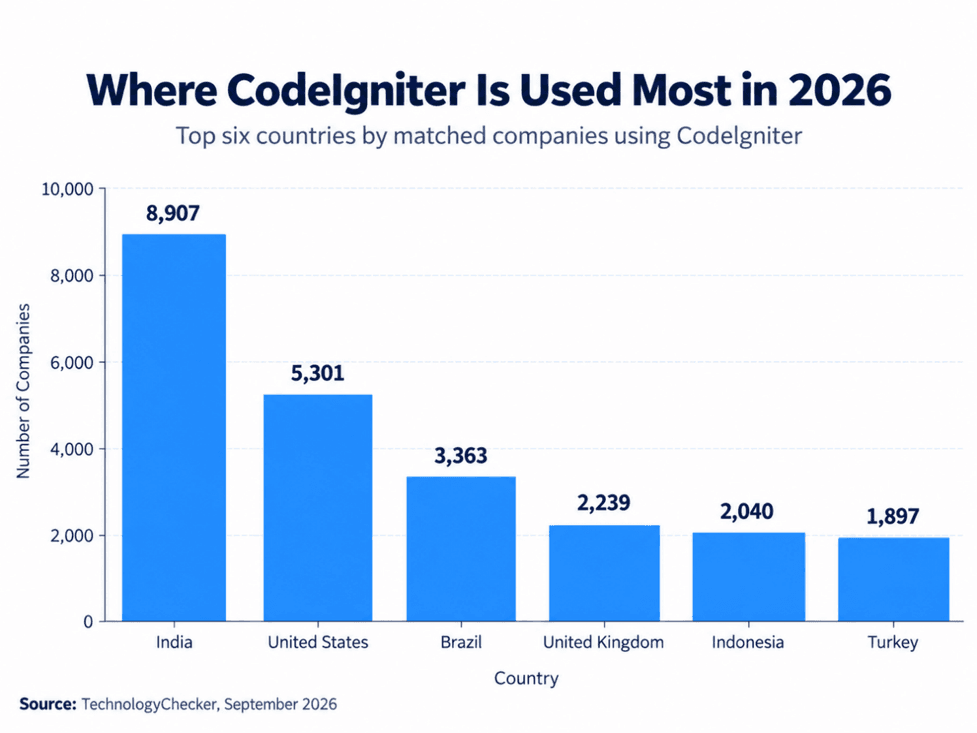
In 2026, that question deserves a practical answer. CodeIgniter 4 is actively maintained, with version 4.7.4 released in July 2026. CodeIgniter TechnologyChecker’s August 2026 data detected CodeIgniter on 63,867 active domains, representing 40,176 identifiable organisations across sectors including banking, education, government, healthcare and retail. TechnologyChecker also notes that the increase in detected sites during 2026 largely reflects wider crawl coverage rather than sudden adoption.
That installed base matters. Existing CodeIgniter applications still need upgrades, integrations, maintenance and security work. New projects can also benefit from the framework when the requirement calls for a lightweight framework with a familiar PHP MVC structure.
So, is CodeIgniter still relevant in 2026? For the right type of application, yes
1. Why CodeIgniter Still Fits Modern PHP Development
CodeIgniter remains useful because its core design continues to solve a common development requirement: building a web application with a relatively small framework footprint. For teams working on PHP development projects, some applications mainly need routing, database access, validation, security features and a clear MVC framework structure.
CodeIgniter provides these capabilities while keeping the development model relatively straightforward. This is why it is still considered a lightweight PHP framework. Internal business applications, customer portals, administration systems, database-driven websites and REST API services are all examples of projects where this approach can work well.
Consider a company building an internal order management portal or a customer support dashboard. The application may need authentication, database access, forms, reporting and API connections, but it may not require a large framework ecosystem. In a case like this, CodeIgniter can give developers the required structure without adding unnecessary complexity.
CodeIgniter development can also be easier for teams that already have strong PHP programming knowledge. Its PHP MVC architecture remains familiar, with models managing application data, views handling presentation and controllers processing requests and coordinating application logic. This separation helps developers organise the codebase and maintain it as the application evolves.
The existing market for CodeIgniter developers is another important factor. TechnologyChecker has identified CodeIgniter usage across thousands of organisations and domains in multiple countries. These deployments continue to require maintenance, version upgrades, security improvements, database work and integration support.
For businesses already running a CodeIgniter application, replacing the entire backend framework can also introduce cost, migration risk and additional development effort. In many cases, modernising the application on CodeIgniter 4 can be a more practical path than rebuilding the system from the ground up with another PHP framework.
2. CodeIgniter 4 Is the Version That Matters Now
When people talk about CodeIgniter in 2026, it is important to separate CodeIgniter 4 from CodeIgniter 3. CodeIgniter 3 belongs to the older generation of the framework and is still present in many existing applications, although its role is increasingly associated with legacy systems and ongoing maintenance. CodeIgniter 4, commonly known as CI4, is the modern branch and the version that matters most for current PHP development.
The official CodeIgniter project continues to release updates for CI4. CodeIgniter 4 is currently intended for PHP 8.1+ environments, including PHP 8.4. The framework includes improved routing, namespaces, database migrations, validation tools, security capabilities and command-line functionality through Spark PHP. These features make CodeIgniter 4 better suited to modern application development than earlier versions.
CI4 also works well for backend services. A REST API can be developed using its routing, request handling, validation and database components without introducing a much larger application stack. This can be useful for internal APIs, mobile application backends and web services that mainly need structured access to business data.
A practical example would be a mobile application that needs a PHP API to manage user accounts, product data and transactions. CI4 can provide the routing, validation and database layer needed to support that backend while keeping the application structure relatively lean.
Its database capabilities are also useful for data-driven applications. CodeIgniter supports common database operations and query building, which can reduce repetitive PHP programming and make everyday development tasks easier to manage.
For teams maintaining CodeIgniter 3 applications, it may be worth reviewing whether migration to CodeIgniter 4 makes sense based on the application’s future requirements. Moving to CI4 can provide access to a more current framework architecture and better alignment with newer PHP versions, particularly when the application is expected to remain in active use for several more years.
3. Laravel vs CodeIgniter in 2026
The Laravel vs CodeIgniter comparison remains one of the most common discussions around PHP framework selection. Laravel has a much larger ecosystem and stronger visibility across the wider PHP development community. It provides tools for authentication, queues, caching, events, background jobs, testing and many other application requirements, making it well suited to larger applications and SaaS platforms with multiple integrations and complex backend processes.
CodeIgniter is usually considered in a different context. DevDiligent’s Laravel vs CodeIgniter 2026 comparison describes CodeIgniter as lightweight, with a simpler learning curve and lower framework overhead. The official CodeIgniter site also describes the framework as having a very small footprint. DevDiligent positions CodeIgniter around small and medium-complexity applications where straightforward development can be valuable.
The choice should therefore reflect what the application needs. A focused internal platform or PHP API may be manageable with CodeIgniter 4, especially when the development team already has strong PHP experience. A SaaS platform with extensive background processing, complex authentication flows and numerous package dependencies may require a broader application ecosystem.
Performance also needs to be considered in context. CodeIgniter is commonly associated with low framework overhead because of its relatively small core. However, the speed of a web application depends on much more than the framework itself. Database queries, application architecture, caching, hosting infrastructure and code quality all influence real-world performance.
A lightweight framework can help keep the application layer efficient, but performance decisions should still be based on the complete system.
The Laravel vs CodeIgniter decision ultimately comes down to application size, developer experience, long-term maintenance, available libraries, integration needs and deployment complexity. CodeIgniter 4 remains relevant when a project benefits from a focused framework structure and does not require the wider set of tools found in a larger ecosystem.
4. Conclusion: CodeIgniter Still Has a Practical Role in 2026
CodeIgniter is still relevant in 2026 because it continues to support real business applications and active PHP development projects. CodeIgniter 4 is actively maintained, with version 4.7.4 listed as the current release by the official project. Its relatively small footprint makes it suitable for focused web applications, internal systems, REST API projects and existing CodeIgniter environments.
The Laravel vs CodeIgniter decision should begin with technical requirements. Teams need to consider project complexity, developer experience, integrations, long-term maintenance and the amount of framework infrastructure the application actually needs. For projects that need a lightweight PHP framework, a familiar MVC framework and direct control over application structure, CodeIgniter 4 remains a practical option. Its continued development and active use give it a clear place within the PHP framework ecosystem.
CodeIgniter does not need to be the most talked-about framework to remain useful. It needs to fit the application, support the development team and remain maintainable over time.
FAQ
Modernize Your CodeIgniter Application
Upgrade legacy applications, improve maintainability and move to CodeIgniter 4 with a clear modernization roadmap.