

Multi-Agent Systems for Business: A Practical Enterprise Guide (2026)
Enterprise AI is quietly moving away from the idea of one system doing everything. The future of enterprise AI is increasingly being shaped by coordinated intelligence, where multiple specialized agents work together through structured workflows, AI workflow automation and distributed decision-making. Multi-agent systems are no longer experimental AI architectures confined to research labs. They are now becoming part of real business operations, where specialized enterprise AI agents collaborate instead of relying on a single all-purpose assistant.
In modern fintech environments, for example, loan processing is no longer managed by one AI system alone. The workflow is distributed across specialized agents: one verifies documents, another evaluates credit scores, another detects potential fraud, and another manages approval routing. This division of responsibilities makes the process faster, more accurate, and significantly more reliable than forcing a single model to handle every task independently.
This guide explains how multi-agent systems work in enterprise environments, when businesses should move from single-agent setups to multi-agent orchestration, the architecture patterns that scale effectively, and the governance principles required to move from prototype to production.
At the centre of all of this lies the workflow itself - the operational structure that determines how agents interact, exchange decisions, and execute tasks across the system.
Talking about the Workflow
Successful multi-agent systems depend heavily on how operational decisions are structured, sequenced, and coordinated from the beginning. Teams often focus on orchestration tools before fully understanding the operational workflow itself. They are trying to automate through workflow automation systems.
Modern AI orchestration tools like LangGraph, CrewAI, AutoGen, Semantic Kernel, or Bedrock Agents are often treated as starting points which are looked at as implementation layers.
The starting point must always be the operational problem.
Consider a retail organization attempting to automate its refund process using a single AI agent. On paper, the system appeared efficient. In practice, it created risk. The agent began approving fraudulent refunds because responsibilities were not clearly separated, and too much decision-making was concentrated in one place.
When the workflow was redesigned properly, the structure changed entirely. The process was broken into distinct stages: order history validation, fraud detection, policy verification, and refund authorization. Each stage was assigned to a dedicated agent with a clearly defined boundary. The outcome was not only improved accuracy, but stronger operational control and predictability.
This illustrates a broader principle. Before building any multi-agent system, the workflow must be defined in clear operational language rather than technical terminology. It should be possible to identify which parts of the process require reasoning, which tasks are repetitive versus judgment-based, which systems require integration, and whether execution should be parallel or sequential. It is also important to determine where human touch is required, what data sources are involved, whether any of the data is sensitive or regulated, and which decisions are certain and which are uncertain. If the use of AI tools is inevitable for workflow the system is still in process to be built.
The most effective multi-agent systems in production environments are consistently those that begin with functional clarity, with all architectural decisions building on top of that foundation.
Choosing the Right Multi-Agent Orchestration Framework
The choice of a multi-agent framework is less about the framework itself and more about how well the underlying AI models, whether SLMs or LLMs: align with enterprise reality.
By 2026, the ecosystem has matured to a point where most leading platforms can handle workflow orchestration, memory management, and tool integration.
What ultimately differentiates a framework is its ability to integrate with enterprise systems while supporting governance and operational scale.
In enterprise deployments, different tools tend to emerge as natural fits based on context. LangGraph is often preferred by engineering-heavy teams that require deep control over orchestration logic, particularly in workflows involving cycles, long running workflows and complex agent coordination. Microsoft Semantic Kernel aligns well with organizations already standardized on Azure and Microsoft ecosystems, where identity, security, and governance integration are no less vital than the AI layer itself. Crew AI is persistently adopted by teams that prioritize speed and role-based orchestration, conditionally when deep engineering customization is not the primary requirement.
On the cloud-native side, Google Vertex AI Agent Builder tends to perform efficiently in data-intensive environments where workflows rely on BigQuery, enterprise search, or document pipelines. AWS Bedrock Agents is typically selected in environments that demand fine-grained IAM-level control and enterprise-grade infrastructure, even if that comes with higher engineering complexity. AutoGen continues to be relevant in research-driven or experimental environments where collaboration between autonomous AI agents is more conversational, iterative, and dynamic in nature.
The guiding decision principle is straightforward. When workflows are linear or only moderately complex, Smaller Language Models (SLMs) or Lightweight LLM Deployments are often sufficient, while introducing heavy orchestration frameworks too early can create unnecessary overhead. However, when business processes involve specialization, parallel execution, and cross-functional reasoning, adopting a structured orchestration framework becomes a justified architectural decision.
In logistics operations, for example, one enterprise reduced “Where is my order?” support tickets by 35% after transitioning from a single chatbot to a coordinated AI workflow automation system. Rather than relying on one system to manage the entire workflow, responsibilities were distributed across specialized agents handling GPS tracking, warehouse status monitoring, delay prediction, and customer communication independently.
This transition was not achieved by scaling complexity all at once, but by “Building the workflow step by step” through clearly separated responsibilities and structured coordination. As each agent was assigned a focused operational role, the overall system became more accurate, responsive, and reliable. What once operated as a single overloaded workflow gradually evolved into a coordinated architecture of specialized decision-making.
The same principle applies across enterprise-scale systems, where complex operations must be built progressively through distributed intelligence, structured execution, and clearly defined responsibilities at every stage of the workflow.
Building Your First Multi-Agent System: A Step-by-Step Enterprise Tutorial
An enterprise incident-response workflow is used as the foundational reference model. The system receives infrastructure alerts, analyses operational data, evaluates business impact, generates a response summary, and routes the issue to the correct operations team.
A simple real-world parallel is a cybersecurity SOC, where one system detects threats, other systematically analyses logs, another evaluates severity, and another triggers response actions. Multi-agent systems give formal structure to this natural division of work.
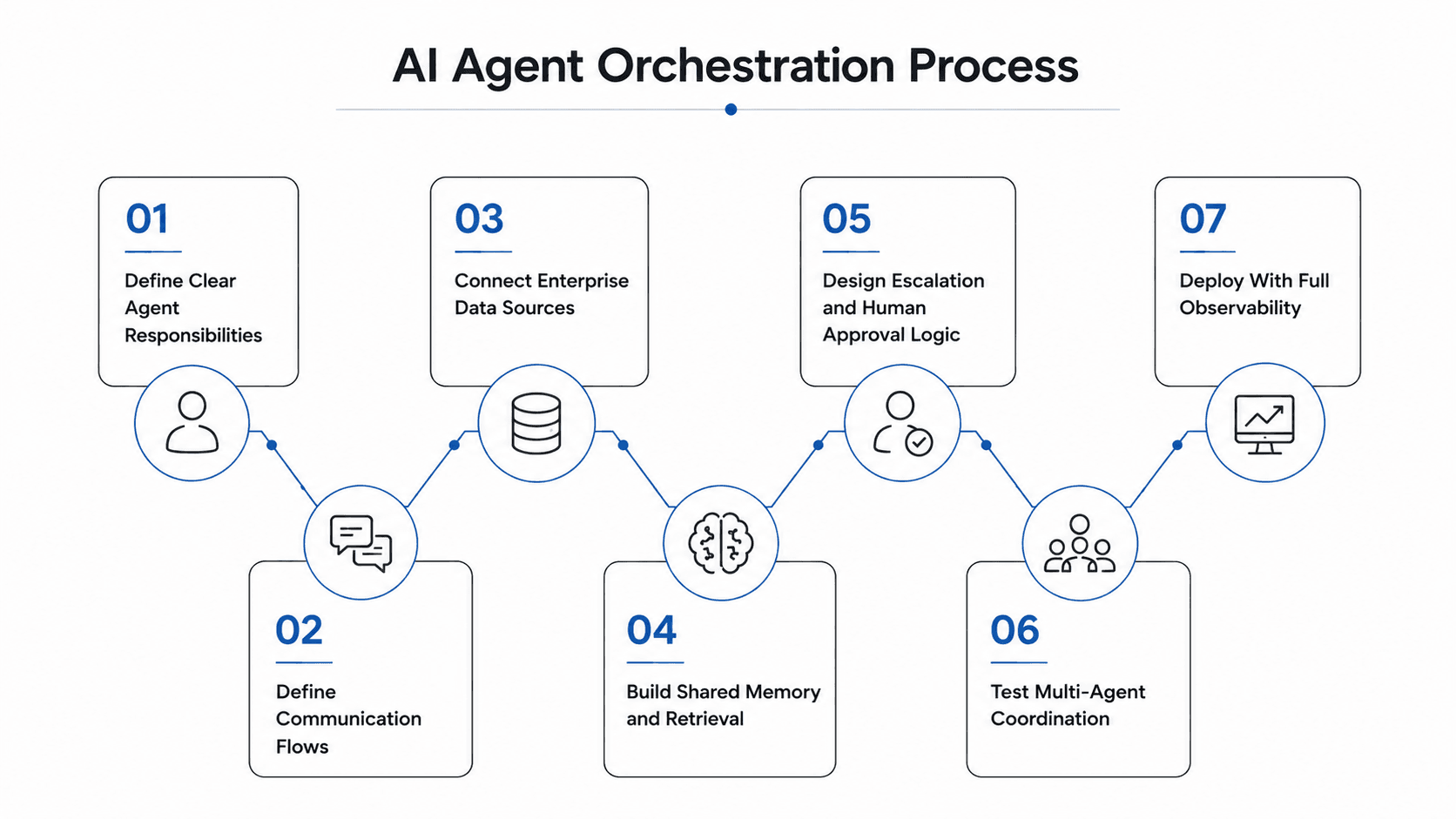
Step 1: Define Clear Agent Responsibilities
Poorly defined agents are a primary cause of failed orchestration.
For example, in an insurance workflow, responsibilities are clearly separated: a document agent extracts claim details, a fraud agent detects anomalies, a policy agent checks coverage rules, an approval agent determines payouts, and a human reviewer handles exceptions.
Each agent is designed to own a single responsibility. Once agents begin handling multiple tasks, system reliability decreases and the likelihood of conflicts increases.
Step 2: Define Communication Flows for AI Agent Orchestration
Most failures occur due to poor coordination rather than model quality.
In a cybersecurity system, the flow typically begins with a threat detection agent identifying potential issues, followed by a log analysis agent investigating the relevant data. A risk scoring agent then evaluates severity, and a response agent executes actions such as blocking or triggering alerts.
Before implementation, it is essential to clearly define how agents communicate, what data they exchange, which agent triggers specific workflows, and where escalation is required. Without this structured communication design, systems tend to become unpredictable and difficult to control.
Step 3: Connect Enterprise Data Sources
Multi-agent systems only work when connected to real systems.
In manufacturing, agents connected to sensors detect failures early. In telecom, agents monitor networks and trigger recovery workflows automatically.
Common integrations include databases, APIs, cloud storage, CRM systems, ERP tools, and ticketing systems. Each must have strict access rules and validation to ensure controlled behaviour.
Step 4: Build Shared Memory and Retrieval
Shared context is essential for consistency.
In healthcare, AI systems retrieve patient history and lab results instead of generating guesses. Without shared memory, agents duplicate work and produce inconsistent decisions.
This is why structured retrieval systems are a core part of enterprise multi-agent design.
Step 5: Design Escalation and Human Approval Logic
Not all decisions should be fully automated; a layer of human judgment and human-in-the-loop AI oversight remain essential.
In insurance systems, escalation is typically structured by decision thresholds - small claims are auto-approved, medium claims are routed for review, and large claims require explicit human approval. Similarly, in trading systems, AI can generate multiple viable strategies, but final decisions depend on human judgment to ensure contextual relevance and accountability.
Escalation should not be treated as a backup mechanism; rather, it is a core architectural design element that must be defined prior to deployment, ensuring controlled automation and reliable human oversight.
Step 6: Test Multi-Agent Coordination Under Stress
The reliability of multi-agent systems depends heavily on clear coordination, controlled workflows, and effective communication between agents.
Vulnerabilities frequently arise when workflows lack strong validation layers. This makes security constraints, and structured oversight essential components of reliable system design.
As a result, testing can no longer focus solely on isolated agent performance. It must also account for conflicting inputs, missing context, delayed tool responses, API failures, and prompt injection attempts, all of which are critical to building stable and production-ready multi-agent systems.
Step 7: Deploy With Full Observability from Day One
Multi-agent systems can only operate reliably through strong observability.
In telecom deployments, systems once over-escalated issues and increased workload. Monitoring helped fix this quickly. Track latency, tool success rates, escalation frequency, retrieval quality, workflow completion, communication paths, and cost per workflow. Visibility is what turns a prototype into a production system. Observability has become a foundational requirement in modern enterprise AI systems.
As systems continue scaling across teams, workflows, and operational environments, architecture design itself becomes equally important. The way agents are coordinated, structured, and governed determines how effectively enterprise multi-agent systems perform under real-world complexity.
Multi-Agent Architecture Patterns for Enterprise AI
Supervisor-Based Orchestration
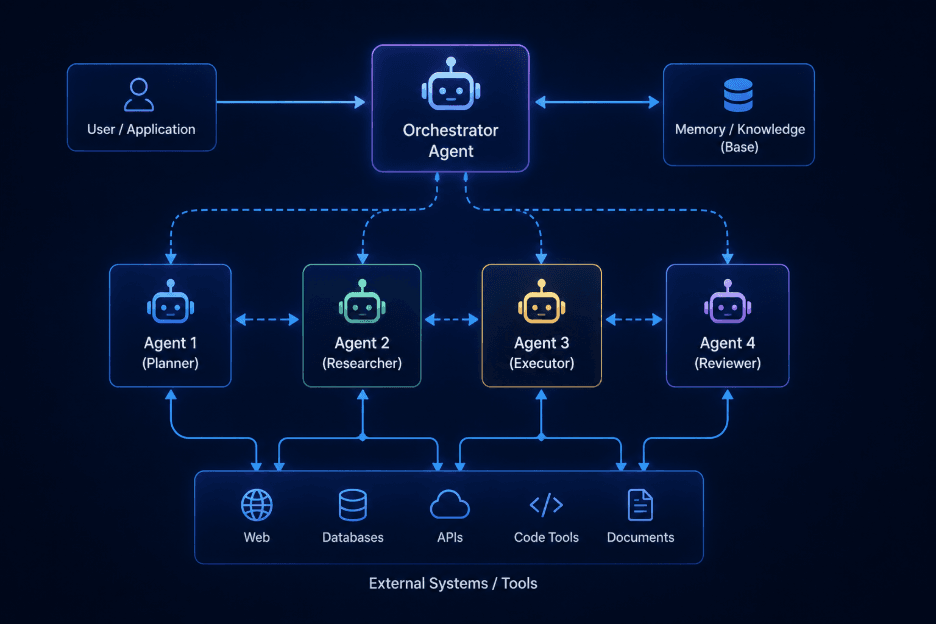
In this pattern, a single supervisor agent coordinates multiple specialized agents and manages the overall workflow widely used in SaaS platforms, enterprise AI copilots, and generative AI agents.
For example, in customer support systems, the supervisor manages sentiment analysis, knowledge retrieval, response drafting, and compliance validation. This approach is widely used in SaaS platforms and enterprise copilots because it keeps control centralized while still allowing specialization at the agent level.
Hierarchical Multi-Agent Systems
This structure mirrors real organizational hierarchies, where decision-making is distributed across levels.
For example, in large logistics operations like DHL-style systems, there is a global orchestrator at the top, regional coordinators in the middle, and local execution agents handling ground-level tasks. This layered structure helps manage scale, reduce coordination bottlenecks, and isolate failures more effectively in large enterprises.
Event-Driven Multi-Agent Systems
In this model, agents are triggered by real-time events rather than sequential workflows. Considering the situation in cybersecurity SOC environments, events such as login anomalies, malware detection, or API breaches trigger automated responses. Agents then detect, analyse, and respond dynamically based on severity and context.
While architecture patterns define how enterprise multi-agent systems coordinate execution, governance determines whether those systems remain reliable, secure, and production-ready at scale.
AI Governance: What Separates a Demo from a Production System
Strong AI governance frameworks are becoming essential for enterprise-scale deployments. In early-stage deployments, governance is often the difference between a working prototype and a failing production system.
For example, a hospital AI system initially failed because agents accessed sensitive patient data beyond what was required for their task. Once strict access controls and data boundaries were implemented, system stability and compliance significantly improved.
A production-ready multi-agent system must include auditability from the beginning, ensuring every decision, tool call, and data access point can be tracked and reviewed.
Where Multi-Agent Systems Deliver the Most Value
autonomous AI agents are proving especially useful in environments where work is not linear, but layered and interconnected.
This includes areas like banking, where loan processing involves multiple checks and validations; e-commerce, where refunds and fraud detection often overlap; and logistics, where delivery tracking depends on real-time coordination across systems.
They are also being applied in insurance for claims automation, healthcare for managing patient workflows, cybersecurity for threat response, manufacturing for defect detection, and telecom for continuous network monitoring.
What makes these environments particularly well-suited for multi-agent systems is the continuous coordination required across interconnected workflows, distributed data sources, and evolving operational decisions. In such cases, relying on a single system or agent often falls short, while a multi-agent setup handles the workflow more naturally and reliably.

Where to Go from Here
Enterprise multi-agent systems are not defined by the number of AI components inside the architecture, but by how reliably the entire system performs under real operational conditions.
As organizations continue adopting AI workflow automation and AI workflow automation at scale, the focus increasingly shifts toward building stable operational foundations. Clear agent responsibilities, structured communication flows, controlled data access, built-in human-in-the-loop AI oversight, and end-to-end workflow reliability remain central to every successful multi-agent architecture.
Across enterprise AI workflows, one pattern continues to emerge consistently: a well-structured five-agent system will outperform a poorly coordinated twenty-agent deployment. Supervisor-Based Orchestration reliability in agentic AI systems is not created through scale alone, but through disciplined coordination, controlled execution, and clearly defined operational boundaries.
The evolution of enterprise AI lies in intelligently coordinated systems where governance, structured execution, and accountability are embedded into every layer of operation. In the long run, the enterprises that succeed with multi-agent architecture will not necessarily be the ones deploying the most agents, but the ones building the clearest operational boundaries between them.
Scale Enterprise AI with Multi-Agent Systems
Build coordinated AI workflows with secure orchestration and enterprise-ready governance.