
How a 5-Million-Resident Smart City Unified 40+ Fragmented Datasets into a Single Geospatial Command Centre
How a 5-Million-Resident Smart City Unified 40+ Fragmented Datasets into a Single Geospatial Command Centre
A centralized GIS data integration platform eliminated departmental silos, cut infrastructure planning cycles from months to weeks and gave city officials real-time visibility into urban operations across transportation, utilities, and public safety.
The Situation
Managing a city of over 5 million residents is an exercise in coordinated complexity. As part of the Middle East's most ambitious digital transformation initiatives, this government-led smart city administration oversees transportation networks serving millions of daily commuters, utility infrastructure delivering water and electricity to hundreds of thousands of households, public safety operations responding to emergencies across hundreds of square kilometers, and urban planning decisions that will shape the city's growth for decades.
The city's leadership had committed to data-driven governance and enhanced citizen services. They had the ambition, the budget, and the political will. What they lacked was a unified view of the city itself.
Each department had built its own data ecosystem over years of independent operation. Transportation managed traffic flow and mobility patterns. Utilities tracked water distribution networks and electricity grids. Urban planning maintained zoning maps and land-use records. Public safety monitored emergency response times and incident patterns. Environmental teams measured air quality and green space utilization.
The data existed. The problem was that it existed everywhere and nowhere at once.
What Was Getting in the Way
Without spatial integration, city officials were making infrastructure decisions worth millions while working from incomplete pictures. A road expansion project required input from transportation, utilities, and urban planning, but coordinating that input meant weeks of back-and-forth between departments working from different datasets, different coordinate systems, and different update schedules.
| Challenge Area | Before Integration | Impact on City Operations |
|---|---|---|
| Data ecosystem | 40+ departmental systems operating independently | No holistic view of city operations; decisions made with partial information |
| Cross-department coordination | Manual data sharing via spreadsheets and email | Infrastructure projects delayed by 8-12 weeks on average during planning phase |
| Real-time visibility | Static reports updated weekly or monthly | Unable to respond quickly to traffic congestion, utility failures, or emergencies |
| Infrastructure planning | Each department analyzed projects in isolation | Conflicting priorities; rework common when underground utilities discovered mid-construction |
| Spatial data standards | Inconsistent coordinate systems and data formats across departments | Geospatial data from different departments couldn't be overlaid or compared |
| Decision-making speed | City council briefings required 2-3 weeks to compile departmental inputs | Slow response to emerging urban challenges; missed optimization opportunities |
Building a Unified Geospatial Intelligence Layer
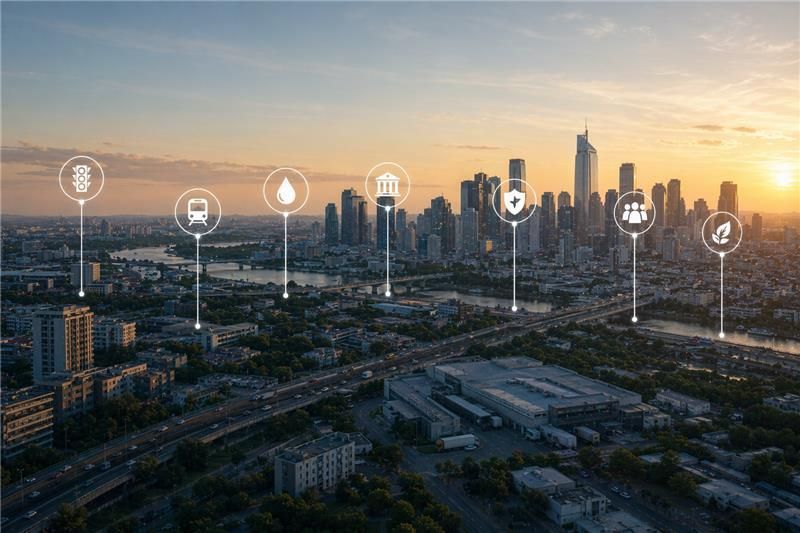
The solution centered on creating what city officials now call the "urban operating system"—a centralized GIS data integration platform that treats the entire city as a connected spatial system rather than a collection of departmental territories.
The platform was built on API-based data integration pipelines that continuously ingest data from across the city's infrastructure. Real-time feeds from traffic sensors, utility monitoring systems, environmental stations, and public safety dispatch systems flow into a centralized geospatial data repository that serves as the single source of truth for all spatial decision-making.
| Data Source | Type | Application in Platform | Update Frequency |
|---|---|---|---|
| Traffic management systems | Transportation | Real-time traffic flow, congestion patterns, mobility analytics across 2,500+ km of road network | Real-time (30-second intervals) |
| Utility infrastructure databases | Infrastructure | Water distribution network (5,000+ km), electricity grid mapping, infrastructure age and condition | Daily |
| Environmental monitoring | Environmental | Air quality sensors (50+ stations), green space utilization, temperature mapping | Hourly |
| Public safety platforms | Emergency response | Incident locations, response times, emergency service coverage mapping | Real-time (event-driven) |
| Urban planning records | Regulatory | Zoning maps, land-use classifications, building permits, development projects | Weekly |
| Citizen service requests | Operational | 311 complaints, maintenance requests, service patterns by neighbourhood | Daily |
| Mobile network data | Behavioural | Population density patterns, movement flows, peak activity zones | Weekly |
Interactive dashboards give city officials the ability to layer these datasets spatially, running what-if scenarios for infrastructure projects, simulating traffic impacts from new developments, and identifying optimal locations for public services based on actual demand patterns rather than administrative boundaries.
Advanced spatial analytics enable planners to model infrastructure scenarios, optimize resource allocation across districts, and forecast the cascading impacts of major projects before ground is broken.
What Changed After Launch
The transformation in operational efficiency was immediate and measurable. Infrastructure planning cycles that previously required 12-16 weeks of cross-departmental coordination now complete in 8-10 weeks—a 30% reduction in time from concept to approval.
More importantly, the quality of planning improved. With shared access to integrated geospatial data, departments began identifying optimization opportunities that were invisible in the old siloed system. Utility upgrades could be coordinated with road maintenance. New transit routes could be aligned with population density patterns. Emergency response stations could be repositioned based on actual incident data rather than historical assumptions.
KEY METRICS: Platform Impact
| Metric | Target | Actual Result |
|---|---|---|
| Cross-department data integration | 15 systems | 42 systems integrated |
| Infrastructure planning cycle time | Reduce by 25% | 30% reduction achieved (16 weeks → 10 weeks average) |
| Real-time data sources | 10 feeds | 18 real-time feeds operational |
| Departmental users trained | 150 users | 220+ active users across 8 departments |
| Geospatial analyses per month | N/A baseline | 340+ spatial analyses conducted monthly |
OPERATIONAL IMPROVEMENTS: Before vs After
| Outcome Area | Before Platform | After Platform | Change |
|---|---|---|---|
| Planning cycle speed | 12-16 weeks for major projects | 8-10 weeks for major projects | 30% faster |
| Data accessibility | Fragmented across 40+ departmental systems | Unified in single geospatial repository | Full consolidation |
| Real-time monitoring | Static weekly/monthly reports | Live dashboards with 30-second traffic updates | Real-time operational view |
| Cross-department collaboration | Email and manual file sharing | Shared geospatial workspace with role-based access | Seamless data sharing |
| Infrastructure conflict detection | Discovered during construction (costly delays) | Identified during planning phase | Eliminated major rework incidents |
| Citizen service response | Reactive to complaints | Proactive based on spatial pattern analysis | Predictive maintenance enabled |
| Decision support for city council | 2-3 weeks to compile departmental reports | Same-day briefings with interactive maps | 10x faster executive reporting |
SPATIAL ANALYSIS CAPABILITIES: New Tools Available
| Analysis Type | Use Case | Monthly Usage |
|---|---|---|
| Traffic flow simulation | Road expansion impact modeling | 45 analyses |
| Utility network optimization | Infrastructure upgrade prioritization | 38 analyses |
| Emergency response coverage | Fire station and ambulance positioning | 22 analyses |
| Population density mapping | Public service facility placement | 67 analyses |
| Environmental impact assessment | Development project air quality forecasting | 31 analyses |
| Land-use compatibility | Zoning decision support | 54 analyses |
| Infrastructure age heatmaps | Predictive maintenance planning | 83 analyses |
A Foundation for Long-Term Urban Intelligence
Smart cities are not built through technology alone. They emerge when urban operations, citizen services, and infrastructure planning are guided by shared intelligence about how a city actually functions where people move, how systems connect, what infrastructure is aging, and where demand is growing.
For this Middle Eastern city, the shift from departmental data silos to a unified geospatial platform did more than improve planning efficiency. It fundamentally changed how city officials think about urban management from reactive problem-solving to proactive system optimization.
The platform continues to evolve. New data sources are added quarterly. Departments that initially resisted integration now actively request new analytics capabilities. City leadership uses the system for strategic planning discussions that would have been impossible without a spatial view of operational reality.
This is what digital transformation looks like when it's done with purpose: not a collection of disconnected tools, but a shared intelligence layer that makes the invisible visible and turns urban complexity into actionable insight.